

INTREP360 INTELLIGENCE REPORT
01.26.2026

January 26th, 2026
Greetings! Late Friday, the Defense Department—or War Department, if you prefer—dropped its new National Defense Strategy (NDS).
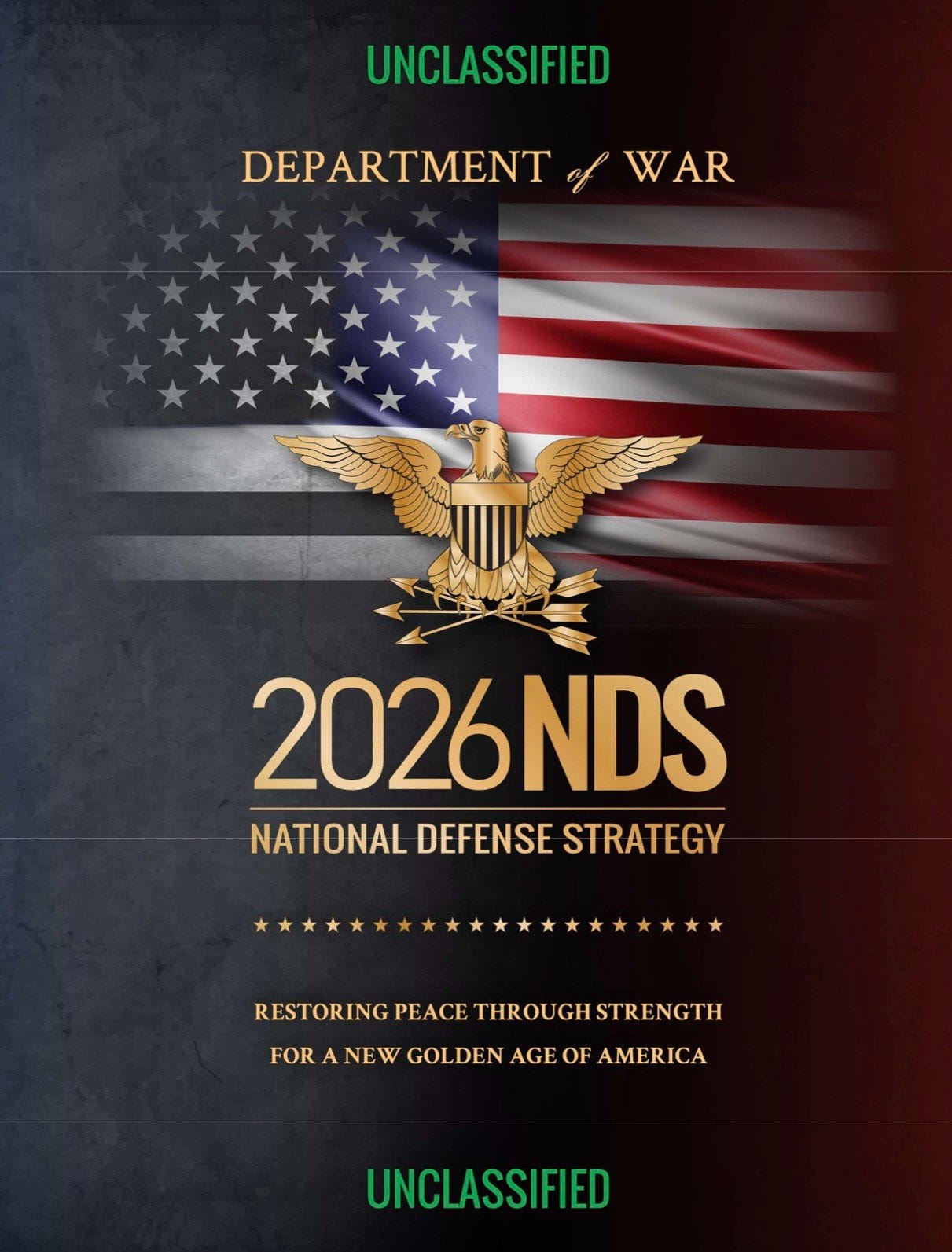
Photo credit: Department of Defense. Illustrator/designer unknown. 2026 NDS.
For newcomers, this might be confusing. The NDS should not be confused with the National Security Strategy (NSS).
The NDS is a Pentagon document & focuses on military assessments, posturing & strategy whereas the NSS is a much broader presidential plan encompassing all of the instruments of national power: Diplomacy, Information, Military & Economic.
Earlier, last December, we reviewed the NSS in-depth. You can read our detailed assessment of it here.
Today, we will focus on the new NDS. As we do, we are keeping an eye on the U.S. build-up in the Persian Gulf. Ditto Russian President Vladimir Putin’s ongoing war & targeting of Ukrainian civilians & infrastructure in Ukraine & the growing palace intrigue in Beijing as Chinese President Xi Jinping continues to consolidate power.
We will cover those stories & more tomorrow. Now on to the NDS!
***
A line from the 1963 comedy It’s a Mad, Mad, Mad, Mad World—starring Spencer Tracy, Milton Berle, Ethel Merman, Sid Caesar & Buddy Hackett—sums up our take on the Pentagon’s 2026 National Defense Strategy:
“We’ve figured it seventeen different ways, and every time we figured it, it was no good, because no matter how we figured it, somebody don’t like the way we figured it! So now, there’s only one way to figure it. And that is, every man, including the old bag, for himself!”
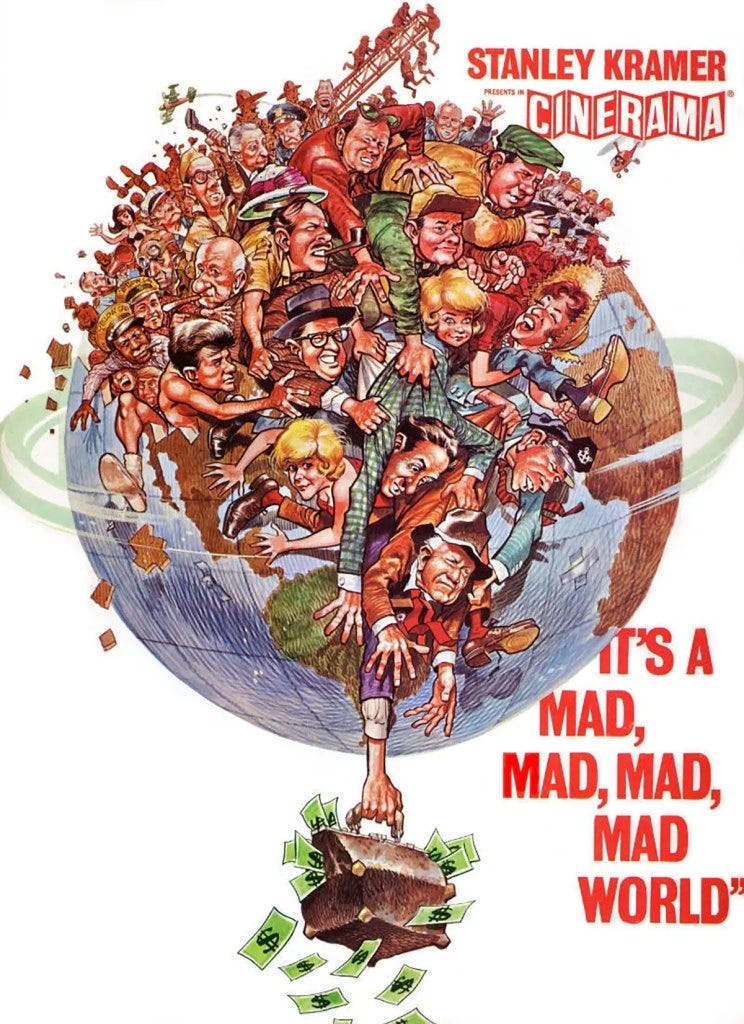
Image credit: ©United Artists/courtesy RetroVision Archives. Movie poster for It’s a Mad, Mad, Mad, Mad World.
Essentially—intended or not—the new NDS is telling our allies it is every country for itself when it comes to defense. That messaging is masked. The NDS disguises it by referring to it as “Increase Burden-Sharing with U.S. Allies and Partners.”
We call it differently. We see it as “Lead Fatigue.”
This approach is the polar opposite of a strategy proposed by Richard Haass in his 1998 book “The Reluctant Sheriff.” A book review by the Council on Foreign Relations stated that Haass proposed that the U.S. adopt a new foreign policy of “regulation” and work to promote order in an often-unruly world.
He suggested that “the U.S. needs to assume the role of global sheriff, forging coalitions or posses of states and others for specific tasks.” He also argued that “America needs to resist the lure of isolationism and maintain spending on defense, intelligence, foreign aid, and diplomacy at current (and affordable) levels.”
Haass warned that anything less risked squandering the spoils of winning the Cold War—and setting the stage for a new era of dangerous global competition.
***
Arguably, Haass is proving to be a Nostradamus. He foresaw—more or less—where we are now.
So how did we get here?
***
Fast-forward from 1998 to 2026. Our nation’s foes—simultaneously—are coming at our national interests & our allies from multiple angles.
Everywhere we look there is now Great Power competition from the Axis of Evil. Putin’s invasion of Ukraine. Russian hybrid warfare throughout Europe & Gaza.
Ditto indirectly through proxies. E.g., Iran’s proxies fomenting kinetic instability throughout the Middle East including in Lebanon, Gaza, Yemen & Syria. Plus, ISIS remains a threat. Not just in the Middle East but in Africa as well.
Nor do the threats stop there.
Russia’s paramilitary forces—are actively destabilizing Sudan. Ditto the Sahel region of Western & North Central Africa. China is meddling in Venezuela & the Panama Canal and has declared itself a near-Arctic power which poses new threats to Greenland.
Other primary threats abound too. Beijing’s growing designs on Taiwan. The ongoing conflict between North Korea & South Korea.
***
President Donald Trump claims to have ended eight wars: Israel & Hamas, Israel & Iran, Pakistan & India, Rwanda & the Democratic Republic of Congo, Thailand & Cambodia, Armenia & Azerbaijan, Egypt & Ethiopia, and Serbia & Kosovo.
But are they resolved or have they just been placed on hold?
Religion, ethnic conflict, rare earth materials, oil, drugs and aspirations of restoring past kingdoms and glory all contribute to this “new era of dangerous global competition.”
***
The U.S. military is not built to take on this alone—sequentially or concurrently. Gone is the concept of a 1.5 contingency national security strategy that focused on winning one major conflict while managing or deterring a lesser conflict simultaneously. And that was a shift from the post-Cold War two contingency strategy, which called for the capacity to fight two major regional conflicts simultaneously.
Today, with Russia, China, Iran and North Korea—the U.S. could potentially—in a worst-case scenario, be involved in 3 to 4.5 contingencies at once.
***
Repositioning assets from one combatant command to another—as is the current scenario with the USS Abraham Lincoln Carrier Strike Group moving from Venezuela (U.S. Southern Command) back to Iran (U.S. Central Command) and repositioning F-15 fighter aircraft & KC-135 Stratotanker aerial refueling aircraft from RAF Lakenheath (U.S. European Command) in the United Kingdom to Muwaffaq Salti Air Base in Jordan—takes time & creates strategic & tactical gaps.
***
Now is not the time to be pulling away from a leadership role in Europe & around the globe that we assumed at the conclusion of World War II. We earned it, we exercised it, & our allies fell in line & let Washington run with it.
Generations of Europeans—understandably—got used to the U.S. being their safety net. Plus, after the Berlin Wall fell in 1989 & the Soviet Union collapsed in 1991, many old NATO countries no longer perceived the Russian bear as an existential threat. NATO commitments to spend 2% of GDP on defense fell by the wayside, military equipment and readiness suffered, and the U.S. picked up the slack.
Spending that peace dividend is now coming back to haunt Europe. Russia, once again, is an existential threat & Europe isn’t fully prepared to face that threat alone. Earlier today, NATO Secretary General Mark Rutte made that very point.
Addressing lawmakers sitting on the European Parliament’s defense & foreign affairs committees, Rutte said, “If anyone thinks here ... that the European Union or Europe as a whole can defend itself without the U.S., keep on dreaming.” To underscore his point, Rutte forcefully asserted “[Europe] can’t.”
***
Enter President Donald Trump, who made it known to NATO members in May 2017 that they were behind in their obligations: “I have been very, very direct with Secretary [Jens] Stoltenberg and members of the alliance in saying that NATO members must finally contribute their fair share and meet their financial obligations.”
When Trump was reelected in 2025, they were still short—despite being three years into the war in Ukraine. From Team Trump’s perspective, short on supporting Ukraine militarily as well. A war being waged on European soil, yet no sense of urgency on behalf of the countries who share the continent with Ukraine. They seemed to be waiting on the U.S. to take the lead, & from Trump’s perspective, the tab too. He wanted nothing to do with that & eventually took measures to force Europe’s hand.
***
Lead fatigue—as we now call it—had set in & Trump’s position on Ukraine was that it’s “not my war” & “not my problem.” As far as he was concerned, Russia posed no direct threat to the U.S.—at least not in Europe.
We, of course, strongly disagree. Russia does indeed represent a threat to the U.S. in Europe. Not just our military bases there. Not just our economic interests. But also, because of our NATO Article 5 obligations.
***
NATO teetered as a result. The President withheld funds & weapon shipments to Ukraine, and funding for Baltic Security Initiative. NATO, and the ‘coalition of the willing’ responded, filling the void created by Trump, and voted to increase defense spending from 2% to 5% of GDP.
That said, while his method was harsh, Trump did get the result he wanted: more skin in the game from Europe in the form of defense spending.
***
Then the White House dropped its 2025 NSS. Podium talk became a written policy. Team Trump assessed that Russia was not a major threat & that the U.S. priority of effort belonged in the Western Hemisphere—the Trump Corollary to the Monroe Doctrine.
Team Trump codified that the U.S. is transitioning into a country of ‘me.’ The ‘we’ in the form of alliances is becoming one of transactional relationships—‘What’s in it for me?’ In our view—and many others—the U.S. guardians of liberty, democracy & freedom are losing their way if not the plot altogether.
***
As the African proverb goes, “If you want to go fast, go alone. If you want to go far, go together.” When the 2026 National Defense Strategy dropped last week, the tone was to go alone, at least in the Western Hemisphere—specifically, Greenland.
Trump wanted Greenland—a territory owned by fellow NATO member state Denmark—to secure North America from none other than Russian ballistic missile attacks. Its strategic location in the Arctic Circle also dominates the Northern Sea Routes—potential commercial shipping lanes both Russia & China would like to control.
Team Trump was prepared to go it alone; however, neither Denmark nor Europe would cede the territory to the U.S.
As we noted in our January 22nd INTREP360 Intelligence Report, the U.S. & NATO wisely chose to ‘go far … together.’ The Pentagon acknowledged that Moscow continues to pose security risks to NATO members “for the foreseeable future,” but added that Washington’s priority remained “defending the homeland.”
***
Fast-forward to today. The NDS at its core is too inward-looking. In many ways, it’s akin to throwing in the towel on a global scale. It also risks throwing away everything that the U.S. has achieved since World War II—including winning the Cold War.
Strategic balance is what’s needed. But it is missing in action in the new NDS. Naively retreating to the Western Hemisphere dangerously ignores that U.S. national interests—military, economic & diplomatic—are under active Russian & Chinese hybrid & kinetic threat in every region of the world.
Washington must work with our allies, not abandon them or—militarily-speaking—overburden them. In return—to be fair—our European & Indo-Pacific allies must also recognize that it’s a two-way street.
Lead fatigue is not a strategy. It certainly isn’t a solution. Yet it is not just being directed at Europe but at South Korea as well. The new NDS says that the Pentagon is planning to shift more responsibility for deterring North Korea to South Korea, stating it “would take a more limited role in keeping North Korea in line.”
In this vein, lead fatigue could set off a nuclear arms race. North Korea has nukes. South Korea does not.
***
Frederick the Great is credited with saying, “He who defends everything defends nothing.” That is an accurate statement, but it does not have to be every country for themselves either.
Alliances work, burden-sharing is essential, but it requires skin in the game & leadership. America has provided that leadership since the end of World War II—and we are pretty good at it.
Team Trump stepping away now from the world stage is not the solution. Not when Russia, China, Iran & North Korea are actively posing a threat to a global order that the ‘Greatest Generation’ fought & died for to give us as an enduring legacy.
From a U.S. strategic perspective, the new NDS—in our opinion—is a road to nowhere. If left unchanged, then alarmingly, it self-defeatingly opens up roads for Putin & Xi everywhere to exploit & undermine U.S. global interests.
***
Thank you for reading! We will see you tomorrow. Please subscribe, comment and share. We truly appreciate it!
Jon & Mark
Follow Jon on X at @JESweet2022 or on Bluesky at @JonSweet.bsky.social.
Follow Mark on X at @MCTothSTL or on Bluesky at @MarkToth.bsky.social.
Very informative piece. Thank you.