

INTREP360 INTELLIGENCE REPORT
01.22.2026

January 22nd, 2026
Greetings! The World Economic Forum in Davos, Switzerland captured national headlines this week, and rightfully so. It was billed by the organizers as, “leaders from government, business, civil society and academia … convene[d] in Davos to engage in forward-looking discussions to address global issues and set priorities.”
The two main themes going into the week were Greenland and Ukraine. Russia was the common denominator.
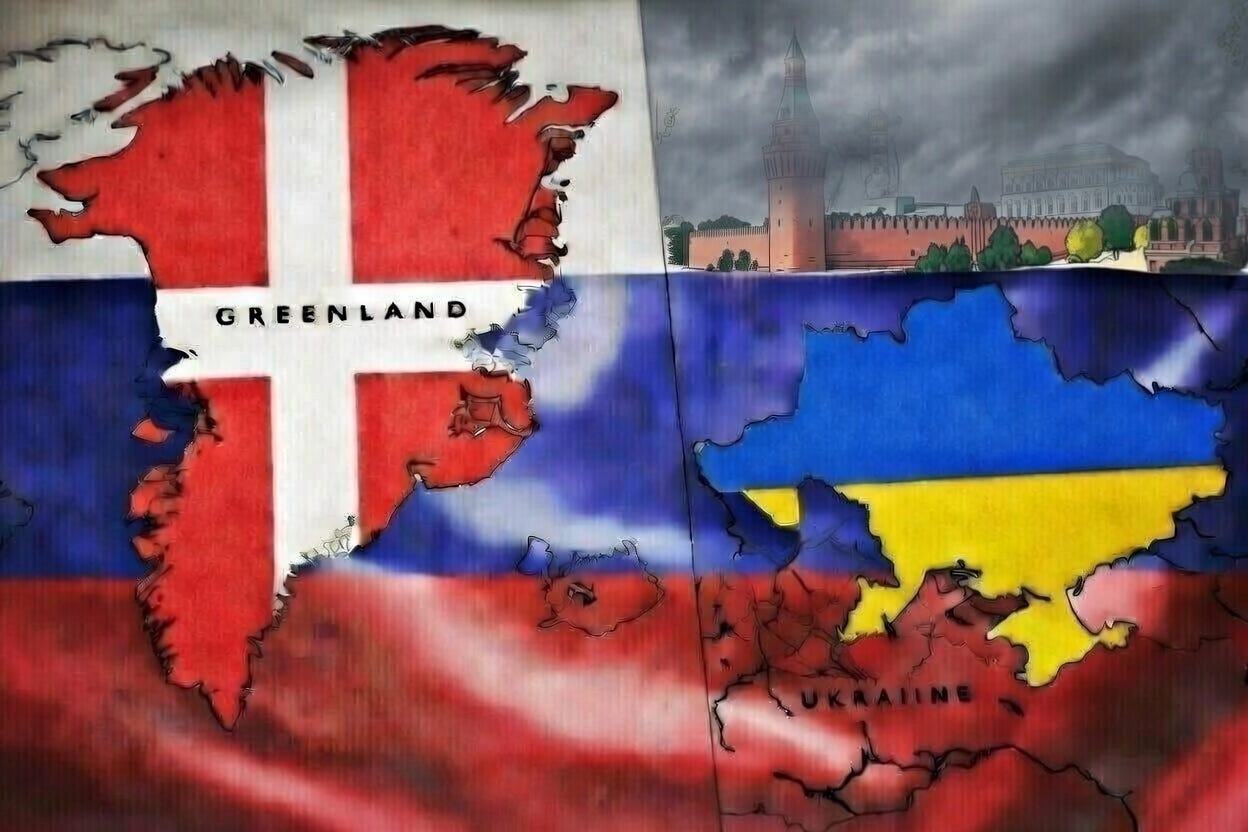
We would think that the NATO Alliance—founded on April 4, 1949—to deter Soviet expansion westward, could figure that out.
Alas, apparently not.
We examine why that’s the case in this special edition of the INTREP360 Intelligence Report. Let’s get started!
***
Nearly 73 years later, NATO’s founding principle was tested again on February 24th, 2022, when Russian President Vladimir Putin illegally invaded Ukraine.
Initially, Putin’s so-called ‘special military operation’ brought the Atlantic alliance closer together. It even added two new members—Finland & Sweden extending Brussels’ reach further into the Arctic & turning the Baltic Sea into NATO lake.
Both countries—proudly neutral for decades—recognized that a new Russian ‘Iron Curtain’ was in the making & they didn’t want to be on the wrong side of it as Poland, the Baltic States, Romania, Hungary & other Eastern European nations found themselves at the end of World War II.
Putin was trapped in Ukraine by NATO.
His war had grinded to a bloody halt. By Fall 2022, Ukrainian President Volodymyr Zelensky & his generals in a daring counteroffensive had recaptured nearly all of the Kharkiv Oblast from Russian forces.
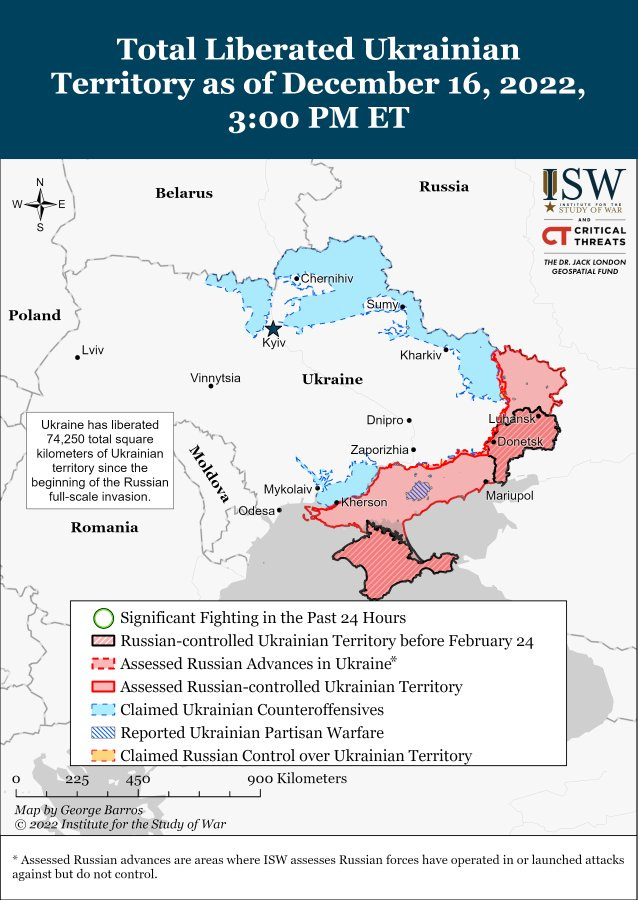
Used with ISW permission. Credit: Institute for the Study of War and AEI’s Critical Threats Project.
Nearly four years later the frontlines in eastern & southern Ukraine essentially mirror today what they were on December 16th, 2022—albeit with discernible tactical Russian gains; but none of them are strategic let alone game-changing & many of those resulted from intentional Ukrainian tactical withdrawals.
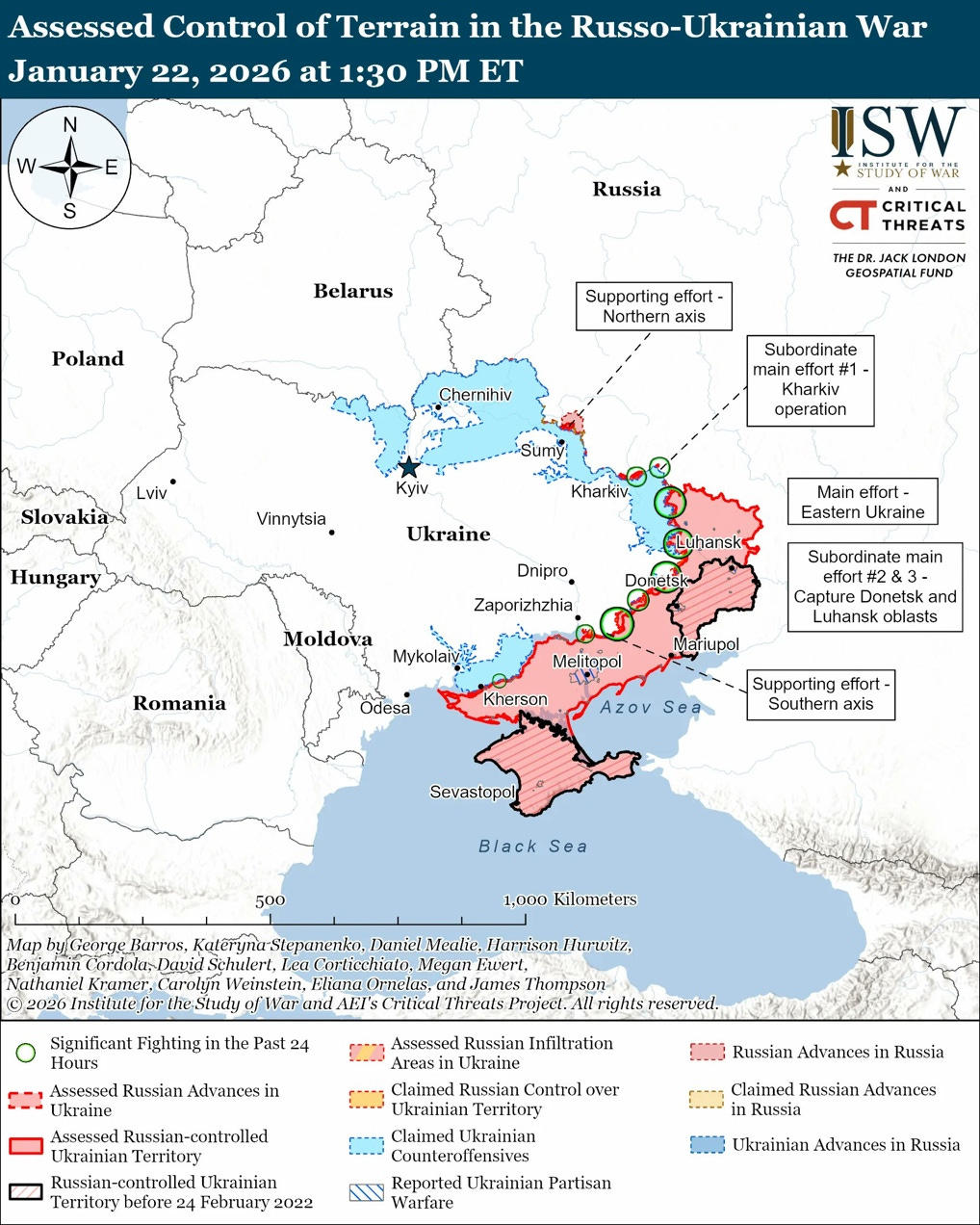
Used with ISW permission. Credit: Institute for the Study of War and AEI’s Critical Threats Project.
Putin’s war sputtered on. Unable to achieve sweeping gains in the east, Moscow changed tactics & began targeting Ukrainian cities & towns.
Targeting the Zaporizhzhia Nuclear Power Station—we called it Putin’s ‘Nuclear Force Z’ at the time—was one way. Weaponizing winter—as we wrote in September 2022 at The Hill—was yet another. Ditto committing environmental warfare including when the Kremlin destroyed the Nova Kakhovka Dam on the river Dnipro.
Now, almost daily, Putin is intentionally targeting Ukrainian civilians. As we noted here, Moscow turned the 12 Days of Christmas that began on December 25th, 2025 into 12 days of relentless war crimes.
***
Yet, after President Donald Trump was elected, instead of referring to the war in Ukraine as ‘Putin’s war,’ he started proclaiming that it was “Biden’s war, not mine.” Blaming former President Biden for Putin’s decision to invade Ukraine & in effect declare war against the West was novel.
However, that is not factual.
Certainly, Team Biden bears responsibility for not doing more to help Ukraine decisively win. The slow-walking of weapons—including HIMARS, Patriots, M1 Abrams battle tanks, ATACMS, & F-16 fighter jets—was self-defeating.
Nonetheless, Biden’s “just enough” strategy didn’t make it Biden’s war any more than it made it Europe’s war.
This is—and let’s be clear here—Putin’s war & Putin’s war alone.
***
Putin’s war against Ukraine is exactly what NATO was designed to deter in Europe. Trump’s failure to see it as Putin’s war—ditto as a hybrid war against NATO—has shaken the alliance to its core as it is now uncertain of Trump’s intentions.
***
Trump 47 does not see Putin as an enemy to the U.S.––at least not in Europe. However, somehow that inexplicably changes in Greenland. There—suddenly—Russia is the enemy. Therein lies the dichotomy for the White House.
Presumably—but not justifiably—it is because Trump’s ‘America First’ foreign policy is centered on the Americas. To that end, for our purposes here, let’s just call it the Western Hemisphere effect—it’s real, but it is myopic.
***
By hyper-focusing on Greenland, Team Trump—alarmingly—has spent a disproportionate amount of time on a potential Russian threat, while punting on the most dangerous threat Putin is posing to Europe & Ukraine—& by extension the U.S.—that has already claimed 1,230,810 Russian casualties after nearly four years.
Trump is making this a ‘me versus we’ outcome. Lost was the ‘all for one’ alliance forged between allies bound together during World War II against a common enemy.
Greenland & Ukraine are facing the same threat: Russia. NATO is the same alliance tasked with defending both. As we have said on many occasions: defeat Putin & his army in Ukraine & this all stops. Team Trump’s constant bickering with our NATO allies is self-defeating & simply further emboldens Russia.
***
German Chancellor Friedrich Merz fully recognizes that Russia is the common denominator in Greenland & Ukraine. He shares Trump’s concerns about Greenland’s security & expressed hope that a “mutually acceptable solution” could be found within NATO.
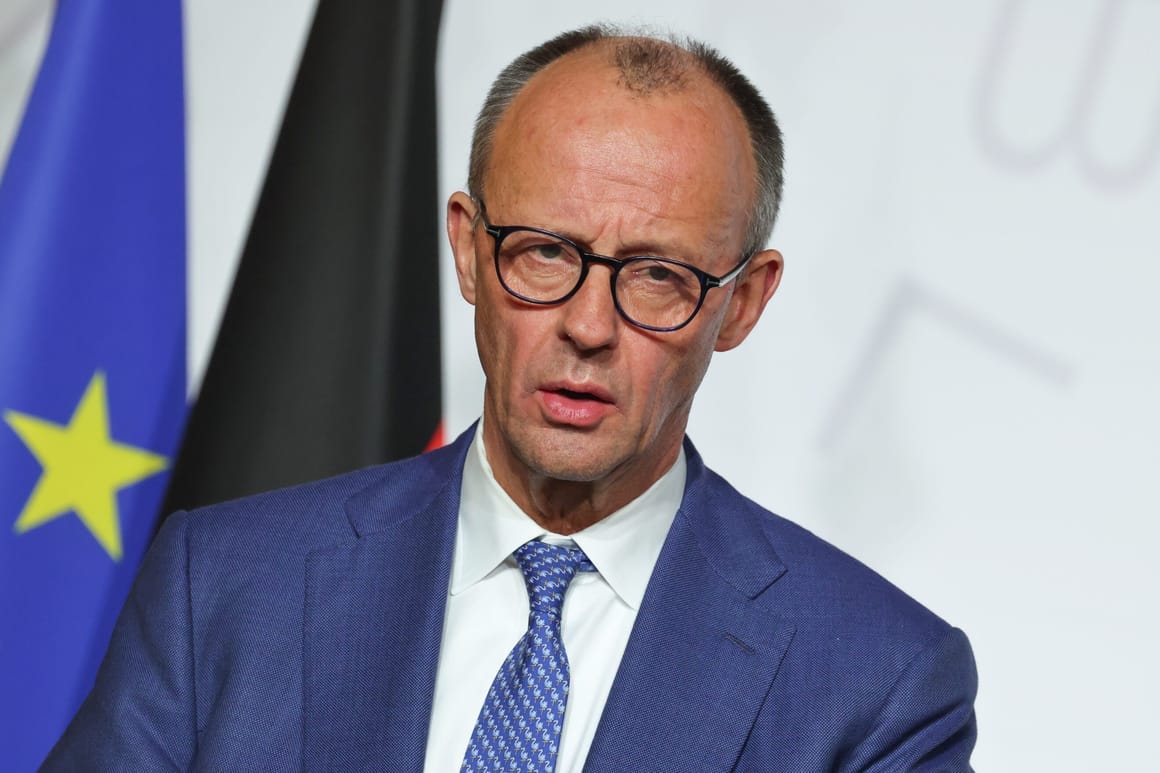
Photo credit: Ludovic Marin / EPA. Merz.
Merz is working to keep NATO together by portraying Greenland’s security as a matter for the alliance to handle in cooperation with the U.S.
“We are indeed discussing Greenland within NATO,” Merz told reporters, “We share the American concerns that this part of Denmark needs to be better protected. I hope that we will reach a mutually acceptable solution within NATO.”
As we covered in our regular Thursday 7 AM ET national security column today at The Hill, Trump admitted, despite days of hinting otherwise—& seemingly at the eleventh hour—that the U.S. was not going to militarily invade and seize the Danish territory.
Soon after his speech on Wednesday, the President announced that, “Based upon a very productive meeting that I have had with Secretary General of NATO, Mark Rutte, we have formed the framework of a future deal with respect to Greenland and, in fact, the entire Arctic Region.”
If agreed to by Denmark, that will provide strategic security for the U.S., against Russia in the Western Hemisphere. Now how about security in return for Copenhagen, Eastern Europe, the Baltic States & Ukraine?
***
Trump & Zelensky met in Davos this afternoon. Zelensky left the meeting saying Ukraine had reached an agreement on post-war security guarantees with the U.S.; however, the long pole in the tent remains Putin, and he has yet to come off his maximalist demands.
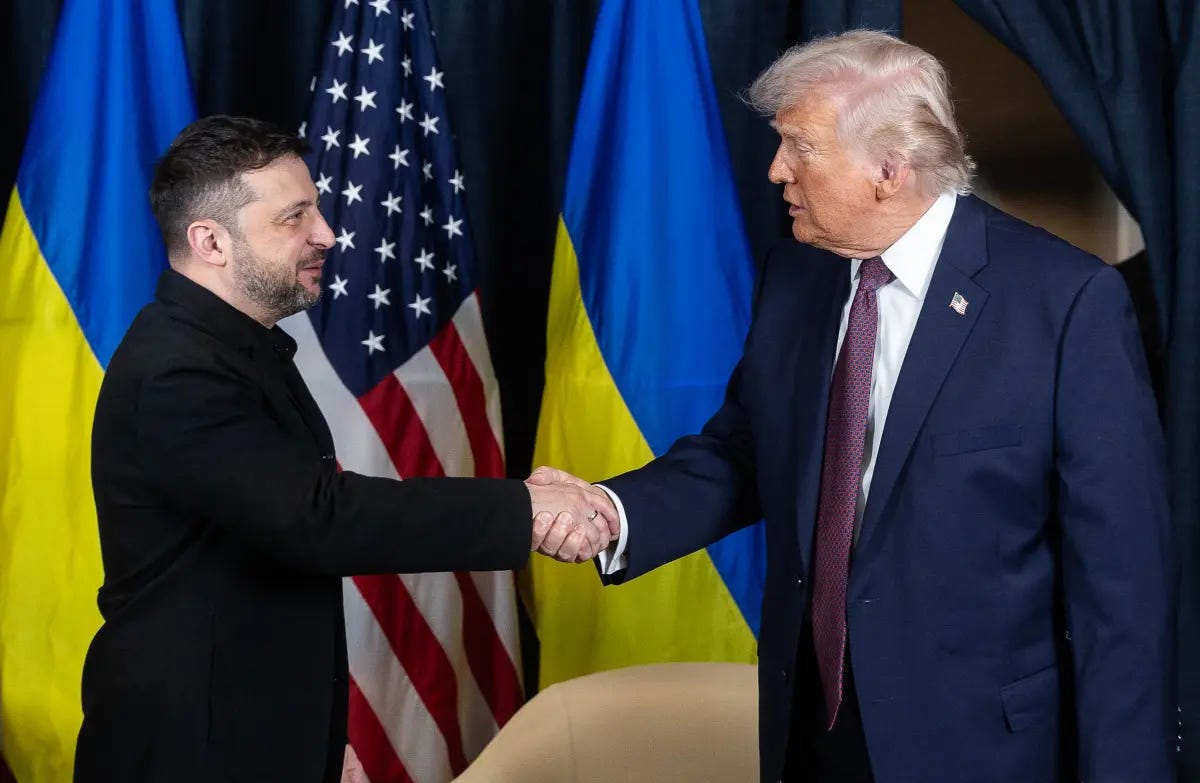
According to Gen. Kyrylo Budanov, “There is movement, and it’s real. We are really making progress.”
Time will tell. Special Envoy Steven Witkoff & the President’s son-in-law Jared Kushner traveled to Moscow & met this evening Putin, Russian presidential aide Yuri Ushakov & Kirill Dmitriev––the Russian president’s envoy to the U.S.
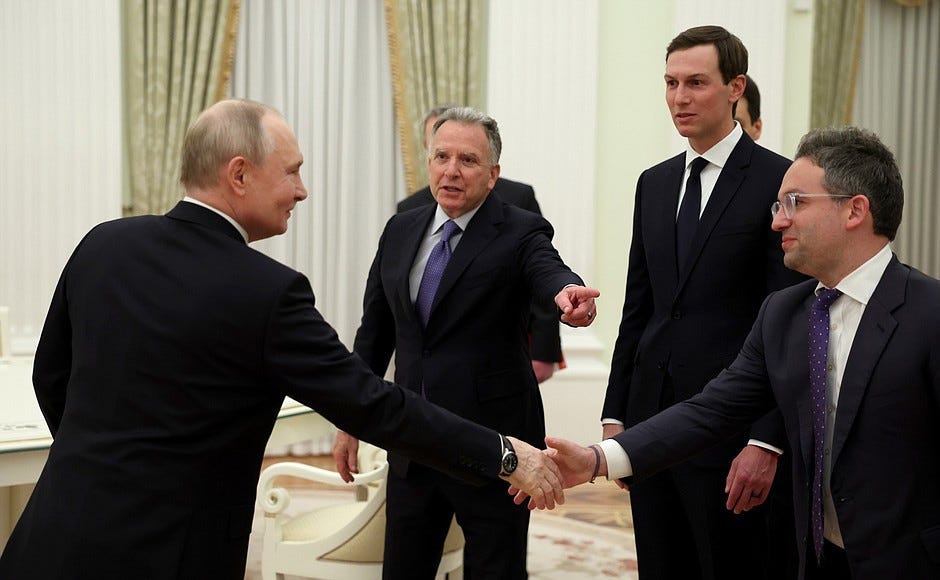
Photo credit: Kremlin. Putin greets Witkoff, Kushner, & White House Advisor Josh Gruenbaum at the Kremlin on January 22nd, 2026.
One outcome is that the U.S., Russia & Ukraine have agreed to hold trilateral talks tomorrow in Abu Dhabi. If that happens, it will be the first time that all three countries have met together to discuss a potential peace deal.
Could a peace deal come out of the trilateral meeting between Washington, Moscow and Kyiv in Abu Dhabi tomorrow?
Maybe. But in all likelihood, Donbas—especially its key defensive belt-lines—will remain the sticking point.
Those belt-lines defend parts of NATO as much as they defend Ukraine. Under no circumstances should Kyiv withdraw from them. They are equally to Europe’s security as Greenland is to U.S. national security.
***
Thank you for reading! We will see you tomorrow. Please subscribe, comment and share. We truly appreciate it!
Jon & Mark
Follow Jon on X at @JESweet2022 or on Bluesky at @JonSweet.bsky.social.
Follow Mark on X at @MCTothSTL or on Bluesky at @MarkToth.bsky.social.