

INTREP360 INTELLIGENCE REPORT
01.30.2026

[Editor’s note: This is an updated version from what was originally emailed to subscribers. We inadvertently sent out the unedited draft. Please accept our apologies.]
Greetings! Sometimes—when it comes to Team Trump & Ukraine—it feels like one step up and two steps back.
Let’s get started figuring out why!
***
The next round of peace talks concerning the resolution of the war in Ukraine is set to take place in the United Arab Emirates on February 1; however, the United States will not be participating in these discussions. At least not their lead negotiators.
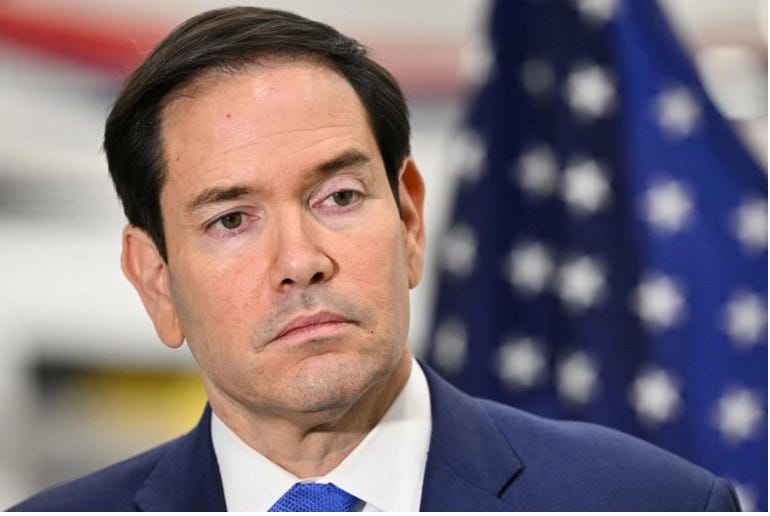
On Wednesday, Secretary of State Marco Rubio told the Senate Foreign Relations Committee that neither U.S. Special Envoy Steve Witkoff nor President Donald Trump’s son-in-law Jared Kushner would be participating.
The trilateral talks have been reduced to bilateral talks, and the way things are going, may not take place at all.
The situation is reminiscent of the first few lines of Bruce Springsteen’s 1987 hit “One step up.”
Woke up this morning my house was cold
Checked out the furnace she wasn’t burnin’
Went out and hopped in my old Ford
Hit the engine but she ain’t turnin’
We’ve given each other some hard lessons lately
But we ain’t learnin’
We’re the same sad story that’s a fact
One step up and two steps back
Rubio did not provide an explanation, only that “[Russia and Ukraine] are going to follow up talks again this week. In that regard, bilateral. There might be a US presence, but it won’t be Steve and Jared.”
But why were they removed?
***
As we wrote in last night’s INTREP360 Intelligence Report—there is a lot going right now. We described it as Kabuki theater and trap doors—and it is. Team Trump is decisively engaged in Venezuela, Cuba, Gaza and Israel. And a decision to use military force against Iran—the Islamic Revolutionary Guard Corps and the regime—is imminent. Military assets are in place.
Both Witkoff and Kushner are principal negotiators for Middle East affairs. Is Iran the higher priority?
The White House does not view Russia as a threat to the U.S. in Europe; therefore, they may be assuming risk with the meeting on February 1st to address the crisis in the Middle East with what they believe is the A Team.
Or maybe these two have simply hit a wall.
***
As we noted in The Hill on Thursday, “The U.S. is now 0 for 7 in its negotiations with Russia to end the war.”
Witkoff owns most of that. His negotiations have done nothing to bring the war to an end. They have only prolonged it, though, creating a “forever-war” that former President Joe Biden had promised to end.
Since Trump’s inauguration, the Russian military has suffered 418,280 casualties. That averages about 1,115 a day, or about two U.S. Army Infantry Battalions. During Biden’s tenure, they suffered 820,430 casualties, about 755 a day.
Civilian casualties have increased too. According to the UN Human Rights Monitoring Mission in Ukraine, in 2025, 2,514 civilians were killed and another 12,142 wounded. That was 31% higher than in 2024, and 70% higher than 2023.
For a President who said he would end the war in 24 hours, and who wanted to stop the killing, those numbers are pretty dismal.
In his frustration, he often reminds us that “The War between Russia and Ukraine is Biden’s war, not mine.” But the killing has increased on his watch.
***
Putin’s weaponization of winter this year has been compounded by extreme Arctic-like temperatures. According to Ukrainian President Volodymyr Zelensky, “Russia’s main targets right now are our energy sector, critical infrastructure, and residential buildings.”
Last week, the Kremlin launched more than “1,700 attack drones, over 1,380 guided aerial bombs and 69 missiles on Ukraine.”
Around 1,700 apartment buildings in Kyiv were left without electricity or heat; 1.2 million properties were without power countrywide during sub-zero winter temperatures.
During the Cabinet meeting at the White House yesterday, Trump told reporters that he had spoken to Russian President Vladimir Putin personally and asked him “not to fire into Kyiv and the various towns for a week” due to the extreme winter temperatures. Putin agreed, and the President told reporters, “I have to tell you, it was very nice.”
Nice is probably not how Ukrainians would describe the agreement.
Russia may just be short on drones and ballistic missiles.
While the moratorium on energy infrastructure remains in place after nearly 48 hours, Russia has simply shifted their attacks to logistics infrastructure and residential buildings. On Friday, facilities were struck in Kharkiv, Zaporizhzhia, Kherson, and the Dnipro region.
And Ukraine’s rail network. Ukrainian Prime Minister Yulia Svyrydenko said that Russia had launched seven drone attacks on the country’s railway infrastructure over the past 24 hours as part of an escalating campaign against their rail network. She posted on Telegram that “Russia is deliberately attacking our logistics routes – this is deliberate terror against people and civilian logistics.”
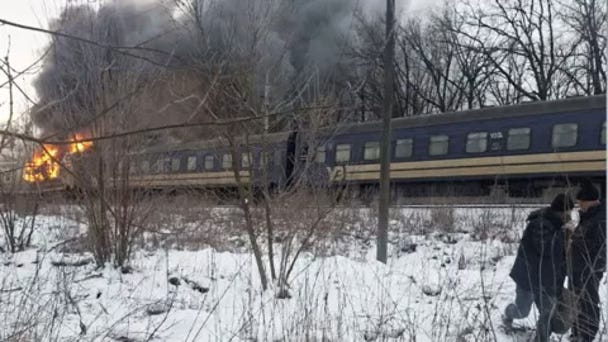
On Wednesday, a Ukrainian passenger train was struck by multiple drones in the Kharkiv region, killing five.
Kremlin spokesperson Dmitry Peskov said that Moscow agreed to the “personal request” from Trump to stop striking the capital city of Kyiv until Sunday. Adding that the president’s request was made in order to “create favorable conditions for negotiations.”
Zelensky responded to Trump’s announcement with his own: “If Russia does not strike our energy infrastructure—generation facilities or any other energy assets—we will not strike theirs.” He then noted that discussions concerning a temporary halt in attacks on energy infrastructure took place during trilateral meetings in Abu Dhabi last week.
The President may have elevated the issue and gotten Putin to respond in a favorable manner – but words matter. Russia is still targeting—terrorizing—Ukrainian citizens in their homes.
***
Putin extended an invitation to Zelensky today to come to Moscow for face-to-face talks. He rejected the offer, telling reporters “I can just as well invite him to Kyiv, let him come. I’m openly inviting him, if he dares.”
The Kremlin tried to assassinate Zelensky a dozen times during the first year of the war. Then in March 2024, they narrowly missed killing Greek Prime Minister Kyriakos Mitsotakis who had just finished meeting with Zelensky in Odesa when, getting into their motorcade, a Russian ballistic missile exploded 200 meters away. Zelensky is not going to make it easy for the FSB.
***
The military likes to start their briefings with the bottom line of front – the BLUF. So as we wrap this up – let’s get to the BLUF.
Russia has not indicated an intention to resolve its ‘special military operations’ through peaceful means. From Putin’s perspective, peace would be realized only when Ukraine ceases to resist and no longer exists as a nation, government, people, or culture.
Their ‘negotiations’ are aimed to set conditions that ultimately achieve that end state. They choose their words carefully and let the West mirror-image their own version – what they want to hear.
Next weeks bilateral meeting is not going to develop a solution to the Donbas. Kyiv is not going to bend the knee on this key terrain. Ukraine has drawn the line in the Donetsk Oblast – their Fortress Belt It is essential to the defense of Ukraine – protecting key avenues of approach towards Kyiv and Odesa.
Other sticking points – security guarantees that impede their end state. These include weapons systems provided to Ukraine for their defense, the physical presence of NATO or European Forces in Ukraine as peacekeepers, and the size of the Ukrainian military.
Moscow will not have a sympathetic ear in this meeting—if there even is a meeting.
Reuters reported this evening that Putin’s special envoy Kirill Dmitriev is flying back to Miami to meet with the Trump Administration tomorrow.
Despite what Russian Foreign Minister Sergey Lavrov thinks, whatever was ‘agreed’ to between Trump and Putin during their Alaska Summit in August 2025 has no bearing on Ukraine. That was between the two of them—and clearly Trump has not been able to persuade Ukraine to live up to his end.
The meeting on February 1 was supposed to be the ‘next step’—one step up. But world events—or possibly an unwillingness to exert pressure upon Russia – will take them two steps back.
How many Ukrainian civilians will pay the price?
***
Thank you for reading! We will see you Monday. Please subscribe, comment and share. We truly appreciate it!
Jon & Mark
Follow Jon on X at @JESweet2022 or on Bluesky at @JonSweet.bsky.social.
Follow Mark on X at @MCTothSTL or on Bluesky at @MarkToth.bsky.social.