

INTREP360 INTELLIGENCE REPORT
07.02.2026: Putin's Demise


July 2nd, 2026
Greetings, and welcome to another turbulent Thursday!
Defeat on the battlefield and an inablitiy to defend the skies over Russia has again resulted in the usual response from the Kremlin – targeting civilians and more nuclear saber-rattling.
Russian President Vladimir Putin remained true to form last night, launching another ‘‘massive’’ barrage of ballistic missiles and drones at Kyiv, killing 27 and wounding another 100 civilians.
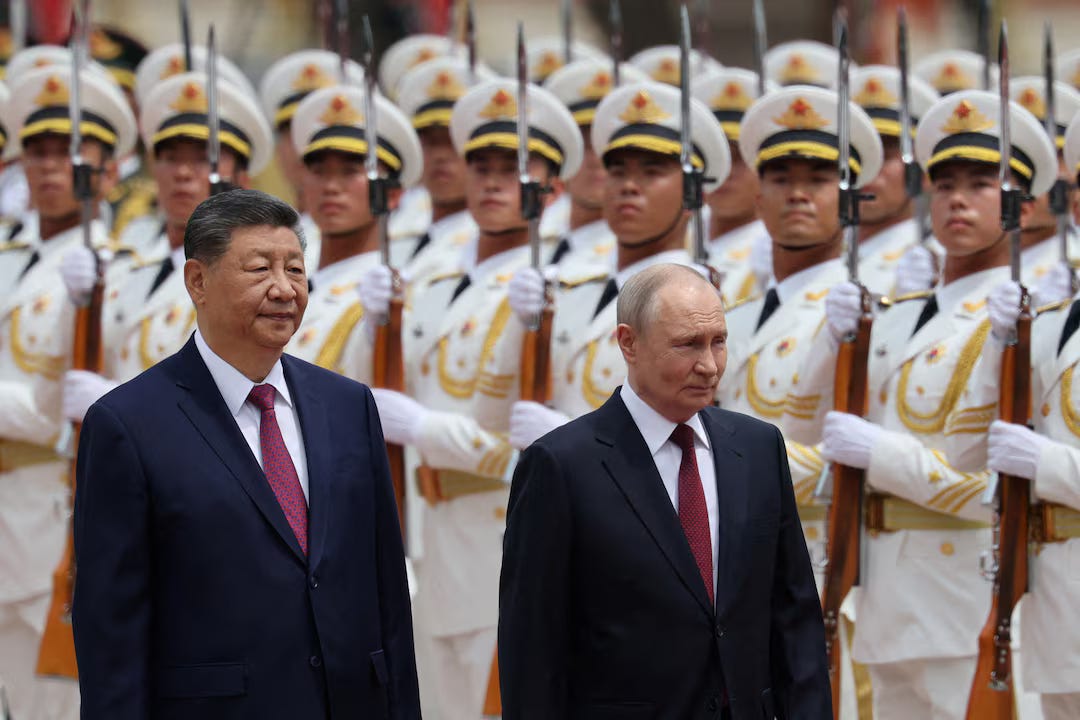
Photo Credit: Reuters. Russia approved secret China military training at top level, sources say
And as Mark wrote in last nights INTREP360 Intelligence Report, Russian Defense Minister Andrei Belousov personally approved China’s “Covert miltary training of Russian forces.”
According to Reuters:
A classified Russian document seen by Reuters directly referred to an internal decree issued by Defense Minister Andrei Belousov in August, 2025.
It said that, in accordance with a decision by Belousov, a delegation from Russia’s armed forces travelled to China to participate in training exercises at People’s Liberation Army (PLA) facilities.
Training in Radiological, Biological, Chemical Warfare.
The same report detailed one of the training courses – a three-week session focused on radiological, chemical and biological protection at a military facility in Beijing in November.
This is what desperation looks like. Lets take a look at some of the contributing factors.
*** BATTLEFIELD LOSSES
Let’s start where the rubber meets the road – the report card. A.K.A. The battle damage assessment (BDA). As of July 2nd, it looks like this:
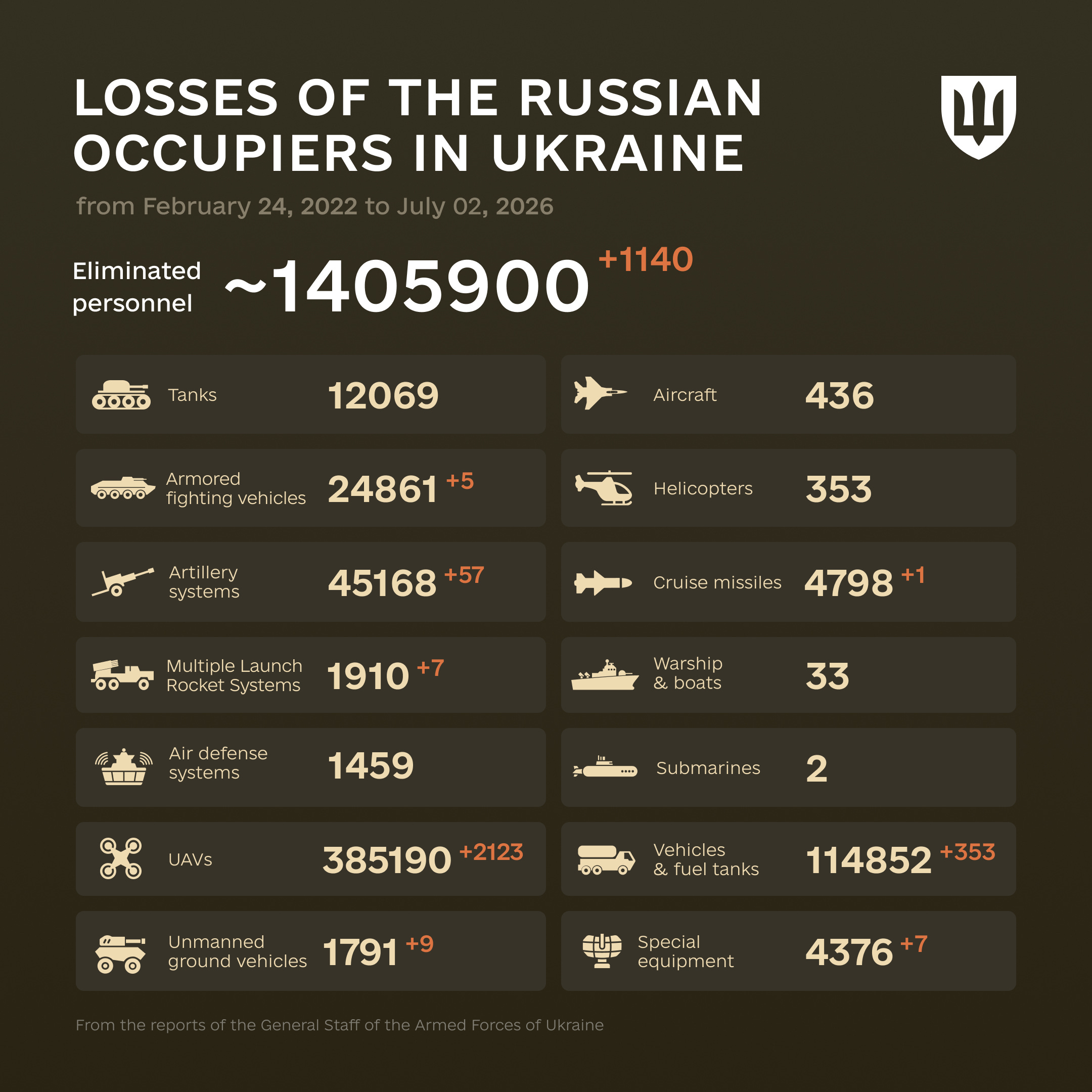
Photo Credit: General Staff of the Armed Forces of Ukraine. Losses of the Russian Occupiers in Ukraine.
1,588 days of combat = 855 casualties a day. That’s a little over one light infantry battalion a day. In 2026, Russia has lost between 30,000 – 35,000 soldiers a month.
Equally as telling – Russia’s recruitment rate for the first four months of 2026 fell below its battlefield losses.
We can give you 1,405,900 reasons for that.
***
BUT WAIT, THERE’S MORE
In case you missed the report in Foreign Policy last week:
“According to Russian military bloggers, the average life expectancy of a new recruit – from arrival at a training ground to death in a combat zone – lies somewhere between 10 days and three weeks. Once they are sent onto the battlefield, Russian fighters survive an average of 20 to 35 minutes. Much of the reason for this is the extraordinary shift in battlefield technology and tactics – in particular, the ways that drones have become the primary killing machines in this war, with stark implications for the future of combat in other parts of the world.”
Ukraine has become quite efficient in killing Russians. And their primary tool is the drone.
As we wrote in our April 24th INTREP360 Intelligence Report, Ukraine’s Kill Zone strategy has contributed to the bulk of Russian casualties in 2026.
The result: “90 percent of Russian soldiers are being killed before they even get to the front lines – and without ever confronting a Ukrainian soldier. 96 percent of those casualties come from remotely operated drones.”
And then there was the report from the Center for Strategic and International Studies in January that stated, “Russian forces have advanced at an average rate of between 15 and 70 meters per day in their most prominent offensives, slower than almost any major offensive campaign in any war in the last century.”
And that was six months ago – Russia is now giving back terrain. According to the Institute for the Study of War, “Ukrainian counterattacks liberated much of Kupyansk late 2025, over 400 square kilometers in southern Ukraine in Winter and Spring 2026, and several settlements in western Zaporizhia Oblast since late April 2026.”
That’s a trifecta of bad news – especially for draft age Russian men as Putin weighs mobilitzing an additional 500,000 soldiers for their slaughter in Ukraine.
More isn’t better. Its just more – targets.
***
DEEP STRIKES
Another thing Ukraine has become quit efficient at – with their own manufactured weapons courtesy of Fire Point – are deep strikes.
In June, St. Petersburg and Moscow took center stage – but Ukraine has been successfully targeting other facilites in Crimea and throughout Russia. Oil refineries, weapons production facilities, ammunition storage facilities, airfields and more.
And its having an effect – on the economy, but also on the Russian people. Ukraine has brought the war to Russia. They are experiencing the effects of war first hand, and they don’t like.
Ukrainian sanctions work – residents of St. Petersburg, Moscow and Crimea can attest.
Back in March, TVP World reported that the Levada Center – a Russian independent, nongovernmental polling and sociological research organization – found that just “24% of Russians polled thought military operations in Ukraine should continue as of mid-February, the lowest support since the center began its polling.”
More complelling finding was that as many as 67% of the respondents said now is the right time for Russia to move to peace negotiations, 6 percentage points up on January this year.
Newsweek reported yesterday that a poll conducted by the Kremlin-friendly FOM (Public Opinion Foundation) found that 69 percent of the respondents trusted Putin – a drop of five percentage points from June 14, and the lowest level for the Russian president since the start of his full-scale invasion.
***
UKRAINE REINFORCES SUCCESS
On June 25th, Ukrainian President Volodymyr Zelensky said he had approved a plan – an influence operation – for Ukraine’s State Security Service (SBU) to launch a 40-day operation aimed at pressuring Russia to end the war.
The plan is based upon the success of Ukraine’s long-range sanctions plan, mid-range sanctions, and the results of the Security Service of Ukraine – specifically the Center of Special Operations “Alpha” – on the front. The Kill Zone strategy.
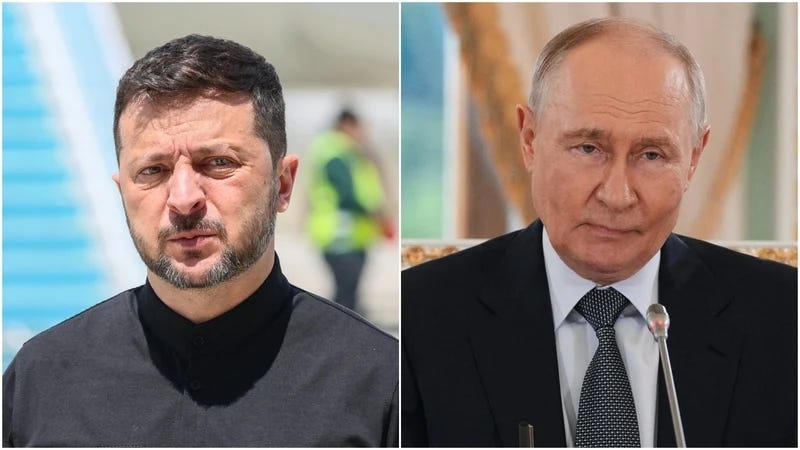
Photo Credit: Getty. Ukrainian President Volodymyr Zelensky had proposed face-to-face talks with Russian President Vladimir Putin
His open letter to Putin shortly after the first drone strikes in St. Petersburg proposing an immediate ceasefire along the current frontline and a face-to-face bilateral meeting in a third country to end the war was rejected. Putin’s response was, “I see no point in meeting.”
That was then – by day 40 Putin may have a different perspective.
***
BUT NOT WITHOUT RISK
Zelensky knew what the Russian response would be – Russian ballistic missiles, drones and glide bombs on Ukrainian cities targeting civilians.
And they have, striking cultural centers, the Premier Palace Hotel in central Kyiv, the Dormition Cathedral at Kyiv Pechersk Lavra, residential buildings, a Red Cross humanitarian warehouse, a kindergarten in Sumy, and more.
The intent is to strike fear and to destroy all things associated with Ukrainian culture. We have said it before – but if these strikes are war crimes and an attempt to erase an entire culture. Genocide – as we laid out in our June 15th INTREP360 IR.
UN Secretary-General António Guterres finally stepped up and condemned the Russian attacks on Kyiv, warning that “strikes against civilians and civilian infrastructure violate international humanitarian law and must stop immediately.”
But they won’t.
Condemnation – lawyer talk – won’t stop the attacks. It’s Putin’s only recourse since the West isn’t buying his nuclear rhetoric and Belarus President Alexander Lukashenko isn’t going to open a second front.
***
SQUARING THE CIRCLE
Knowing what the response will be and defending against it are two different things.
Ukraine remains woefully short of air defense assets and munitions. They can handle the drone threat – but need more Patriot missiles to address the ballistic and hypersonic missile threat.
The Kyiv Post reported today that Ukrainian Defense Minister Mykhailo Fedorov “wrote to nearly 40 partner countries, urging them to immediately transfer Patriot missiles from existing stockpiles to Ukraine, in exchange for future deliveries already contracted for Kyiv.” He added that “shooting down ballistic missiles remains a key challenge due to a shortage of missiles for Patriot systems.”
Putin’s ‘special military operation’ is on day 1,588, and Ukraine still does not have an integrated air defense system or an established No-Fly Zone despite all the talk amongst European countries to support them.
That cost is borne by the Ukrainian civilian. As the saying goes, “deeds not words.” While Europe has stepped up to fill the void of U.S. support in 2025, more is needed to defend Ukraine from Russian bombardments. More must be done to strengthen Ukraine’s air defense network.
A decision by President Donald Trump to release the licences for Ukraine to begin production of Patriot missiles would be a step in the right direction.
***
ICYMI. We published two national security articles today in The Washington Star and our weekely column in The Hill. You can read them here:

https://thehill.com/opinion/national-security/5949847-iran-taming-trump-negotiations/
***
Thank you for reading. We will see you tommorow.
Please subscribe, comment & share. We truly appreciate it!
Jon & Mark
Follow Jon on X at @JESweet2022 or on Bluesky at @JonSweet.bsky.social.
Follow Mark on X at @MCTothSTL or on Bluesky at @MarkToth.bsky.social.
The greatest allies of putler are the lack of determination, the lack of commitment, and the 'weakness' ( = pusillanimity) of our EU and NATO countries in putting an end to this genocide committed in Europe by a COMMON NAZI enemy! And still no SKYSHIELD! This passivity implicitly contributes to these terrorist and murderous acts: how shameful is cowardice!