

INTREP360 INTELLIGENCE REPORT
02.04.2026

February 4th, 2026
Greetings! It’s a Mad, Mad, Mad, Mad World. Forgive us—we know—we’ve used that a couple of times.
Yet tonight—as we write this INTREP360 Intelligence Report—it checks all the right boxes as we sweep around the globe.
START is out. MAD is likely returning.
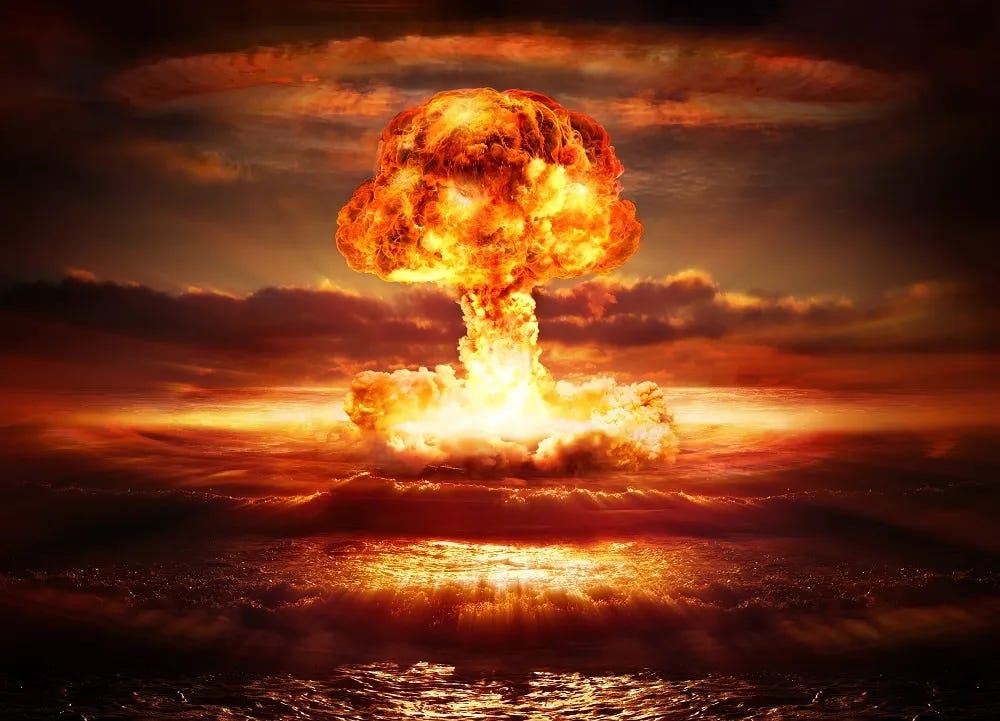
Photo credit: Romolo Tavani / Fotolia.
Ukraine is burning. Russia is spinning. Iran is trying to play Team Trump for fools—and China is lurking while playing a deep game.
The global order is—finally—completely broken as we’ve known it since the end of World War II.
Let’s get started putting all of that together. It does all make sense in a crazy dystopian type of way.
***
NORTH AMERICA
By the time most of you read this edition, the New START Treaty likely will have expired. Unless renewed—and that is highly unlikely—it was set to end today.
Initially the treaty—first signed on February 5th, 2011—limited the U.S. & the Russian Federation to:
1. 700 deployed intercontinental ballistic missiles (ICBMs), deployed submarine-launched ballistic missiles (SLBMs), and deployed heavy bombers equipped for nuclear armaments;
2. 1,550 nuclear warheads on deployed ICBMs, deployed SLBMs, and deployed heavy bombers equipped with nuclear armaments;
3. 800 deployed and non-deployed ICBM launchers, SLBM launchers, and heavy bombers equipped for nuclear armaments.
The pact also provided for 18 reciprocal on-site inspections a year, warhead verifications during those inspections, biannual data exchanges, & telemetric information. It also required rolling status reports for all strategic delivery vehicles & launchers.
Ditto notifications for ballistic missile tests & the introduction of any new delivery vehicle or launcher variants.
Significantly—up until now—both parties have met the core requirements of the New START Treaty. Now, all bets are off.
Essentially, we are back to MAD—the theory of mutually assured destruction—as the only curb on the use of nuclear weapons. In reality, MAD really never went away. Instead, it was more of a consensus not to say the quiet part—MAD—out loud, but that Russia, China & the U.S. understood the unspoken rule.
For now, Team Trump is fine with that. Earlier in January, when asked during an interview with The New York Times about the treaty, President Donald Trump responded, saying, “If it expires, it expires.”
Geostrategically, he has a point. The New START Treaty had a major flaw. China was never part of the agreement & Chinese President Xi Jinping has rebuffed overtures from the Trump Administration to consider joining.
As we warned in here last December, China is quickly expanding its nuclear weapons arsenal & launch vehicles & is aiming to have 1,000+ nuclear-capable ICBMs by 2030. Beijing lags in all three areas of its nuclear triad—land, sea & air nukes—& they are determined to close the gap as quickly as possible.
It is a large gap. According to estimates by the Federation of American Scientists, Russia has 4,309 nuclear warheads, the U.S. has 3,700 & China 600. Mass, however—as Moscow is finding out the hard way on the ground in Ukraine—doesn’t mean everything. Much of Russia’s nuclear warheads are aging.
Significantly—at least for now—Russia has 1,718 actively deployed nuclear warheads & the U.S. has 1,770.
And China?
The consensus is Beijing has deployed around 100 nukes.
In other words, we are looking at a new global nuclear arms race. In fairness, Team Trump is right here. Unless Beijing is part of a nuclear arms treaty going forward, it makes no sense for the U.S. to negotiate a bilateral agreement with Russia—especially since Russia & China are acting in concert.
In this MAD light, Trump’s Golden Dome initiative to defend North America becomes more of an imperative than a national security luxury. To be clear—especially for our Danish friends here—this means Team Trump constructively working with Denmark & not threatening to invade Greenland.
***
CARIBBEAN
Cuba is beginning to feel the pressure over Trump threatening last week to impose new tariffs on any country exporting oil to the Caribbean island nation. Earlier today, Carlos Fernández de Cossío—the country’s deputy foreign minister—said that Havana is ready for “meaningful” talks with Washington.
De Cossío––essentially––is pleading for bilateral talks. Thus far, it has been crickets from Washington.
That said, Cuba is unlikely to like the terms. Team Trump––according to various reports––is seeking the “return of property confiscated from Cuban exiles who left the island following the 1959 revolution.”
Plus, Secretary of State Marco Rubio is on record recently saying that Washington “would love to see” regime change in Cuba.
Don’t sleep on Cuba. We highly suspect that Team Trump is intent on effecting the fall of Cuban President Miguel Díaz-Canel & his communist regime. To be clear—as it is presently—we don’t mean U.S. military intervention.
Washington’s calculus—instead—is focused on collapsing the Cuban economy. That could happen sooner rather than later. By some estimates, Cuba is down to 10 to 14 days of oil reserves under its current rationing program.
***
EUROPE
Ukrainian President Volodymyr Zelensky—rightly, in our view—is hardening his negotiating position. He is making it clear that Ukraine has no intention whatsoever of ceding the remaining part of the Donbas still under his country’s control.
Earlier today, Zelensky took aim at Putin ahead of the trilateral talks between the U.S., Russia & Ukraine taking place in Abu Dhabi. He warned Putin that if Russia wants “to conquer eastern Ukraine, it will cost them another 800,000 corpses.”
Plus, to get it, Zelensky estimated it would take two more years of fighting. But—in a direct taunt to Putin—he said that he doubted Russia could “last that long.”
It’s cold in Ukraine. Very cold. But Zelensky is increasingly on fire. His taunting of Putin comes on the heels of his comments at Davos in January that Europe must do far more in ensuring the defeat of Russia.
Even Rustem Umerov—the Secretary of the National Security & Defense Council of Ukraine & chief Ukrainian negotiator in Abu Dhabi—is getting in on the act. In what was likely a rebuke aimed at Steve Witkoff, after today’s sessions were over, Umerov described them as “substantive and productive.”
Those words are very similar to how Witkoff described his surprise meeting with Kirill Dmitriev—Putin’s special envoy to the U.S.—over the weekend. Umerov—likely, in our opinion—was telling Witkoff that two can play that game.
In that vein, Witkoff can’t be sidelined too soon. Tomorrow—Thursday—in our weekly 7 AM ET column at The Hill, we will have a lot more to say on the strange shadowy bromance between Witkoff & Dmitriev.
Meanwhile, Putin continues to bomb Ukraine & Kyiv is waking up to a new reality. Going forward—post-war—they cannot rely on the West for security guarantees. As Politico is reporting today, Kyiv is determined to turn itself into a “steel porcupine” to fend off any future Russian invasion.
That means a large standing army and heavy investment in arms (especially drone & missile technology). Ensuring both will inform what Ukraine is willing to agree to—or not—in any peace settlement with Russia.

Sadly, however, we are not close to peace in Ukraine. Despite Dmitriev’s constant spinning on X—does anyone use the peace dove emoji more than he does?—Moscow is not after peace. They are after all of Ukraine.
***
MIDDLE EAST
Iran—for now—is wagging the dog. Initially, the U.S. canceled scheduled peace talks with Tehran after Iranian Supreme Leader Ayatollah Ali Khamenei balked at the scope of the meeting & its location in Turkey.
Then, after some obviously strong-arming by the Gulf States, Team Trump agreed to switch the meetings to Oman on Friday & to—reportedly—narrowly discuss ending Iran’s nuclear weapons program.

That is a mistake. As we detailed here yesterday, Khamenei is not going to give up his pursuit of nukes in the long run.
Iran is in no position to dictate here. Peace terms are clear: stop killing protestors, zero enrichment, terminate its ballistic missile program, & cease its backing of Hamas, Hezbollah, the Houthis & other IRGC-backed militias.
Of course, Khamenei will not agree to any of that. Meanwhile, as Trump noted today, Iran is at work on a new nuclear facility.
It’s time Team Trump reads the room.
***
INDO-PACIFIC
Don’t look now but it appears that China is now funding—according to retired Air Marshal Ed Stringer, the former head of RAF intelligence—as much as 60% of Russia’s ongoing war effort in Ukraine.
Why?
Stringer believes it is so Beijing can “gain an economic advantage over the West.” He further noted that “Russia can only maintain this war because China is essentially bankrolling it.” Stringer isn’t wrong.
Others are warning that Xi’s machinations—ultimately—will not be confined to Ukraine. Sir Hew Strachan—a Wardlaw professor of international relations at the University of St Andrews—warns that Beijing might encourage Russia to attack Estonia to “distract NATO” while China continues to build its military.
In his view—and Stringer’s—the idea would be to create a second frozen conflict that buys Xi time to catch up. Meanwhile, if so, the side benefit would be that China continues to purchase Russian oil at heavily discounted prices.
***
ICYMI!
In our latest column at the Kyiv Post, we followed the oil. When we did, Team Trump’s recent moves—for good or bad—made a lot more sense.

Photo credit: Kyiv Post.
***
Thank you for reading! We will see you tomorrow. Please subscribe, comment and share. We truly appreciate it!
Jon & Mark
Follow Jon on X at @JESweet2022 or on Bluesky at @JonSweet.bsky.social.
Follow Mark on X at @MCTothSTL or on Bluesky at @MarkToth.bsky.social.
Excellent analysis of the current global situation. The point about China bankrolling 60% of Russia's war effort while also building its own capabilities is chilling. We're seeing coordinated moves that most western analysts seem to miss or downplay. The nuclear arms race angle teis into this perfectly too, especially with Beijing refusing treaty participation whileramping up production.