

INTREP360 INTELLIGENCE REPORT
06.05.2026: THE PHILIPPINES AND JAPAN FORGE AHEAD AGAINST CHINA

June 5th, 2026
Greetings!
In April and May, as we noted here at the time, the U.S. and Philippines held their bilateral military exercise known as Balikatan. In Tagalog, an Austronesian language primarily spoken in the Philippines, Balikatan means ‘shoulder to shoulder.’
The annual multi-domain drill “is designed to strengthen regional security through combined air, land, sea, cyber and space operations featuring maritime drills, coastal defense training, joint live-fire exercises and humanitarian projects.”
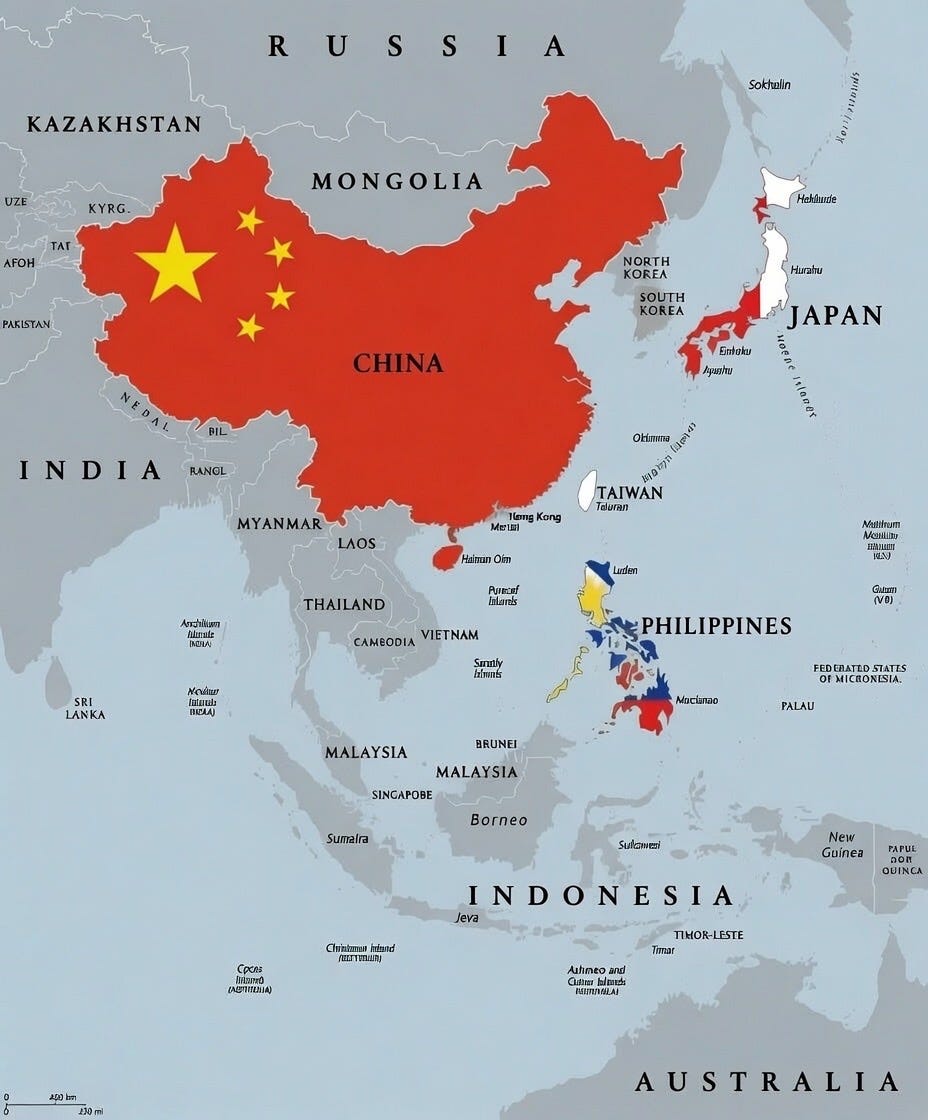
AI image credit: Grok. A map of the Pacific Rim highlighting China, Japan, and the Philippines.
Notably, this was the first year that Japan took part in Balikatan as a full-scale active combat participant. Significantly, it was the first historic deployment of Japanese combat troops to the Philippines since World War II.
1,400 Japanese Self Defense troops participated. Japan also dispatched warships, including the JS Ise and JS Shimokita, US-2 amphibious aircraft, C-130H transports, and Type 88 anti-ship cruise missiles for live-fire drills.
Fittingly, one of the key exercises was the sinking of “a World War II-era minesweeper off the coast of northern Luzon Island.” It was, in many ways, a 21st-century symbolic renewal of the end of World War II. Other participants included troops from Australia, New Zealand, France, and Canada.
In commercial real estate, it is often said that location is everything. In terms of this year’s Balikatan exercise, its location was all about messaging to China. Its live-fire drills took place “in the north of the Philippines facing the Taiwan Strait, as well as a province off the disputed South China Sea, where Philippine and Chinese forces have engaged in repeated confrontations” in recent years.
Beijing was not pleased. It accused the U.S., Japan, and the Philippines of “playing with fire.” Guo Jiakun, a Chinese foreign ministry spokesman, angrily claimed that “What the Asia-Pacific region needs most is peace and tranquility, and what it needs least is the introduction of external forces to sow division and confrontation.”
China’s attempt to bully the Philippines backfired. Instead, ever since, it has brought Manila and Tokyo closer together.
Let’s get started finding out how.
***
THE THREE ISLAND CHAINS
First, a quick recap. As we first examined here in-depth on May 19th, the U.S.’ defensive posture is secured by three island chains in the Pacific Ocean. Broadly speaking, they are defined as follows: The First Island Chain, which is the closest to mainland China, extends from the Aleutians in the north, to Japan, then to the Ryukyu Islands, Taiwan, the Philippines, Borneo & ends in Indonesia.
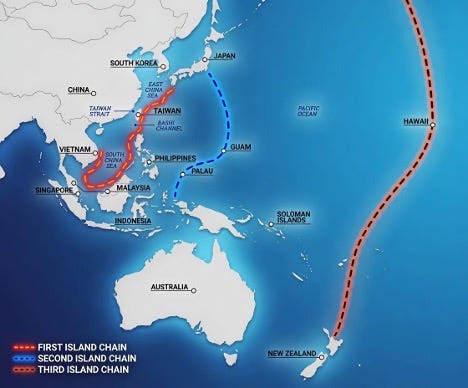
AI image credit: Grok. The Three Island Chains containing China in the Pacific.
The Second Island Chain stems from Japan southward to Guam, Palau & ends in western New Guinea. The Third Island Chain begins in Hawaii, extends through Oceania & ends in Australia & New Zealand.
Plus, as we said in May, it’s a big map. Each chain is interdependent on the other. But there is only one ‘cork’ — at least for Beijing — that opens up this entire bottle: Taiwan. However, now the Philippines and Japan are working to make sure that cork never gets popped by Chinese President Xi Jinping.
***
MANILA AND TOKYO DRAW CLOSER
Since the beginning of the year, the Philippines and Japan have been deepening military cooperation between the two countries to counter — and confront, if necessary — increasing Chinese People’s Liberation Arny (PLA) assertiveness in the South China Sea and throughout the Indo-Pacific. On January 15th, they signed two new defense pacts.
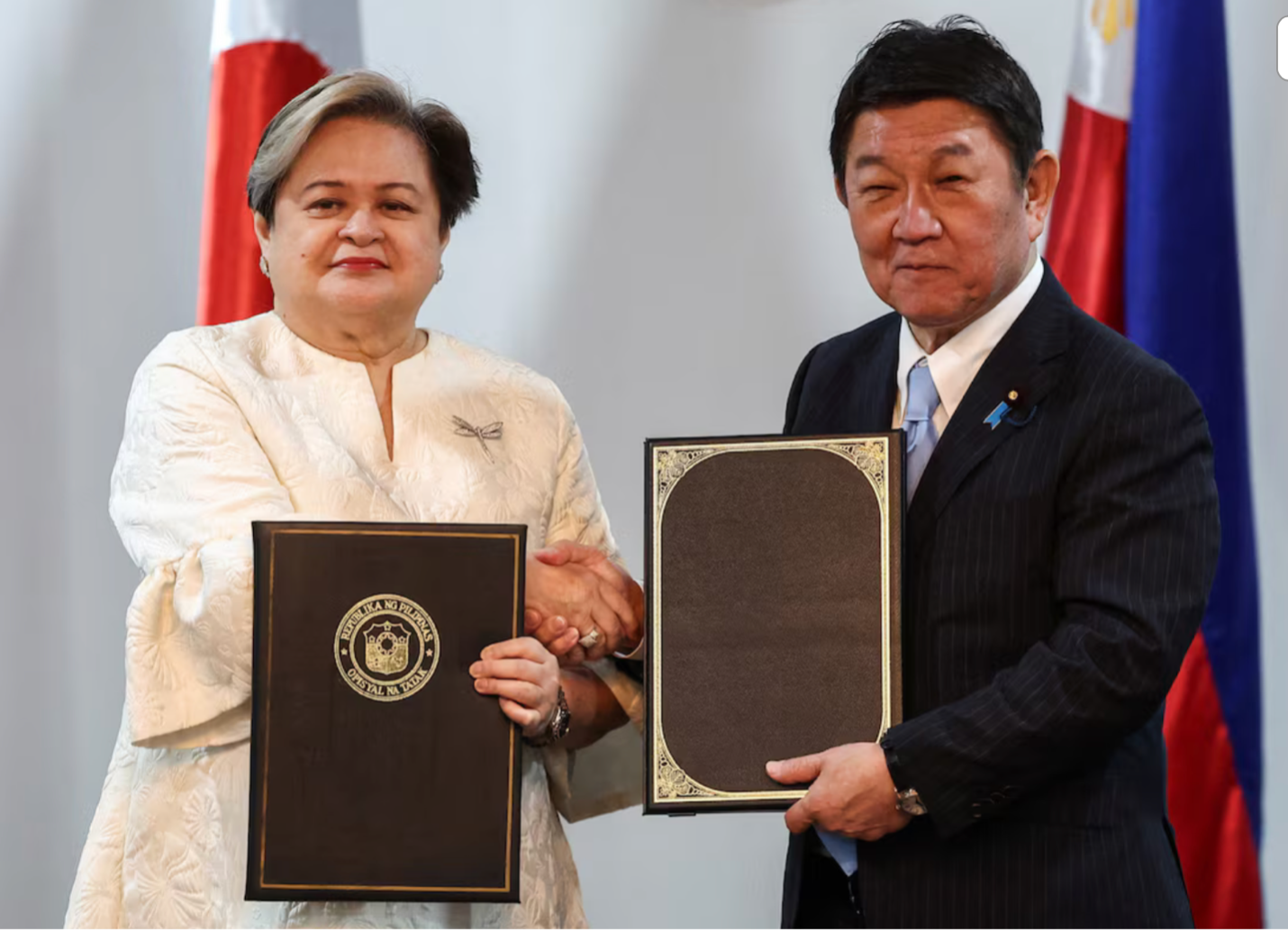
Photo credit: Japanese Foreign Ministry. Secretary of Foreign Affairs of the Philippines Maria Theresa Lazaro and Japanese Foreign Minister Motegi Toshimitsu shake hands while holding signed bilateral agreements ahead of their joint press conference in Pasay City, Metro Manila, Philippines, January 15th, 2026.
The first pact, entitled The Acquisition and Cross-Servicing Agreement, is structured to facilitate both nations’ military forces to exchange “supplies and services.” This is a key element in establishing interoperability between the Armed Forces of the Philippines and the Self Defense Forces of Japan.
The second agreement provides $6 million in “Official Security Assistance from Tokyo to fund the building of facilities to house rigid‑hulled inflatable boats donated by Japan to boost Manila’s naval capabilities.”
Both pacts come only months after the Reciprocal Access Agreement that was signed between the two countries in 2024 went into effect. That pact was acclaimed by Manila and Tokyo as being “unprecedented” given that it allows “deployment of forces on each other’s soil in the face of China’s increasingly assertive stance in the region.”
Notably, it was Japan’s first such pact in Asia.
***
WEAPON TRANSFER NEGOTIATIONS
On May 5th, during a meeting in Manila between Japanese Defense Minister Shinjiro and Philippine Secretary Gilberto Teodora Jr., the two Pacific nations agreed to begin negotiating a defense equipment pact. The initial discussions between the two officials centered around transferring used Japanese destroyers to Manila.
Both men accused Beijing of “coercive activities,” especially Beijing’s laying claim to virtually all of the South China Sea as well as disputing ownership of “uninhabited East China Sea islands known as Senkaku in Japan and Diaoyu in China.”
Bear in mind, this is the same China that back in the Fall of 2023 published a new official map falsely laying claim to Taiwan, the South China Sea, “as well as contested parts of India and Russia.”
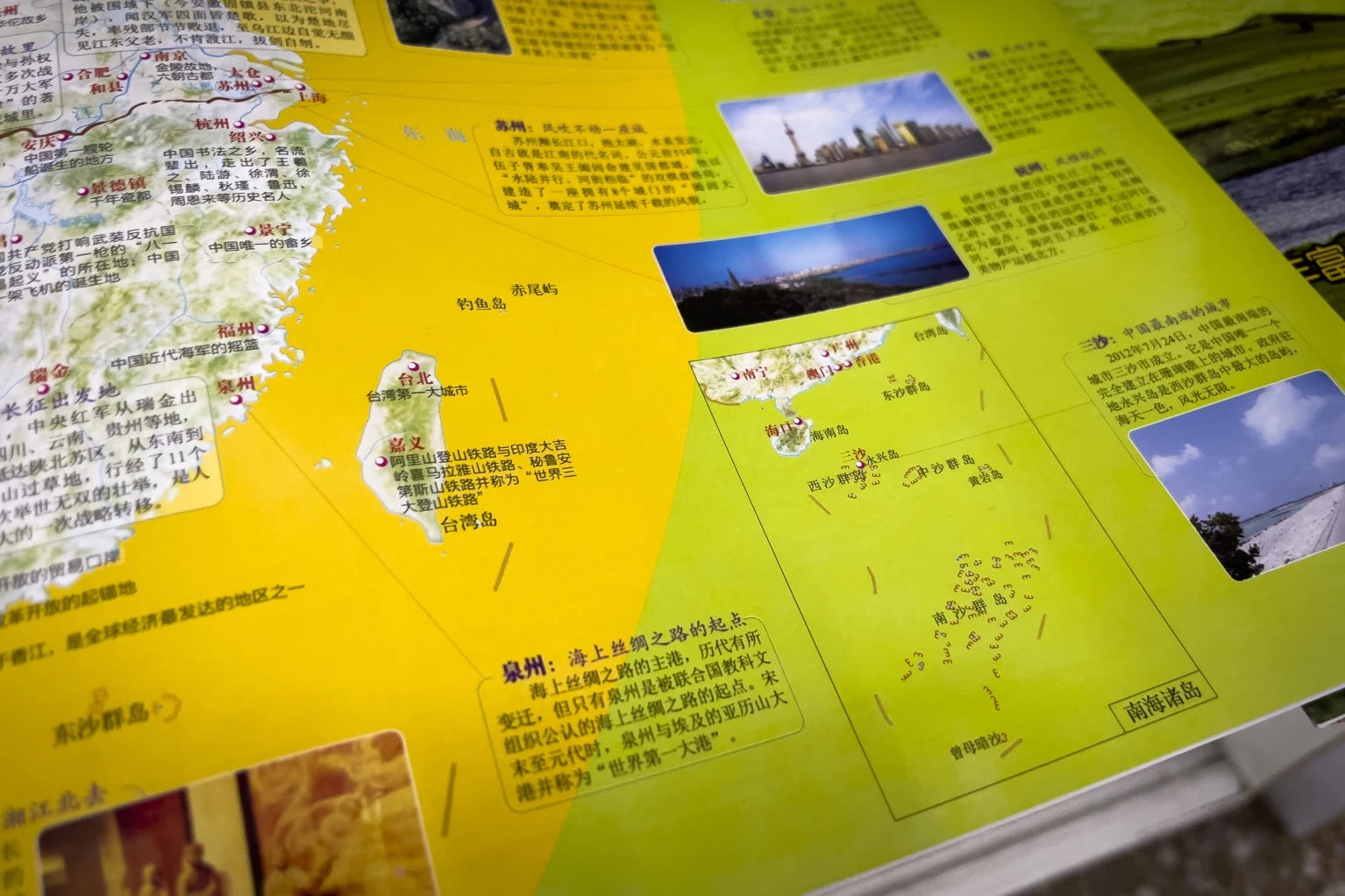
Photo credit: Andy Wong / AP. China’s 2023 official map laying claim to Taiwan, the South China Sea as well as parts of India and Russia.
In late May and early June, the Philippines and Japan accelerated talks to transfer Japanese weapon systems to Manila. These include Japan Maritime Self Defense Force Abukuma-class destroyers, TC-90 training aircraft, and maritime surveillance assets.
Its significance is historic. Earlier, on April 21st, Japan “scrapped a ban on lethal weapons exports, a major change in its postwar pacifist policy as the country seeks to build up its arms industry amid worries over Chinese and North Korean aggression.”
Japanese Prime Minister Sanae Takaichi, who Xi Jinping undoubtedly has come to hate, sought and obtained her cabinet’s approval on the change. Guo, once again speaking for the Chinese Foreign Ministry, reacted by saying that China “will resolutely resist Japan’s reckless moves toward a new type of militarism.”
Sure Jan.
Or maybe the new post-Brady Bunch saying should be: Sure Guo. Beijing, as we noted above, is the only one in the Indo-Pacific redrawing maps and attempting to enforce — indeed, impose — them via militarism.
***
HEALING OLD WOUNDS
During the May 28th summit between Philippine President Ferdinand Marcos, Jr. and Takaichi, Manila and Tokyo announced formal negotiations to related overlapping claims related to Exclusive Economic Zones (EEZ). Under the United Nations Convention on the Law of the Sea, these zones extend up to 200 nautical miles from a country’s coastline.
Beijing, yet again was not pleased.
In response, the People’s Liberation Army Navy — yes, you read that right, Army Navy! — began conducting blue water naval patrols east of Taiwan. Apparently only Beijing gets to redraw existing maps.
China is upset because Taiwan also has overlapping EEZ claims with the Philippines and Japan. Or more to the point, Beijing views those EEZ waters as its own.
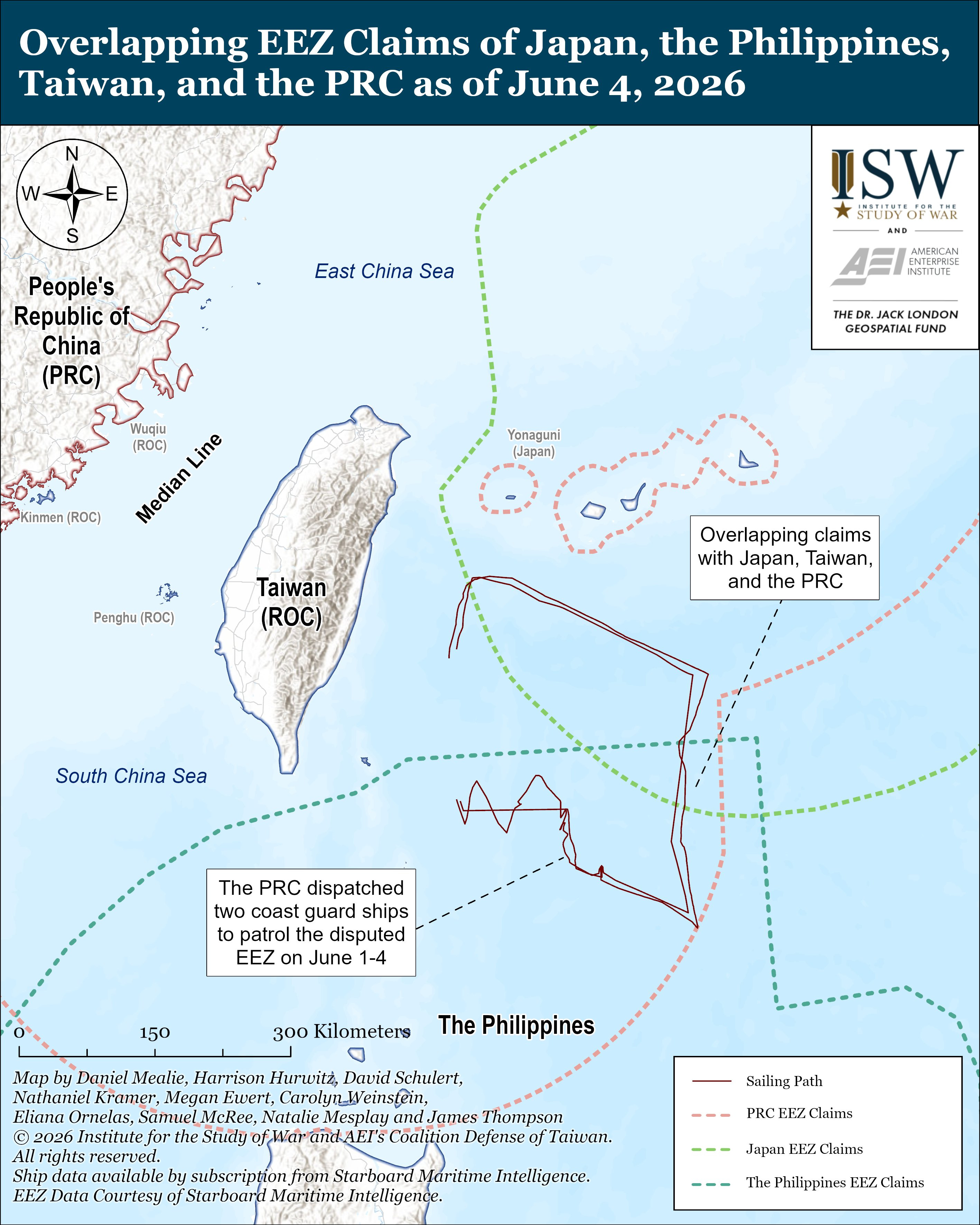
Used with ISW permission. Credit: Institute for the Study of War and AEI’s Critical Threats Project. Map detailing the overlapping claims between the Philippines, Japan, Taiwan, and China.
***
SLEEPING GIANT
Beijing, wittingly or not, has awakened a sleeping giant in Japan. Tokyo made that same self-defeating mistake on December 7th, 1941, when it bombed U.S. military forces in the Philippines and Pearl Harbor.
Now, it is Xi’s turn.
Japan is rapidly realizing it can no longer stay on the sidelines when it comes to regional defense. Tokyo has come a long way since May 11th, 2022, when we urged in The Hill for Japan to rescind Article 9 of its Constitution.
Article 9 prohibits Japan from creating or using offensive military weapons. It still is in effect although Tokyo has increasingly found legal ways around it.
Time will tell, but we would not be surprised if Takaichi seeks to rescind it herself in the near future. If that happens, Xi will only have himself to blame.
Meanwhile, Manila and Tokyo are doing their level best to keep Taiwan corked up. Given that it is in the national security interest of the U.S., Washington should be helping the Philippines and Japan every step of the way.
***
ICYMI
Earlier today, in an exclusive for The Washington Star as part of our daily foreign affairs column, we briefly interviewed Rep. Don Bacon (R-NE) after the House voted 226-195 to pass the Ukraine Support Act.

Screenshot credit: C-SPAN. Rep. Don Bacon speaks from the House floor on June 4th, 2026, in support of the Ukraine Support Act.
You can read it here. It is not paywalled at our request.
***
Thank you for reading. We will see you Monday. Please subscribe, comment & share. We truly appreciate it!
Jon & Mark
Follow Jon on X at @JESweet2022 or on Bluesky at @JonSweet.bsky.social. Follow Mark on X at @MCTothSTL or on Bluesky at @MarkToth.bsky.social.