

INTREP360 INTELLIGENCE REPORT
05.18.2026: CHINA'S RINGS OF FIRE

May 18th, 2026
Greetings!
It’s Monday and we are having a sense of déjà vu. Last Friday, during an interview with Bret Baier on Fox News, President Donald Trump told the Fox News anchor that he sees Taiwan as “a very good negotiating chip for us frankly.”
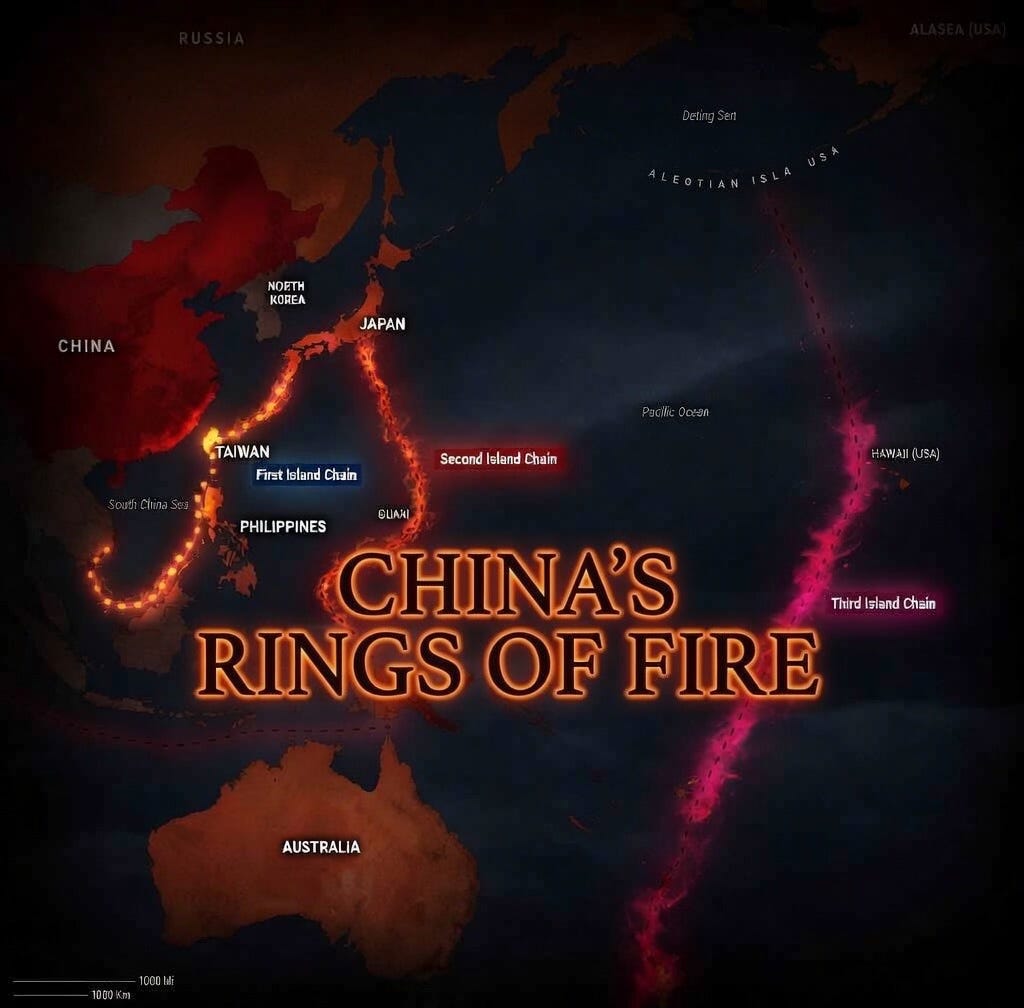
AI image credit: Grok. Graphic depicting the first, second, & third island chains underpinning the U.S. military’s defense of the Indo-Pacific.
Trump was referring to the $14 billion arms package sale to Taipei, the largest ever with respect to Taiwan, that was pre-approved by Congress in January. Ever since, it has been stalled awaiting the president’s approval.
Taiwan as a bargaining chip?
Where have we heard that dangerous belief before?
Bingo. Back in November 2017, Katherine Chang, Taiwan’s then-minister for mainland affairs during Trump’s first term in office, voiced the concern that he might view Formosa as a “bargaining chip” with Beijing.
Her concern wasn’t new. Trump himself, in a very different vein, suggested when he was still President-elect in December 2016 that he wasn’t bound by the longstanding “One China Policy” — adopted by the U.S. in 1979 — and that if he wanted, he could use it as a bargaining chip with Beijing.
The policy holds that “there is but one China in the world, Taiwan is an inalienable part of China’s territory, and the Government of the [PRC] is the sole legal government representing the whole of China.”
That same year, during the Carter Administration, Congress enacted The Taiwan Relations Act, which provided for the following:
The United States will make available to Taiwan such defense articles and defense services in such quantity as may be necessary to enable Taiwan to maintain a sufficient self-defense capability;
It is U.S. policy to consider any effort to determine the future of Taiwan by other than peaceful means, including by boycotts or embargoes, a threat to the peace and security of the Western Pacific area and of grave concern to the United States; and
It is U.S. policy to maintain the capacity of the United States to resist any resort to force or other forms of coercion that would jeopardize the security, or the social or economic system, of the people on Taiwan.
Then, in 1982, President Ronald Reagan communicated what has become known as the “Six Assurances” to Taiwan. Chief among them was the assurance that the U.S. will not “consult with the PRC on arms sales to Taiwan.”
Yet here we are in May 2026, and Trump is appearing to do just that at worst, or at best, is using military arms sales to Taiwan as a bargaining chip with Chinese President Xi Jinping. Doing so is dangerous.
Trump’s foreign policy, as it is, is already too transactional. Treating the $14 billion package as leverage risks eroding the deterrence posture codified in the Taiwan Relations Act & Six Assurances. Beijing could interpret any delay or linkage as a signal that U.S. commitment is transactional, potentially emboldening gray-zone coercion or accelerating Chinese military modernization timelines.
So, let’s be clear here: Taiwan CANNOT become a bargaining chip, nor should it ever be unless we are prepared for China to be the victor.
The strategic island — and it is as strategic as strategic gets — is the linchpin of U.S. national security in the Indo-Pacific and Washington’s islands chain defensive strategy. It has been since it was first conceived by John Foster Dulles in 1951 to contain the Soviet Union & China during the Korean War.
That’s why Beijing wants it back so badly & why Xi is on offense. Especially in the Indo-Pacific as Beijing works to strategically & tactically chip away at all three island chains used by the U.S. to militarily contain China.
Let’s get started understanding all three island chains & how each, in varying ways, is already under attack by Beijing.
***
DULLES’ ISLAND CHAIN BLUEPRINT
Once upon a time in Washington, there was true bipartisanship. John Foster Dulles, a Republican who would later become President Dwight D. Eisenhower’s Secretary of State, was a key advisor to President Harry S Truman, a Democrat.
Prior to the start of the Korean War, on May 18th, 1950, Truman & Dean Acheson, the then-Secretary of State, asked Dulles to oversee negotiating the Japanese Peace Treaty. Five weeks later — on June 25th, 1950 — war broke out on the Korean Peninsula & Dulles’ role was quickly expanded to include crafting Pacific security.
From that role, Dulles is credited with first crystallizing the U.S. island chain strategy to contain the Soviet Union & China. Essentially, he proposed using chains of islands as a defensive perimeter to bottleneck Soviet & Chinese forces, thereby preventing their breakout in the open waters of the Pacific.
In its initial form, it was also conceived as a forward network of bases to stage & project U.S. sea & air power. It also militarily linked the U.S. with its Pacific allies: Japan, Okinawa & the Ryukyu Islands, Taiwan, the Philippines, as well as Australia & New Zealand.
Dulles explicitly described the strategy during a 1951 meeting with Elpidio Quirino, the president of the Philippines. Truman’s ambassador stressed “the importance to the future containment of Communism in the Pacific, of the maintenance of the integrity of the island chain extending from the Aleutians through Japan, the Ryukyus, Formosa, the Philippines down to Australia and New Zealand.”
Over time, Dulles’ blueprint evolved into the three chains strategy that underpins U.S. national security in the Indo-Pacific.
***
THE THREE CHAINS
Fast-forward to today. The three island chains are broadly defined as follows. The First Island Chain — the closest to mainland China — extends from the Aleutians in the north, to Japan, then to the Ryukyu Islands, Taiwan, the Philippines, Borneo & ends in Indonesia.
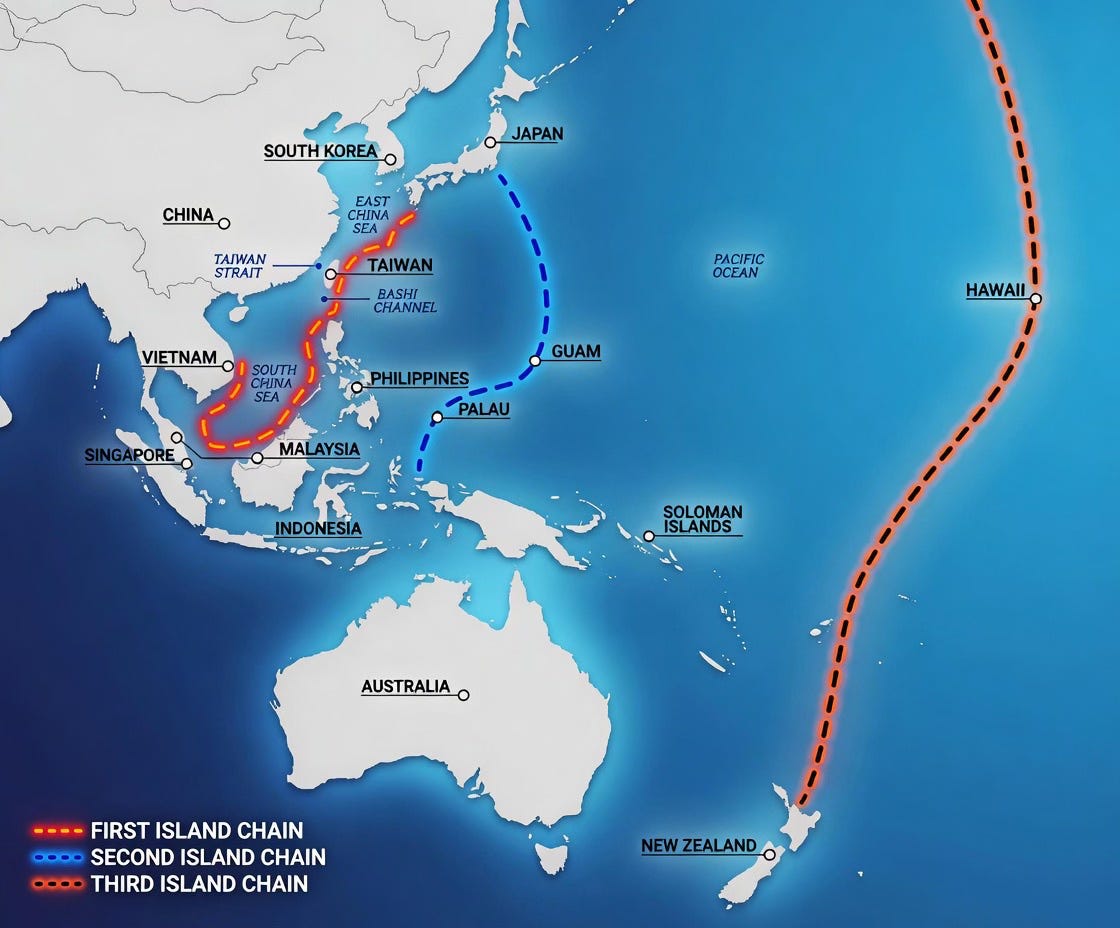
AI image credit: Grok.
The Second Island Chain stems from Japan southward to Guam, Palau & ends in western New Guinea. The Third Island Chain begins in Hawaii, extends through Oceania & ends in Australia & New Zealand.
It’s a big map. Each chain is interdependent on the other. But there is only one “cork” — at least for Beijing — that opens up this entire bottle: Taiwan.
***
UNSINKABLE AIRCRAFT CARRIER
Xi is right about two things. Taiwan is the “most important” bilateral issue as he put it to Trump last week during his state visit to China — and each side has a lot to lose if they ‘mishandle the conflict.’
Simply put, Taiwan is the ‘decisive terrain’ of this war of words between Washington & Beijing. While it isn’t a war in a traditional sense, its outcome — meaning who ultimately controls Formosa — could well determine the outcome of future wars in the Indo-Pacific if the U.S. is forced to militarily defend its interests or that of its allies.
Lose Taiwan and it is a lot harder to contain China — maybe constrain is a better word these days — and to ensure long lasting peace & security in the region. Taiwan’s importance to U.S. national security cannot be overstated.
Gen. Douglas MacArthur famously described Taiwan in 1950 as an “unsinkable aircraft carrier” and noted that it was key to defending against Red China. He warned that “Formosa in the hands of the Communists can be compared to an unsinkable aircraft carrier and submarine tender ideally located to accomplish Soviet offensive strategy.”
He wasn’t wrong in 1950 & he is still right today. Taiwan sits at the geographic center of the First Island Chain.
It is what prevents China from an unimpeded breakout into the open Pacific & forms the gateway to protecting the Second Island Chain from Chinese attack. Or if a surprise attack occurs, then Beijing’s sustainment of that operation.
Last December, Secretary of Defense Pete Hegseth recognized that reality. During a speech in Simi Valley at the Reagan National Defense Forum, he argued that it was essential to ensure that China will not have “the ability to dominate us or our allies.”
To that end, Trump’s 2025 National Security Strategy strongly advocated increasing the forward deployment of U.S. forces in the Indo-Pacific to protect the region — and to deter any Chinese invasion of Taiwan.
So why is it now a negotiating chip?
Especially since Taipei is the dominant semiconductor and a critical-tech hub in the world. 90% of the world’s most advanced semiconductors are produced in Taiwan. If China is able to seize the island, it could — and likely would — devastate the global supply chain & upend the U.S. economy in the process.
U.S. artificial intelligence companies, defense firms, & civilian tech companies would take an immediate, if not irreversible hit. Formosa — tiny as it is — has outsized economic & military importance to the U.S.
In 1950, it was just a physical unsinkable aircraft carrier. Today, it is a hi-tech one capable of sinking much of the U.S.’ economy.
***
59 MILES VERSUS 9,500 MILES
Yes, Taiwan is small. Recently, Trump said “You know, when you look at the odds, China is a very, very powerful, big country. That’s a very small island. Think of it, it’s 59 miles away. 59 miles. We’re 9,500 miles away. That’s a bit of a difficult problem.
It is but it isn’t insurmountable.
Like in regard to Ukraine — when he said, “You don’t start a war against someone 20 times your size then hope that people give you some missiles.” —Trump tends to frequently equate size with strength.
Ukraine has proved that wrong. Taiwan can — and likely will too — so long as Washington doesn’t turn its back on Taipei.
If we do, then it’s likely game over. Our future credibility — on a global basis — would be destroyed & Xi would, whether we like it or not, be crowned king of the world.
***
CHINA IS CHALLENGING US
Beijing is on offense. Especially in the First Island Chain of Defense. China has been building & militarizing artificial islands in the South China Sea. These outposts are being armed with missiles, radars, and airfields to help Beijing break out of its “near seas” enclosure fostered by Dulles’ original blueprint.
Xi has also ordered Chinese naval forces to operate in gray-zone coercion of U.S. allies. For a decade plus, Beijing, on a persistent basis, has been harassing Philippine maritime traffic in the Second Thomas Shoal. Ditto interdicting Japanese naval patrols in the Senkaku Islands.
Even more overtly, Xi has been putting immense direct military pressure on Taiwan by conducting massive drills, encirclement exercises, and invasion rehearsals. Notably, since Russian President Vladimir Putin’s invasion of Ukraine, China has rapidly intensified as well as escalated these demonstrations of force.
Xi is testing the West’s resolve. He doesn’t see Taiwan as a mere bargaining chip. He sees it as China’s winning hand. Not just in the First Island Chain, but the other two chains as well. That is why, on an increasing basis, Beijing is practicing carrier & naval breakout operations to reach the open Pacific.
Notably, China’s efforts to dominate the First Island Chain are not just military in nature. As Michael O’Hanlon and Andrew Yeo noted back in February 2023 for Brookings, Beijing is looking to economically & diplomatically dominate the Pacific Rim.
***
SETTING LONG-TERM CONDITIONS
Xi isn’t just playing for the First Island Chain. He is also aiming to neutralize, if not dominate, the Second Island Chain as well.
Guam — Washington’s own midocean unsinkable carrier — is already being targeted by China. Beijing is developing long-range precision missiles capable of hitting the island and others in the Mariana Islands. This includes the DF-26 “Guam Killer” and other hypersonic deep strike weapons that could undermine Washington’s ability to supply & defend the First Island Chain.
Likewise, Beijing is playing the same economic game — infiltration if you will — in this region as well. As Cleo Paskal, a Non-Resident Senior Fellow at the Foundation for the Defense of Democracies (FDD) warned back in March 2025, “Chinese activities in many of the Pacific island countries have been economically and politically destabilizing.”
Increasingly, Beijing’s actions are becoming more overt in the Pacific islands. In recent years, there have been more cyberattacks and critical infrastructure attacks in Guam. China — slowly, but deliberately — is prepping a future potential battlefield.
Washington, far too often, ignores it. That is particularly short-sighted given the ongoing Chinese oceanographic research vessels that are mapping the region’s seabed. You only do those thousands of miles from Beijing to prep submarine routes & to cut communications cables in the event of war.
China is even taking a page out of the Russian playbook in the Sahel in Africa. It is attempting to sell security services throughout the region as a means of undermining U.S., Australian & New Zealand influence.
***
PHASE 3!
Phase 3 — as envisioned by Liu Huaqing, the commander of China’s navy from 1982 to 1987 — is already underway. Liu, who is considered the father of China’s modern navy, was adamant that Beijing must be able to fully float a truly global deep-water navy by 2050.
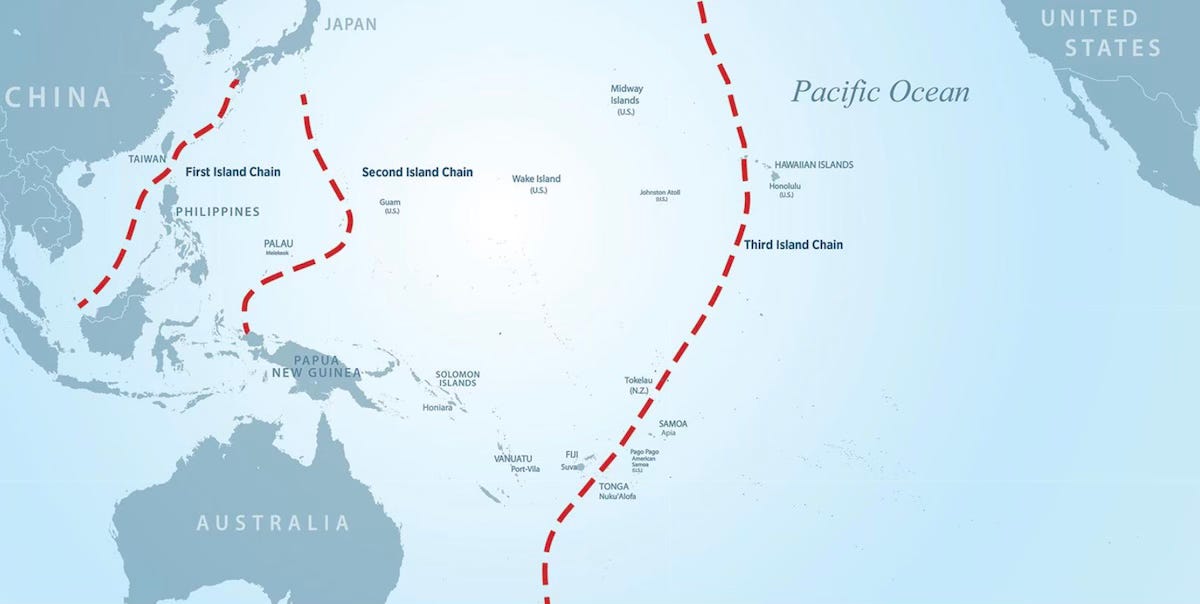
Graphic credit: U.S. Naval Institute.
To achieve that, Beijing has to acquire dual-use infrastructure throughout the Third Island Chain, including ports, airfields, intelligence-gathering capabilities & undersea cables. All of these would be needed in the event of a naval war with the U.S.
Reaching Hawaii, if need be, is the goal. To start getting there, China has been targeting the Solomon Islands, Kiribati, and Vanuatu.
Hawaii is already being targeted by Chinese spy ships, balloons and space-based satellites. Likewise, Beijing is conducting influence operations across the region to undermine U.S. interests & diplomatic influence.
Notably, the Chinese navy is planning to project naval power into the Third Island Chain. AUKUS — the naval alliance between Australia, the United Kingdom & the U.S. — will have its hands full by 2050.
***
CHINA’S RINGS OF FIRE
Taiwan, still, is the U.S.’ first line of defense against China’s increasing rings of fire — economic, diplomatic & military — that are increasingly threatening the entirety of U.S. national security interests throughout the Indo-Pacific.
Trump cannot bargain it away. Beijing gets its long-term value & it’s the same value that Dulles & MacArthur assessed it as in the early 1950s. Taiwan is the key to our security against our country’s true pacing threat.
Quite the opposite, instead of negotiating it away, Trump should be upping the ante for Beijing. Add two more island chains. One anchored by Diego Garcia in the Indian Ocean & another along the Western coast of Africa anchored by Djibouti.
Doing that would truly be ‘Art of the Deal’ worthy. Anything less risks handing Beijing the keys to victory.
***
ICYMI #1
Mark was on TVP World’s Main Edition on Saturday. He discussed the growing distrust between Europe & the U.S., especially with respect to NATO, and the Pentagon’s decision to slash a long-planned rotation of 4,000 U.S. troops to Poland & NATO’s eastern flank.
He agreed, it was a slap to Warsaw’s face. Especially since Trump has characterized Poland as the “model U.S. ally.”
You can watch the full episode here.
***
ICYMI #2
While Mark was hitting the airways in Europe, Jon on Saturday was on Al Jazeera across the Middle East.
Jon discussed three different scenarios that could determine the outcome in the Strait of Hormuz. You can watch it here.
***
Thank you for reading. We will see you tomorrow. Please subscribe, comment & share. We truly appreciate it!
Jon & Mark
Follow Jon on X at @JESweet2022 or on Bluesky at @JonSweet.bsky.social. Follow Mark on X at @MCTothSTL or on Bluesky at @MarkToth.bsky.social.
Thankfully Our team Sweet/Toth is at it again! Another in-depth look at what only intelligent experienced persons can come together to unravel for our absorption! Thanks Gents!
When I think of China as being ‘Hot’ the first thing that comes to mind is this is the second very important meeting tRump (the worlds greatest negotiator) attended where he was humiliated to his face yet he’s so illiterate he had no idea!
Thus time in China so tRump praised Xi and portrayed himself as an advocate of the great leader even after Xi told him in front of the entire world; that basically lAmerica is a Country in decline under his leadership! Yep, once again tRump left another strategically important meeting empty handed! Backed by humiliation with a side of defeat was all tRump came out of the meeting with Xi with!
You’ll appreciate the Sweet/Toth point of view as they look at the Chinese ‘Ring-O-Fire’ which consists of territory and positions China has lined up to dominate now that tRump has made a disaster of Our Middle East presence!