

INTREP360 INTELLIGENCE REPORT
04.12.2026

April 12th, 2026
Greetings!
Finally, 44 days into the war in Iran, the 47th president of the United States finally gets—or at least for the first time is publicly admitting it—that the Strait of Hormuz, as we’ve been assessing since February 28th, is the decisive terrain of this conflict.
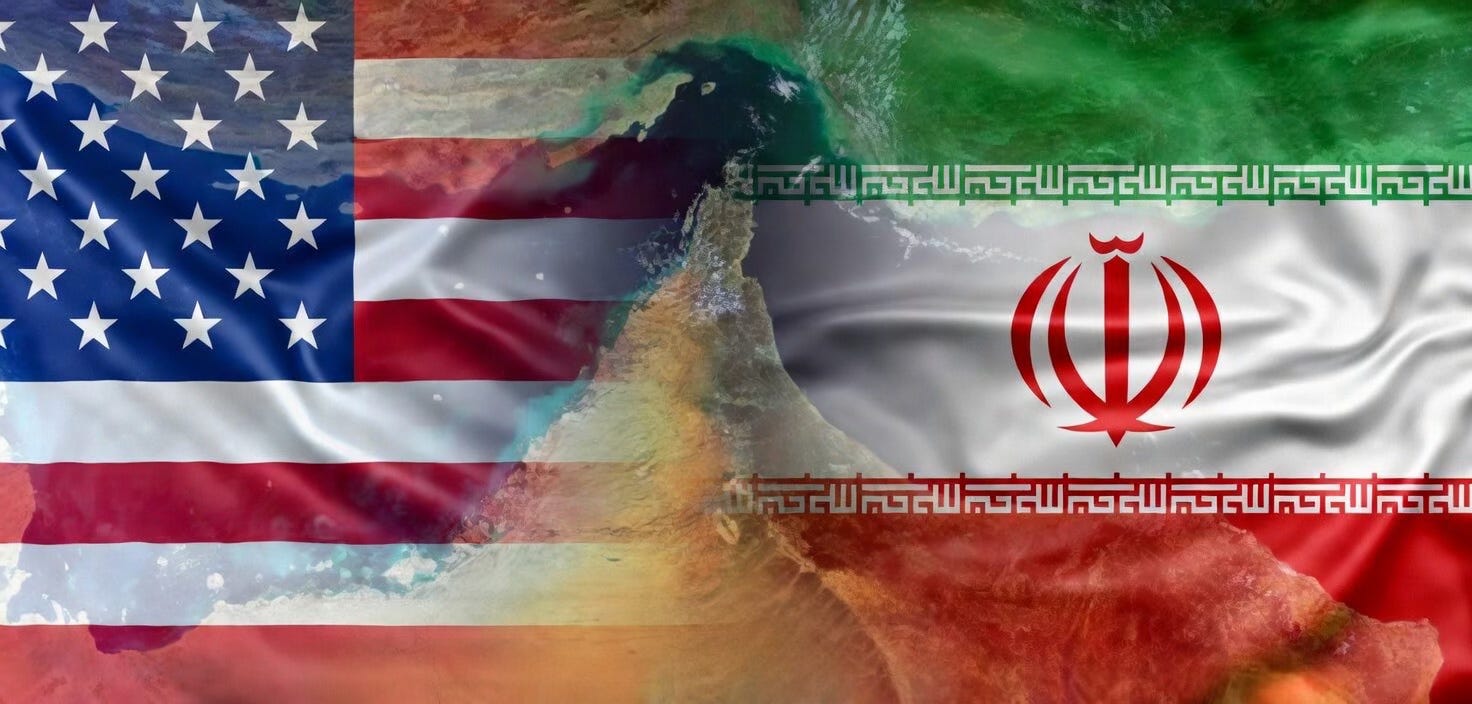
AI image credit: Grok. U.S. & Islamic Republic of Iran flags overlapping the Strait of Hormuz.
Earlier today, in the wake of yesterday’s failed peace talks in Islamabad, and after accusing Iran of “WORLD EXTORTION.” President Donald Trump announced that the U.S. Navy will initiate a blockade of the Strait of Hormuz.
That is a start. However, it still begs the question as to what is the end state? Simply blockading the strait—in our view—likely will not be enough to force an end to the war. Plus, the second and third order effects will have a wider impact—on the Gulf Nation States as well as Europe and Asia Pacific customers.
Especially, since, at least publicly, Trump is continuing to position negotiating differences with Iran as simply revolving around Tehran’s refusal to commit to giving up its nuclear weapons program into perpetuity.
***
In reality, the differences are far deeper. The divide also includes Iran’s refusal to end training & funding of its Islamic Revolutionary Guard Corps’ (IRGC) sponsored proxies—including Hamas, Hezbollah & the Houthis—as well as recognizing the Strait of Hormuz as an international waterway.

Iran’s stance, in our view, is not surprising. Despite Trump’s assertion otherwise, as Mark pointed out here last night, thus far, the U.S. has not affected regime change in Tehran. Faces have changed, but the militant ideology of the 1979 Iranian Revolution has not. Nor will it as long as the IRGC remains in power.
Fundamentally, the IRGC—as we keep reiterating—views its triad of nuclear enrichment, Axis of Resistance proxies, & ballistic missile/attack drone programs as the three pillars of its hold on domestic power inside of Iran & its ability to project power outside of Iran throughout the Middle East—and eventually on a global basis.
***
That ideology can’t be negotiated away. It has to be militarily crushed. If not, then even if Iran temporarily agrees to Trump’s terms, in the long run, the IRGC is not going to adhere to them. As the saying goes, a leopard doesn’t change its spots.
Nor will the IRGC.
Hopefully, and this is key, Team Trump will soon recognize that Mohammad-Bagher Ghalibaf, the Speaker of Iran’s Parliament, is not a man he can negotiate with. Ghalibaf is an IRGC hardliner & even if he wanted to waver, Ahmad Vahidi—the IRGC’s commander-in-chief—is not going to let him.
As Mark pointed out earlier today on Al Qahera News in Cairo, Egypt, Iran was aiming to negotiate from the bottom up, using the Strait of Hormuz card as a means of extracting U.S. concessions on nukes, proxies & ballistic missiles.
***
We suspect—obviously, we can’t know—that Trump’s decision to blockade the Strait of Hormuz has more to do with messaging to NATO than it does in terms of getting Iran to capitulate at the negotiating table.
Essentially, if our suspicion is correct, Trump is telling NATO that it is now or never in terms of going all in against Iran. Not just in terms of militarily opening the Strait of Hormuz, but also for the U.K., Spain, France & Italy to end overflight restrictions on U.S. war planes undertaking military operations in Iran.
In addition to NATO, clearly, it was also Trump messaging Russian President Vladimir Putin & Chinese President Xi Jinping. The unspoken part? Rein in your Axis of Evil ally or else endure the economic pain.
It is a loud message be it to Iran, NATO, Russia, or China. Especially as it relates to oil, liquified gas, & fertilizer. As retired Gen. Barry McCaffrey noted on X, this could create “a catastrophe for our allies and a calamity for [the] global economy.”

Yet, this messaging, due to the economic impact, likely has a very short shelf life as leverage or in Team Trump’s terms, as imposing maximum pressure on Iran. Blockading the Strait of Hormuz won’t be the solution.
Instead, Trump has to find a way to control it.
***
The Iranian regime likely gets that. The IRGC is unlikely to give up the Strait of Hormuz as a negotiating card. We got a glimpse of that yesterday. During U.S. Central Command’s (CENTCOM) mission to force the strait, the IRGC Navy purportedly issued a threat, saying “This is the last warning. This is the last warning.”
Yesterday, it was just a warning. That may soon change. Today, Ebrahim Zolfaghari, a military spokesman for the Islamic Republic of Iran Armed Forces, warned that U.S. “warships nearing the Strait of Hormuz will be met with a firm and decisive response.”

The only question is who fires first. Each side has good reason to argue that it is the other side that violated the ceasefire. Notably, Trump, in a Truth Social post this morning, asserted that Tehran already had, noting that “Iran promised to open the Strait of Hormuz, and they knowingly failed to do so.”
***
There is also one more message that Iran needs to digest. As Mark emphasized on Al Qahera today, Trump sent the IRGC an even louder message yesterday by tapping Vance to lead the U.S. delegation.
Usually, vice presidents are sent to get deals that are 99% there across the finish line & not to begin negotiations. Given that Iran publicly stated that they didn’t trust Steve Witkoff or Jared Kushner, sending Vance was a way for Trump to deliver one last message to the Iranians in terms of his redlines.
What was it?
Namely that there isn’t anyone else to negotiate with now. Ghalibaf in pushing for Vance got what he wanted. But he—and the IRGC—didn’t get what they needed out of it. Vance wasn’t there to capitulate. He was there, in effect, to negotiate, as we noted above, Iran’s complete capitulation to Team Trump.
***
Notably missing at the table for the U.S. yesterday in Islamabad was a hammer. The CENTCOM Commander Adm. Brad Cooper or his deputy, U.S. Army Lt. Gen. Patrick Frank should have been there. Iran saw this as a business deal type of negotiation. They needed to look into the eyes of the men directing the military campaign to destroy its military.
***
So where do we go from here? Chiefly, it is what Jon called for on March 12th—literally, a month ago today—when he took the lead writing for us in The Hill. Team Trump must continue attacking Iran’s center of gravity.
That means the IRGC. It also means the Basij, the regime’s street militia that suppresses—kills, really—internal dissent.
Simultaneously, as we have repeatedly urged here, CENTCOM must seize key terrain in & around the Strait of Hormuz & destroy all remnants of the IRGC intent on targeting shipping. The far side (the Iranian coastline) of the objective (Strait of Hormuz) must be secured—whether it’s a naval blockade or actually securing the strait—and that means boots on the ground supported by U.S. Air Force A-10 Warthogs or Army AH-64 Apache Helicopters in close air support mode.
It won’t be easy but doing so will deprive the IRGC—and any remnants of the Khamenei regime—of their last negotiating card.
Anything less & Trump risks Iran winning and thereby creating an unacceptable strategic defeat for the U.S. in the Middle East.
***
ICYMI!
Mark appeared on First Western TV in Ukraine last week to talk about Ukraine’s drone revolution in military affairs, especially its impact on Russia’s oil export economy. Jon was traveling by air & unable to participate. Our good friend Daniel Tkiie hosted.
Here’s the English version of what was broadcast in Ukrainian.
***
Thank you for reading this special Sunday edition! We will see you tomorrow. Please subscribe, comment & share. We truly appreciate it!
Jon & Mark
Follow Jon on X at @JESweet2022 or on Bluesky at @JonSweet.bsky.social. Follow Mark on X at @MCTothSTL or on Bluesky at @MarkToth.bsky.social.
I think it come to a point where boots on the ground would make the difference, sadly that’s what it’ll take. I still say negotiating with these people is a waste of time, however with the regime suppressing anyone who rises against them, the difficulty in achieving a change in the regime isn’t gonna work. There needs to be the people represented and ending this matter who that would be I have no idea.
The Strait of Hormuz Isn’t the Strategy—It’s the Signal
Lieutenant Colonel John Sweet and Mark Toth make a compelling case that the Strait of Hormuz is the decisive terrain in the current conflict with Iran.
They’re not wrong.
But they’re answering the wrong question.
The focus on the Strait—as blockade, as leverage, as terrain to be seized—misses what actually matters: why it’s being used at all.
Most analysis right now makes three critical errors.
First, it treats Donald Trump’s statements as literal policy instead of strategic signaling. The louder the statement, the more analysts assume inevitability—when in reality, those statements are often designed to provoke reactions, not describe outcomes.
Second, it assumes that the United States can remain insulated from global energy disruption. That’s simply not how oil works. It is not a domestic commodity—it is a globally integrated pricing system. If the Strait of Hormuz tightens, the entire system tightens. There is no opting out.
Third—and most important—it assumes that the objective is regime change.
It isn’t.
We have spent thirty years proving that removing a regime is the easy part. What follows is where strategy fails.
So if this isn’t about regime change… what is it about?
It is about pressure—not on one part of Iran, but on Iran as a system.
Pressure on allies who have been slow to engage
Pressure on global markets that force alignment decisions
Pressure inside Iran that erodes the perception of control
Not to force collapse.
But to change the internal calculation of whether the system is still worth defending.
That distinction matters.
Because Iran today is not collapsing. It is not in revolt. It is in Equilibrium under stress—stable enough to function, unstable enough to matter.
And what happens next depends on whether that stress produces fracture… or adaptation.
My full breakdown—on Trump’s signaling, global oil reality, and why regime change is the wrong lens—is here:
https://rickhoppe.substack.com/p/the-strait-is-not-the-strategy?r=6i79dx