

INTREP360 INTELLIGENCE REPORT
04.03.2026

April 3rd, 2026
Greetings!
Good Friday to you & your family—and to those of our readers who celebrate—Chag Pesach Sameach!
Early on in the U.S.-Israeli war against Iran, we identified the strategic Strait of Hormuz as the decisive terrain of the conflict & we’ve been hammering the point ever since. In U.S. Army doctrine, decisive terrain is what determines mission success.
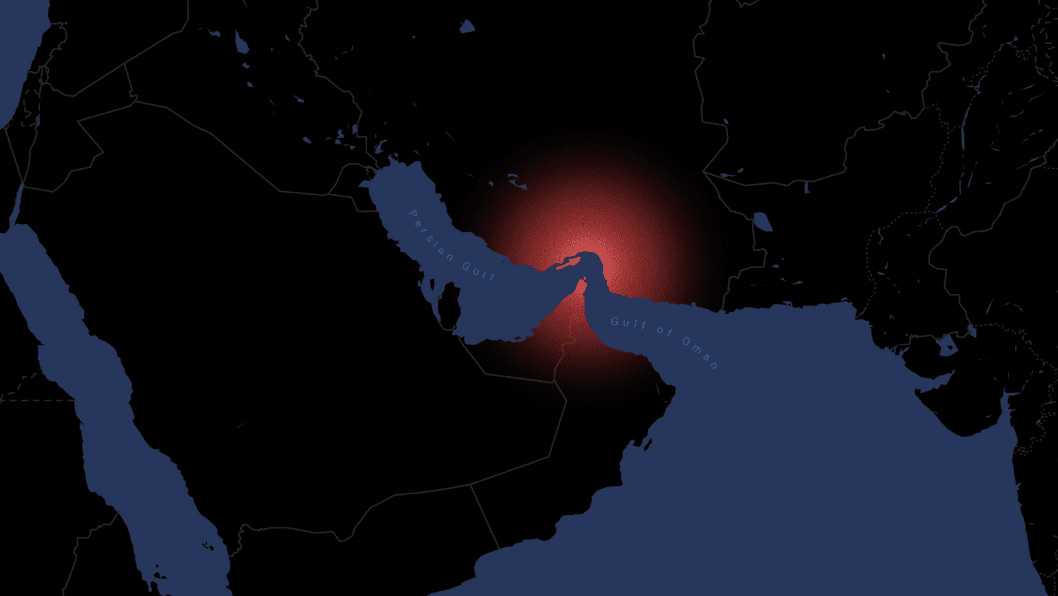
Image credit: United24 Media. Strait of Hormuz.
Control the Strait of Hormuz & you win. Lose it & you risk turning the war into a strategic failure—a modern-day Tet Offensive.
That begs the question as to what should be done about the key strategic waterway. Especially as the war shifts from strategic missions—meaning destruction & denial of domains such as air & naval assets—into operational & tactical target sets.
President Donald Trump—to date—has been coy. Earlier this week, he threatened to walk away from it. We didn’t—as readers here know—buy that threat. Now, he is signaling the opposite. This afternoon, he cryptically posted on Truth Social: “KEEP THE OIL, ANYONE?”

If this were a novel, we’d call it foreshadowing. However, this is war & our gut sense is Team Trump will likely put boots on the ground to secure the Strait of Hormuz. Certainly, we could be wrong. We are not—as we often say here—in the business of making predictions.
Instead, we focus on getting the direction right—and directionally, right now, all signs point to the Strait of Hormuz.
Let’s get started figuring it out!
***
Is there a connection between the firing of Army Chief of Staff Gen. Randy George and the seemingly inevitable introduction of ground forces in Iran?
Maybe. But we’ll have to wait & see how that unfolds.
During his Address to the Nation Wednesday evening, the President told us Operation Epic Fury was “achieving our core strategic objectives” by “systematically dismantling the regime’s [Islamic Republic of Iran] ability to threaten America.” He went on to say that “We are going to finish the job and we’re going to finish it very fast … [and that] we are going to hit them extremely hard over the next two or three weeks.”
Yet Trump still has not provided an end state. All actions point to regime change, but what does a post-war Iran—Persia—look like?
Nor has he provided a solution for the Strait of Hormuz—only that the countries dependent upon oil from the Persian Gulf “must take care of that passage. They must cherish it. They must grab it and cherish it. They could do it easily. We will be helpful, but they should take the lead in protecting the oil that they so desperately depend on.”
But what exactly does ‘helpful’ mean?
***
As the saying goes, “If you’re not part of the solution, you’re part of the problem.” NATO has a problem: the Strait of Hormuz has reached an impasse.
The nations affected most by the closure are pushing back—saying “we didn’t create this problem, this is not our war.”
But the effect—significant increases in the price of oil and other commodities that transit the strait—is their problem.
Despite the President’s comment that the “U.S. imports almost no oil through the Hormuz Strait and won’t be taking any in the future”—it is our problem too.
U.S. oil is sold on the world market—whether we will drill it stateside or from Venezuela—the cost to American consumers is the same. Access to oil is a different story, and that will be the cost to “countries of the world that do receive oil through the Hormuz Strait.”
Reopening the Strait before demand exceeds available supply should be in everyone’s interest—not pointing fingers at one another. There will be plenty of time for that later.
***
But how? Ensuring safe passage of oil tankers through the Strait entails more than just convoy escorts.
Clearing the shipping lanes—and keeping them clear—of mines and underwater obstructions is part of the solution. Minesweeper & mine countermeasure ships are required.
So too are defenses for ballistic missiles, coastal defense batteries, attack drones, submersible drones—Uncrewed Underwater Vehicles (UUVs)—rockets and speed boats while transiting the Strait, and while anchored awaiting passage.
According to the Navy Times, the U.S. still retains four Avenger-class mine countermeasures ships at Sasebo, Japan.
CENTCOM had four deployable minesweepers stationed in Bahrain up until 2025, but they were decommissioned and replaced with three Independence-class littoral combat ships uniquely fitted with a mine countermeasures mission package. The USS Canberra, USS Santa Barbara and USS Tulsa are all homeported right there in Bahrain.
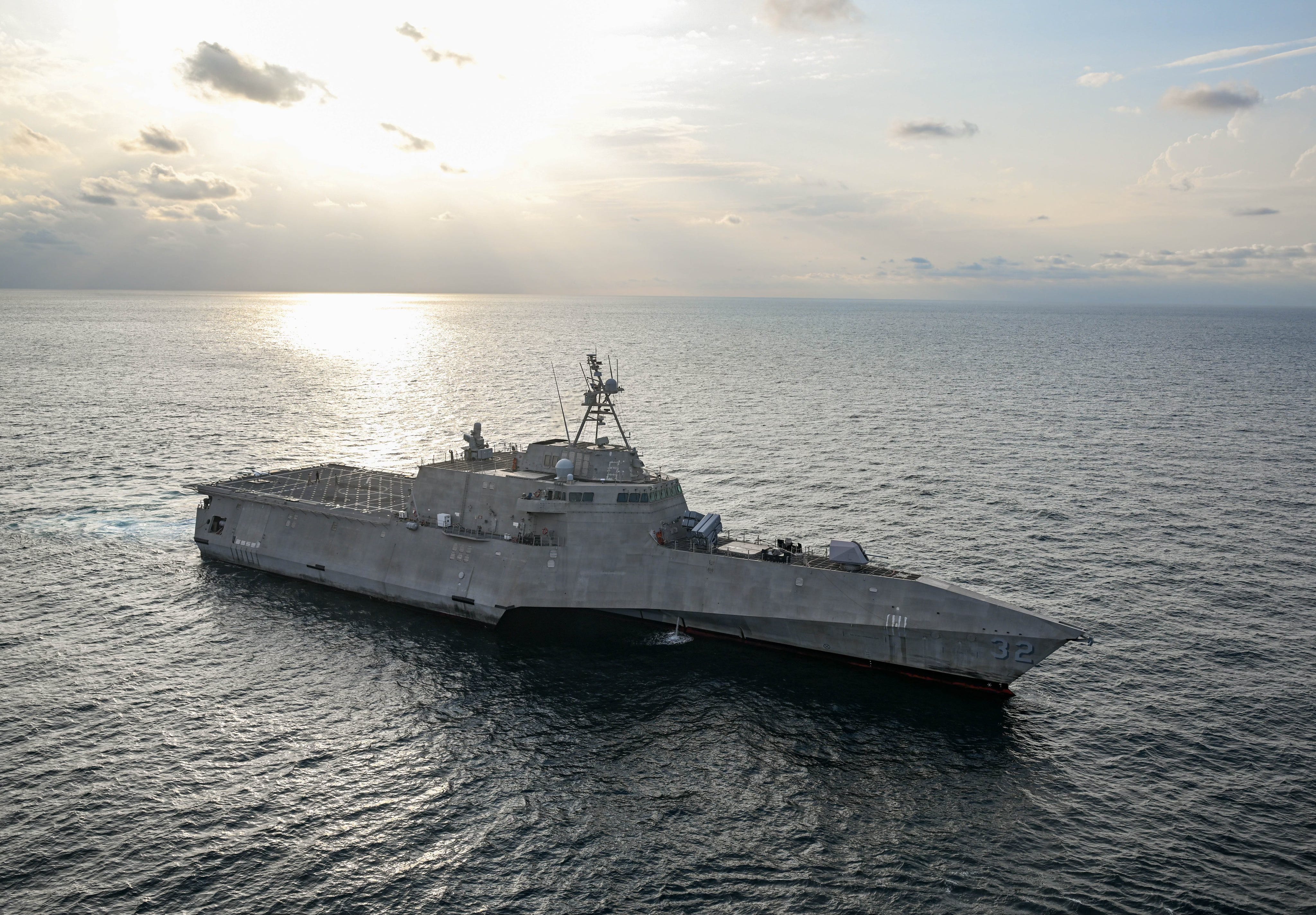
Photo credit: U.S. Navy. USS Santa Barbara (LCS-32).
According to Global Firepower, our allies have plenty of “mine warfare force for neutralizing mines/minefields” and provide an extensive by-country listing. It is a matter of political will—and risk mitigation. NATO requires the former, the U.S. must provide the latter.
***
French President Macron made that clear when he said, “Opening it [Strait of Hormuz] by force is not the option we have chosen, we consider it unrealistic. A military operation would take an infinite amount of time and expose forces to immense coastal and ballistic risks. From the beginning, we have said it must be reopened, but only in coordination with Iran. The world cannot live with a strait that can be opened or closed overnight.”
The alternative for Macron is paying tolls on all ships passing through the Strait of Hormuz—also known as extortion. Iran is already demanding payments of up to $2 million per vessel. Ceding to Tehran the “sovereign role” of the Strait is not the solution. This would be the equivalent of giving the bully your lunch money every day and allowing them to dictate cost.
***
Yet securing the Strait means securing the far side of the objective—the Iranian coastline. This is where the strategic phase of the military campaign transitions into an operational and tactical phase.
Boots on the ground—but not an invasion force, and certainly not an occupation force. This is where U.S Navy SEALs, Marines, Army Rangers, and paratroopers from the 82nd Airborne Division enter the fray.
Their missions would likely involve securing key terrain and conducting raids and assaults along the Iranian coast when threats present themselves—denying the Islamic Revolutionary Guard Corps (IRGC) the ability to attack ships in the Strait.
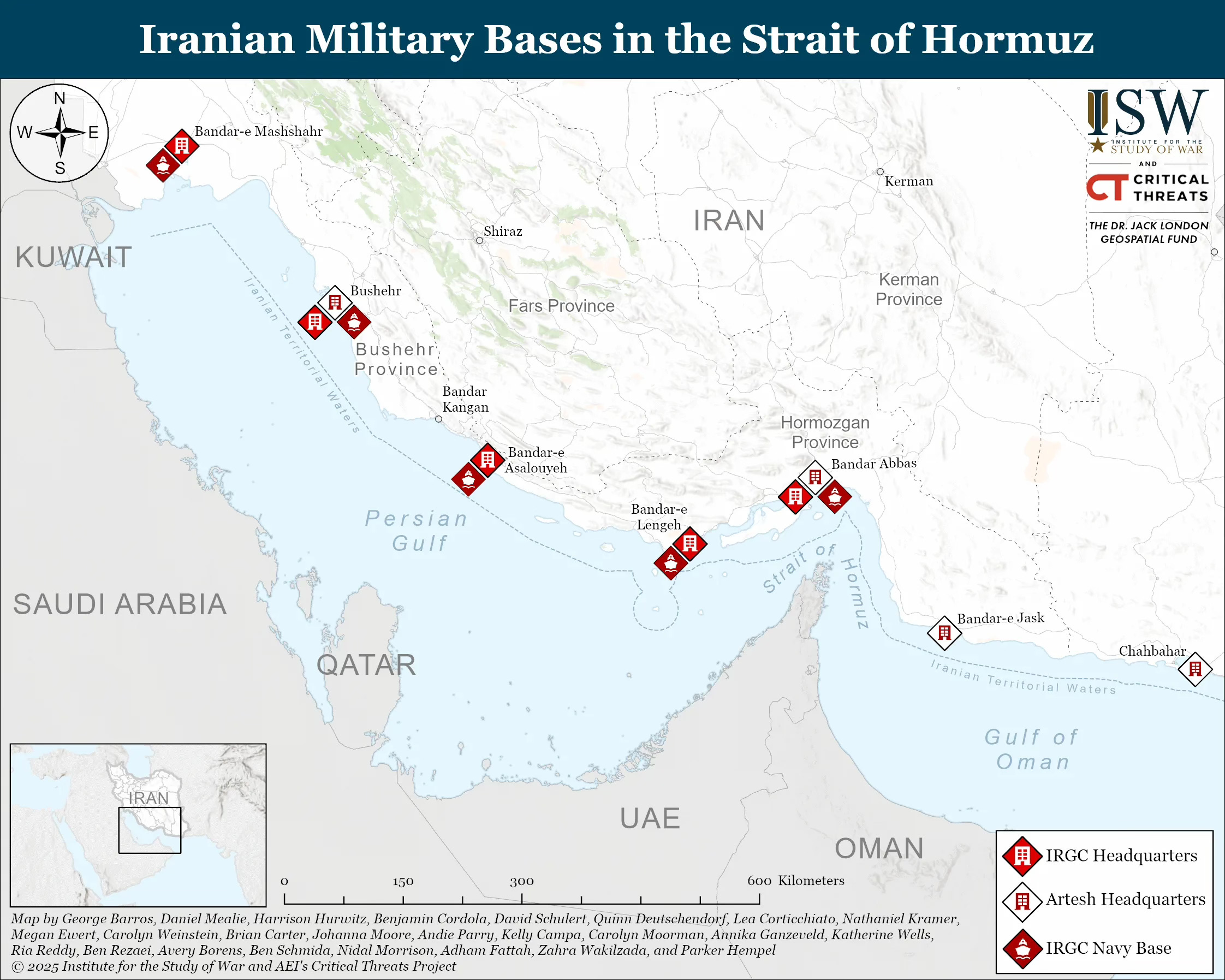
Used with ISW permission. Credit: Institute for the Study of War and AEI’s Critical Threats Project.
Those threats would be identified by persistent surveillance along the coastline, which would queue U.S. Air Force A-10 Warthogs and Army AH-64 Apache helicopters to destroy them and provide close air support to units on the ground tasked with removing the threat and securing key terrain.
The method of their employment may have been what got Gen. George fired—if he disagreed with Secretary of War Pete Hegseth’s plan. As a former battalion commander in the 101st Airborne Division (Air Assault), and commander of the 173rd Airborne Brigade, Gen. George knows a thing or two about Air Assault and Airborne operations.
Retired U.S. Army Lt. Gen. Keith Kellogg—who commanded the 82nd Airborne Division—and others have suggested the U.S. should seize Kharg island, other islands in the Persian Gulf, and islands geographically located in the Strait.
But the presence of U.S. service members—light infantry—on these islands would likely result in attacks from—the Iranian coastline. The end state may eventually become the physical occupation of the islands, but the threat must be addressed first.
***
The U.S., NATO, Gulf nation states and our partners in the Asia-Pacific must coalesce to open the Strait.
They have trained and rehearsed the requirements as recently as February when “CENTCOM hosted the International Maritime Exercise (IMX) 2025, the Middle East region’s largest multinational maritime exercise.”
The exercise “involved 5,000 personnel from more than 30 nations and international organizations committed to preserving the rules-based international order and strengthening regional maritime security cooperation. Hosted by U.S. Naval Forces Central Command (NAVCENT), the 12-day exercise offered a unique opportunity for participants to collaborate and illustrate the importance of regional maritime security cooperation.”
***
The Strait of Hormuz could become Trump’s Tet Offensive—a strategic failure—in what otherwise has been a military success.
***
ICYMI!
Earlier this week, we appeared on First Western TV—they broadcast from Lviv, Ukraine—to discuss how the U.S.-Israeli war against Iran is affecting the war in Ukraine. Our good friend Daniel Tkiie—you can follow him at on X @TkieDaniel—hosted.
You can watch it here. This is the English version. It is also broadcast in Ukrainian.
***
WHAT WE ARE WATCHING!
Tkiie attended a summit in Kyiv that was organized by Gen. David Petraeus—the former CIA director & former commander of CENTCOM—to discuss the latest on the war in Ukraine. During the event, Petraeus hailed heroic Ukrainians fighting for liberty as “Ukraine’s Unbreakable Generation.”
***
Thank you for reading! We will see you Monday. Please subscribe, comment & share. We truly appreciate it!
Happy Easter!
Jon & Mark
Follow Jon on X at @JESweet2022 or on Bluesky at @JonSweet.bsky.social. Follow Mark on X at @MCTothSTL or on Bluesky at @MarkToth.bsky.social.
In Belgium, our prime minister declared that he agreed to send our minesweeping ships to secure the Strait of Ormouz ... AFTER the end of the war ! Like France, presence AFTER the end of the war with Iran! Like the firefighters who come AFTER the fire has ravaged everything or the police officers who arrive AFTER the fight is over. For Ukraine, our EU countries seem motivated by their presence AFTER the end of the war against Russia: they even DARE to name this joint decision 'Coalition of the Willing' (willing : ???). Pathetic. We will pay dearly for this lack of commitment, this weakness and this denial.
I really appreciate you and Jon trying to find reason and sense in the Administration's actions. And flip-flops.
My biggest concern about the "military operation" is two-fold. One, Trump knows very little (nothing?) about war and its consequences. And two, combine that with surrounding himself with sycophants and blind loyalists...these are dark times.