

INTREP360 INTELLIGENCE REPORT
02.02.2026

February 2nd, 2026
Greetings! First off, a huge thank you to our new subscribers. We truly appreciate your readership & we are working on new features to continue to earn your faith in us & what we are trying to build here as a community.
E.g., in the coming months—if not days—we hope to roll out from time to time interviews by us of key national security & foreign policy experts.
Meanwhile, Iran continues to take center stage—and sadly, indeed tragically, Russian President Vladimir Putin continues to bomb Ukraine ahead of this week’s second round of peace talks on February 4th & 5th in Abu Dhabi.
We will have more on Ukraine tomorrow. Tonight—in this special edition of the INTREP360 Intelligence Report—we are focusing on Iran.
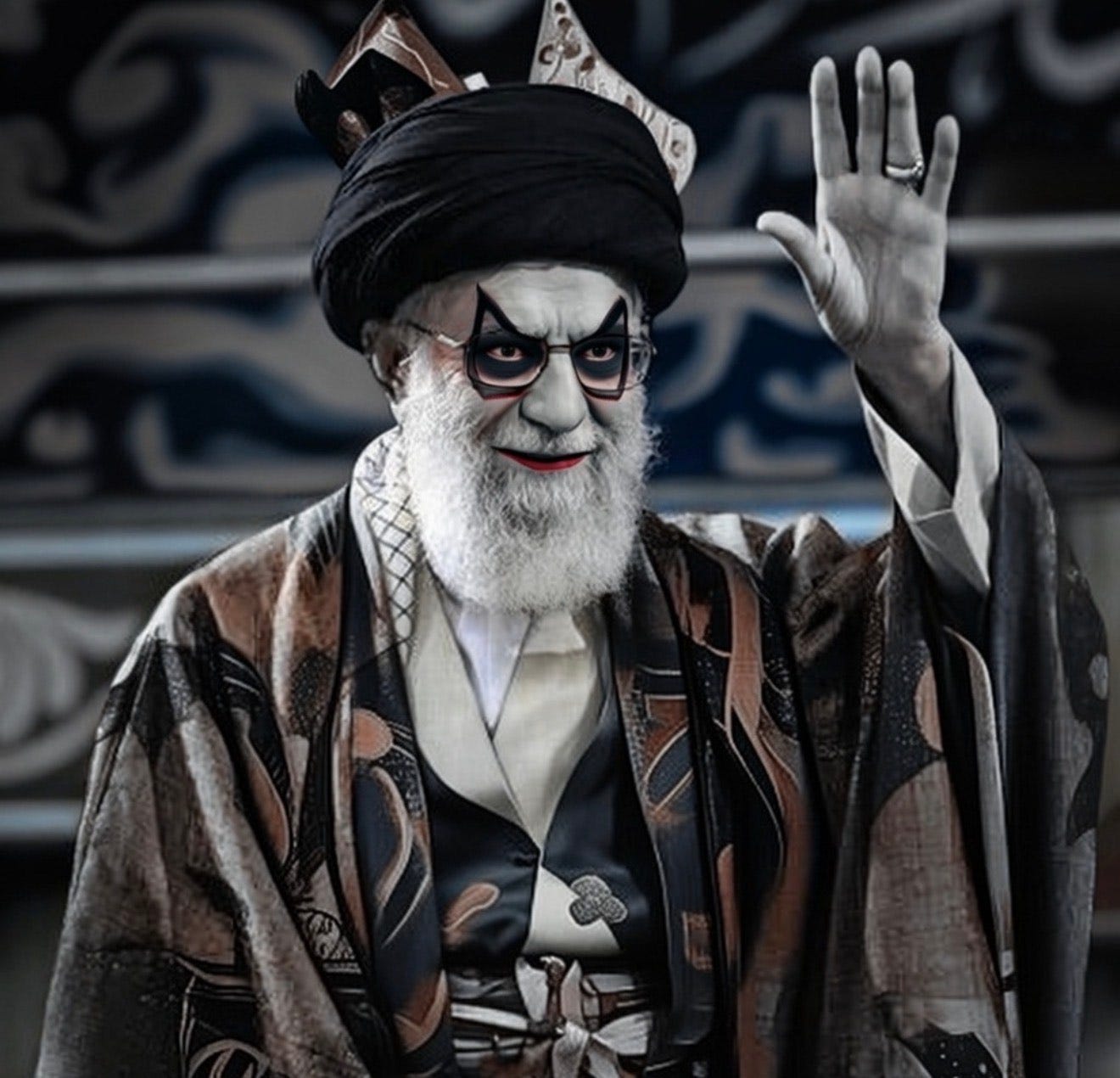
Cover AI-generated image created by Grok. Depicts Iranian Supreme Leader Ayatollah Ali Khamenei dressed as a kabuki theater villain (not a real photograph).
It’s Kabuki theater time in the Middle East. We will do our best to interpret what we are seeing play out while the U.S. buildup of military assets continues in the region.
Let’s get started.
***
Unless your address is 1600 Pennsylvania Avenue and you have a key to the Oval Office, chances are, you don’t know what is happening in Iran. Neither do we, but there are signs if we look past the stagecraft & misdirection.
Both are likely by design.
Strategic ambiguity & maximum pressure—be it for good or bad—have become hallmarks of President Trump’s approach to foreign policy and national security.
For those of us charged with analyzing it, doing so is often like watching kabuki theater in Japan without the benefit of a translator.
Combined, they make for an elaborate global production, replete with highly stylized performative art, trapdoors that intentionally take you down false pathways, and a never-ending revolving platform that changes not just by the day, but the hour.
Our advice?
Ignore the drama in Iran and focus on the vibe. Doing so will likely get you closer to the truth or at least an approximation of it that is still in pre-production.
For now—suffice it to say—Washington & Tehran are on a kinetic collision course. The U.S. military build-up in the eastern Mediterranean and Gulf of Oman is very real.
Its messaging is loud & clear. The Pentagon is forcefully telling Iranian Supreme Leader Ayatollah Ali Khamenei that Team Trump has the military means—if not the ultimate desire—to put an end to his regime & the threat Tehran poses to U.S. national interests.
It is not just mimetic. Dispatching the USS Abraham Lincoln carrier and its strike group to the Gulf of Oman comes at a high strategic cost.
It exposes Taiwan and other U.S. national interests in the Indo-Pacific to potential adverse moves by Beijing.
Nor is that risk merely theoretical. Chinese President Xi Jinping recently purged Gen. Zhang Youxia—his closest military advisor and head of China’s People’s Liberation Army. Zhang—in the eyes of many, was the only top official in Beijing who had enough clout to persuade Xi not to order an invasion of Taiwan.
Xi, of course, has other options. If Iran explodes into a regional war, he could simply order a military & economic blockade of Taiwan––especially if the U.S. gets militarily bogged down in Iran.
U.S. military forces—as they stand—are already stretched between Venezuela & the Middle East. They can ill-afford a third active area of operations. Especially one that is so distant from both current theaters.
That’s why—if we rotate the stage back to Iran—Trump is likely demanding decisive military action. Not just because that’s been his modus operandi to date, be it the killing of IRGC head Qasem Soleimani, capture of Venezuelan President Nicolás Maduro or the bombing of Iran’s nuclear weapons program last June as part of Operation Midnight Hammer.
This is not about a one-and-done strike. It’s likely about quickly getting it decisively done so that the U.S. doesn’t leave itself exposed in the Pacific.
Condition setting to do just that has already started. Not just repositioning of U.S. military assets but actions that may already be kinetic and in play on the ground in Iran—or psy-op in nature.
Need an example?
Consider the curious case of IRGC naval commander Alireza Tangsiri. After an explosion ripped through an apartment building in the port city of Bandar Abbas on Saturday, rumors rapidly spread on social media that he was the target.
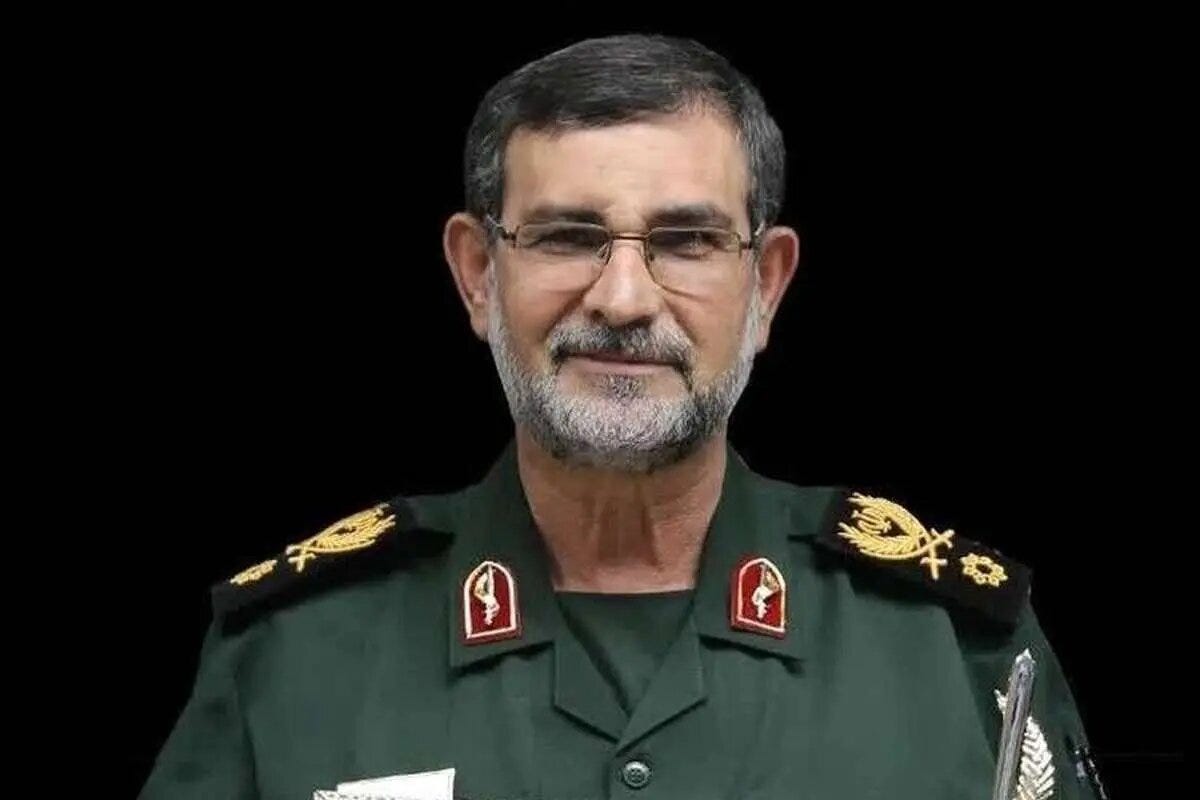
Photo credit: Tehran Times. Rear Admiral Alireza Tangsiri, commander of the Islamic Revolutionary Guard Corps Navy in an undated photo.
If so, it would make a lot of sense. Especially if it were the U.S. military setting conditions for a strike on Iran.
Tangsiri is—was?—in charge of Iran’s fast attack boats that could be used to strike commercial shipping in the narrow Strait of Hormuz if war breaks out. Disrupting its command & control node by killing him would be key.
Tehran, however, vehemently denies he was killed. They claimed it was a gas explosion. Could be or it could have been a CIA or joint CIA-Mossad operation. But operating in kabuki theater mode, the social media storm after the blast could have been a psy-op telling Tangsiri we see you and you are on a list.
Purportedly, Tangsiri released a statement on Sunday via the Tehran Times—a day after his rumored demise—condemning U.S. “hybrid warfare and toxic propaganda.” If that was him—bear in mind that the Tehran Times is friendly to Khamenei’s regime—then he got the intended message.
He’s high on a list. If he is alive—and we suspect he is—be assured he’s constantly looking over his shoulder. Or jumping at the sound of any loud bang.
Trump may have played a personal role here too. Hours later, he reposted on Truth Social a post mocking that “The IRGC are in panic mode, fully sh*tting their pants.”


The U.S. & Israel denied involvement. But of course, they would. Trump’s strategic ambiguity & maximum pressure demand it.
Nonetheless, Khamenei—wisely or not—is likely calculating that he and his regime can survive any U.S. military strike.
We wouldn’t take that bet. While this is kabuki theater now in Iran, it is likely to turn into a kinetic theater of war soon.
Notably, Saudi Arabia—reportedly—told Trump it would be a mistake not to attack. Especially since while Washington & Tehran agree on the redlines—uranium enrichment, IRGC support of militias and Iran’s ballistic missile program—they are at loggerheads over their fate. Khamenei is insisting he keeps them all. Team Trump—rightly—is saying all three must go.
It is an argument Khamenei will lose. Whether he fully understands that or not remains to be seen. There are signs he is worried.
That is where Steve Witkoff—Trump’s special envoy to the Middle East & everywhere else, it seems—is once again taking the stage. Over the weekend, Iran urgently began seeking mediation talks with the U.S.
That is now set to happen this Friday in Istanbul. Purportedly, Iran is willing to agree to zero uranium enrichment to stave off a U.S. attack. Likewise, Tehran is willing to trade its existing stockpile of 400 kilos of 60% highly enriched uranium (HEU) for a deal.
That’s interesting. Especially since Trump has repeatedly claimed—and continues to claim—that the U.S. completely obliterated Iran’s HEU. Ditto its enrichment capacity.
Why trade something if it is gone? Or conversely, why trade for things Team Trump claims that do not exist?
Kabuki confusion at its best.
Let’s clear that up now. It is highly unlikely—in our assessment—that the U.S. destroyed all of Iran’s HEU. Likewise, it is highly unlikely that the U.S. strikes last June destroyed all of Iran’s capacity to enrich uranium to a weapons grade of 90%.
Centrifuges likely still exist. So too does the technical know-how of how to get there if not now, then in the near future.
If Trump backs off of his pledge to come to the aid of the Iranian street protesters—tens of thousands who have likely died—and settles for a nuclear disarmament deal, then Khamenei—in our opinion—will be allowed to survive to once again threaten the U.S. & the region with nuclear weapons.
Khamenei is adamant that Iran becomes a nuclear power. It’s why he is still refusing to give up his ballistic missiles program despite Trump’s threats to resort to the use of U.S. military force in Iran.
Tehran views the missiles as a core deterrent to Israel. Khamenei also knows he needs the missiles to deliver nuclear warheads.
That’s why he is—yet again—playing for time by trying to negotiate with President Trump. Remember as well that Khamenei is not willing to give up his proxies. He sees himself as down but not out.
Kabuki theater or not, don’t be fooled. Nothing has changed here. Iran—no matter what they say or agree to—will aggressively continue pursuing nukes.
We are in regime change territory. We don’t say that lightly. We are decidedly not neocons. We don’t argue—as a primary default position—that preemptive military actions should be the rule & not the exception.
That said, it must be the rule in Iran. The threat Iran poses to U.S. national interests in the region & on a global basis is too great to continue ignoring.
We still assess that Team Trump gets this. Kabuki theater works both ways. Trump is likely playing for time while the U.S. continues to build up the capacity to strike decisively & protect U.S. interests & allies in the region.
This does leave one unanswered question & admittedly it is a big one. Who will be left in charge of Iran if Khamenei & his regime is toppled? The White House—seemingly—doesn’t believe it will be Crown Prince Reza Pahlavi.
If not him, then who? Our answer? Pay attention to who falls through the trapdoors & who is still standing after the curtain drops.
Team Trump is likely still trying to cast that role.
***
Thank you for reading! We will see you tomorrow. Please subscribe, comment and share. We truly appreciate it!
Jon & Mark
Follow Jon on X at @JESweet2022 or on Bluesky at @JonSweet.bsky.social.
Follow Mark on X at @MCTothSTL or on Bluesky at @MarkToth.bsky.social.
Love this perspective! The Grok AI image and Kabuki analogy really nail it. You guys help make sense of such complex politcs.