

INTREP360 INTELLIGENCE REPORT
04.01.2026

April 1st, 2026
Greetings! It is Day 33 of the war in Iran. Earlier this evening—in a highly-anticipated speech—President Donald Trump addressed the nation to provide an operational update about the ongoing U.S.-Israeli military operations.
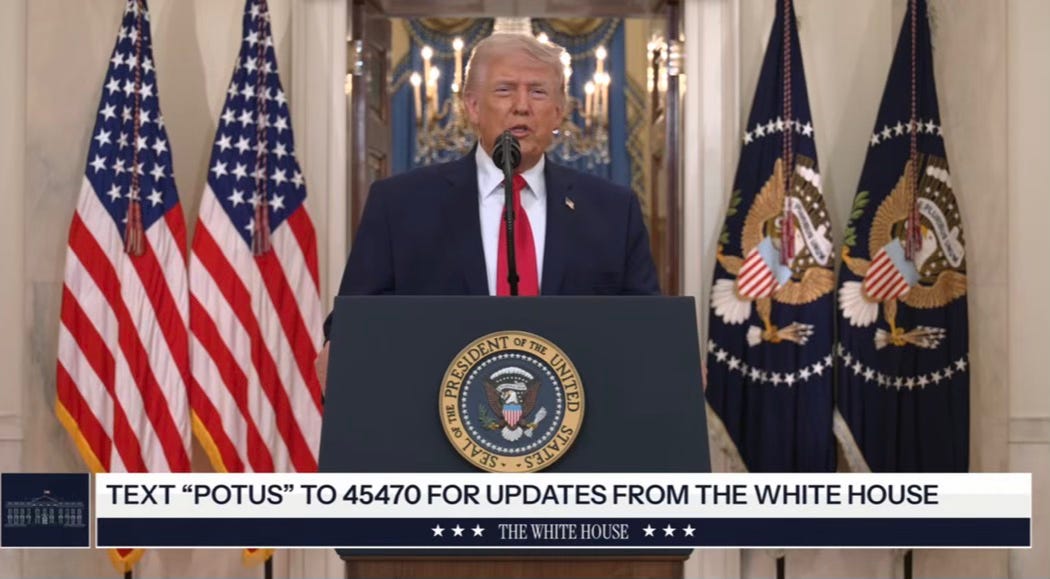
Photo credit: White House. President Donald Trump addresses the nation on April 1st, 2026.
Predictably—despite our best efforts here last night—initial reactions to Trump’s speech are mirroring the partisan divide in the U.S. Sen. Chuck Schumer (D-NY), the Senate Minority Leader, quickly panned it claiming that “Donald Trump’s actions in Iran will be considered one of the greatest policy blunders in our country.”
Sen. John Cornyn (R-TX), lauded Trump’s speech and praised it for making it “clear that Iran will never have a nuclear weapon.” From there, it was a partisan back-and-forth tennis match in reactions to Trump’s war against Iran. Many Democrats believe it to be folly, while many Republicans view it as the best thing since sliced bread.
Our take?
It is way too early to be etching epitaphs into tombstones.
Instead, here is our apolitical—and this, as always, means non-partisan—take on Trump’s speech including the good, the bad & the ugly.
Let’s get started.
***
Most significantly for us—especially since we are viewing his address solely through the lenses of U.S. national security—Trump made it clear tonight that he is continuing the mission in Iran & that he is not seeking an immediate off-ramp despite political & economic domestic pressures to do so.
That is key.
Trump—whether you agree with him or not—is giving Adm. Brad Cooper, the Commander of U.S. Central Command (CENTCOM) the time & space that he and American forces require to complete their mission of destroying Iran’s military capacity to project force—including exporting terrorism—beyond its borders.
For now, that means two or more weeks of continued U.S. attacks on Iran. In our view, Trump’s vagueness here tonight means Cooper will get more time if he & his operational commanders on the ground in the Middle East deem it essential to ensuring a successful prosecution & end to the war in Iran.
Strategic patience in wartime is key. Last week—in our weekly national security column at The Hill in Washington, D.C.—we heavily criticized Trump over his strategic impatience over the wars in Ukraine & Iran.
As such—for now at least—it is a much-needed sign that he is exercising strategic patience in Iran to ensure victory.
***
Unconditional surrender—remember Trump called for it on March 6th—was absent without leave from tonight’s speech. That is telling because in recent days Trump has publicly suggested he is willing to declare victory even if the Strait of Hormuz remains closed or severely restricted to oil tankers transiting the strategic waterway.


Our take as to why?
He is still angry with NATO over its refusal to actively contribute to the ongoing U.S.-Israeli military effort in Iran, especially as it relates to the Strait of Hormuz. Trump is also furious that France, Spain & now Italy are refusing to allow the U.S. to use American military bases in those countries for ongoing operations.
Let’s be clear here—as we urgently call for tomorrow at The Hill—cooler heads need to prevail in Washington, London, Brussels, Paris & Berlin. Trump’s transatlantic bullying is understandably wearing thin in Europe. Yet, of late, Europe is also far too willing to let the U.S. & Israel do the heavy lifting in the Mideast—meaning fighting—while only offering to help after the ballistic missiles & drones stop flying.
Europe can & should do more. Ditto NATO. If the Islamic Republic of Iran survives to fight another day & ends up controlling the Strait of Hormuz, it is Europe that will suffer the most in terms of spiking oil costs.
To that end, it behooves Europe to convince Trump to return to his earlier position of demanding unconditional surrender in Iran. Likewise, unless Team Trump wants to give easy wins to Russian President Vladimir Putin & Chinese President Xi Jinping, he needs to reset his relationship with NATO & base it on mutual respect.
***
To that end—despite many in the media speculating otherwise, Trump didn’t announce tonight that he was effectively withdrawing from NATO.
That’s a good thing.
As we warned here last night, the U.S.—as a force projection military—relies heavily on its bases in Europe for logistics, staging & conducting operations. Especially operations designed to protect commercial & naval shipping in the Suez Canal, the Red Sea, Horn of Africa and the Persian Gulf (including the Strait of Hormuz).
***
Notably, Trump went out of his way tonight to reassure the Gulf State allies—especially Saudi Arabia, the United Arab Emirates (UAE)—that the U.S. would not abandon them in the face of Iranian aggression. Privately, the two of us had discussed yesterday how much Riyadh & Abu Dhabi were in the face of Trump’s threats to walk away from securing the Strait of Hormuz.
So much so that we speculated that Saudi Arabia & the UAE were receiving private reassurances from the White House to ignore Trump’s public rhetoric which was solely aimed at NATO—and at the United Kingdom, France, Germany, Spain & Italy in particular.
That suggests—confirms in many ways—that Cooper still assesses—as do we—that the Strait of Hormuz remains the decisive terrain of this war. To reiterate what we said here last night, abandon it and it likely results in a Pyrrhic victory. Control it post war & Washington will win the war outright.
***
In that vein—and we concur with Brett McGurk here (he is a former U.S. diplomat)—that we are likely headed for escalation in Iran based on what wasn’t said in Trump’s address to the nation this evening.

It likely could come in two places, if not both. Cooper isn’t amassing a sizable amount of U.S. ground forces—9,500 Marines aboard the USS Tripoli & the USS Boxer and 10,000 82nd Airborne infantry paratroopers—as an exercise in logistics & war time deployment.
He likely intends using them to secure key terrain—not all of it—around the Strait of Hormuz and potentially to secure the 440.9 kilograms of 60% enriched uranium believed to be entombed in Isfahan & Natanz.
If so, it is understandable—despite criticism tonight otherwise by partisan critics—that Trump didn’t offer any clarity here. You don’t telegraph your military intentions to the enemy unless you want to get your own troops killed or wounded.
***
Now for the bad. Trump is backing off of regime change despite his earlier assurances that help was on its way to the Iranian street protesters. While he referenced 45,000 of them who—purportedly—have been killed by the Iranian regime since December 28th, he only did so in context of the threat Iran—especially a nuclear Iran—poses to Americans.
Despite killing Ayatollah Ali Khamenei & a host of other top regime officials—including their replacements—Iran’s regime remains entrenched & in power. Until its center of gravity is destroyed—meaning the Islamic Revolutionary Guard Corps (IRGC) & the Basij, Iran’s paramilitary street enforcers—the regime will not likely collapse.
To achieve that, CENTCOM must continue hitting key regime leadership, IRGC command & control, Basij checkpoints, and weapons & munitions depots. Persistent pressure is what is required. No sanctuary, be it space or time should be afforded.
Regime change—when it comes to Iran—is not a dirty concept. Eliminating Ahmad Vahidi, the new head of the IRGC, and his ilk is the only way to avoid a rinse and repeat future in Iran going forward.
***
Now for the ugly. The U.S. does not need to make more enemies in the Middle East, especially among innocent Iranian civilians.
Bombing Iran into the “Stone Age”—as Trump threatened to do tonight—must not be an option. We get it. That messaging was aimed at Vahidi & Iran’s political leadership. That said, blanket threats—such as destroying Iran’s power stations all at once—would not serve any legitimate military purpose.
Doing so would only cause immense—and needless—human suffering. Selective targeting of dual-use military facilities—if it comes to that—is okay. But Adm. Cooper needs to limit it to just that.
***
Lastly, it was notable that Pakistan and its role as a peace mediator didn’t come up in tonight’s speech. Nor did the joint Pakistani-Chinese peace proposal to re-open the Strait of Hormuz. That tells us Trump values the strategic control of the strait more than he was willing to let on this evening during his address.
Hang on. This roller-coaster of a ride in Iran isn’t over.
***
PROGRAMMING NOTE!
Tomorrow, our weekly 7:00 AM ET national security column at The Hill in Washington, D.C., focuses on Trump’s threats to retaliate against NATO over its failure to support the U.S. in the war against Iran.
NATO––and all of Europe––is in Trump’s crosshairs.
You can read it here when it goes live.
***
Thank you for reading! We will see you tomorrow. Please subscribe, comment & share. We truly appreciate it!
Jon & Mark
Follow Jon on X at @JESweet2022 or on Bluesky at @JonSweet.bsky.social. Follow Mark on X at @MCTothSTL or on Bluesky at @MarkToth.bsky.social.
Looks like regime change is still on the menu.
Trump's continued humiliations of EU countries have made Europeans as resentful as Trump himself. There is nothing positive in this for either side, only benefits for our enemies. We Europeans have a short-term perspective: we will pay a heavy price for our weaknes in the face of the TRUE enemy: the axis of evil.