

INTREP360 INTELLIGENCE REPORT
06.17.2026: DID TRUMP JUST SURRENDER TO IRAN?

June 17th, 2026
Greetings!
Forgive the gallows humor, however, we cannot help but observe the French do like their surrenders. Bear in mind, this was Mark’s characterization and he makes it as the grandson of a man born in France in 1895.
President Donald Trump, while dining with French President Emmanuel Macron earlier this evening at the Palace of Versailles outside of Paris, signed the Memorandum of Understanding (MOU) between the U.S. and Iran.
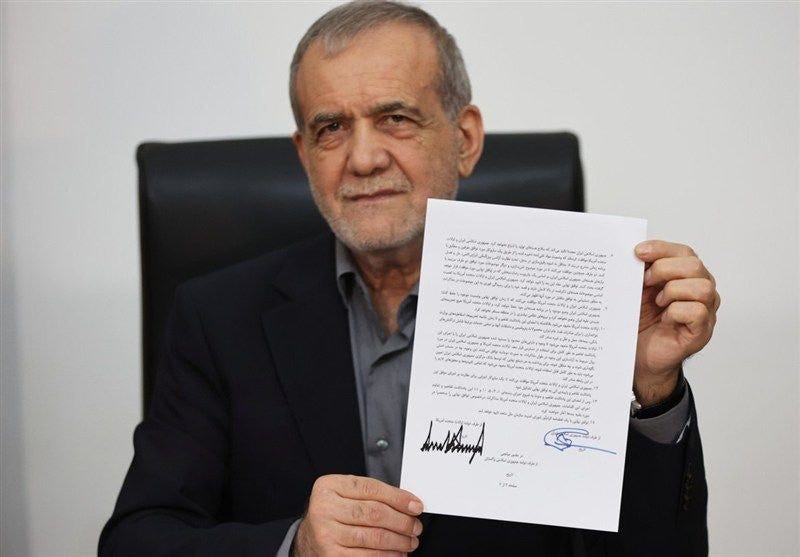
Photo credit: Islamic Republic of Iran Broadcasting. Iranian President Masoud Pezeshkian holds up the signature page of the MOU entered into between the U.S. and Iran on June 17th, 2026. It bears President Donald J. Trump’s signature and his.
Shortly afterwards, in Tehran, Iranian President Masoud Pezeshkian, acting on behalf of the Islamic Republic of Iran, signed the MOU as well.
It was not immediately clear what was different from what Vice President JD Vance claimed that he and Trump signed on Sunday.
Yet here we are. It is signed now.
While Trump did not surrender in a military sense to Tehran, he certainly, in our view after reading the MOU, surrendered the negotiating initiative to Iran. Especially as the two sides now enter into a 60-day window — a window that can be mutually extended — to finalize a permanent peace deal between the U.S. and Iran.
Let’s get started understanding how. To be honest, we are still not sure ‘why’ save Qatar’s $1 trillion investment pledge in the U.S.
***
THE MOU IS FRONT-LOADED IN FAVOR OF IRAN
As we warned earlier today in The Washington Star, Trump’s deal — or is it really Vance, Steve Witkoff and Jared Kushner’s deal? — is front-loaded in favor of Iran. Tehran’s obligations under the agreement are largely oblique, while it is very specific about what Washington is obligating itself to.
Candidly, that is just — well, you know the expression — half-ass backwards. Tehran was losing the war and yet negotiated an MOU that appears as if the U.S. was losing to Iran and that Trump and company had approached the Iranian regime desperately carrying a large white flag of surrender.
WHAT DOES IRAN GET UPFRONT?
First and foremost, Iran immediately begins to receive critically needed revenue. While it will take time for it to return to prewar levels, Tehran eventually will be receiving $500 million a day in oil and gas revenue as a result of Trump’s immediate lifting the military blockade of Iran’s western and southwestern seaports.
To put that in perspective, that is $30 billion, if maxed out, over the 60-day negotiating table. Compare that to former President Barack Obama indirectly releasing $1.7 billion in Iranian frozen funds as part of the Joint Comprehensive Plan of Action (JCPOA).
The math is not even close. And that’s before you consider that the MOU provides for a $300 billion reconstruction fund for Iran.
Trump took great pains today, during his closing press conference at the G7 Summit in Geneva, Switzerland, to argue that Tehran’s access to the fund is performance-based and that it is its own money.

One, the agreement only implies it is performance-based. There is no specific mechanism that triggers it or stops it. Two, Trump’s argument is very similar — as many critics of the deal pointed out on X — to the Obama Administration’s justification of the $1.7 billion asset transfer.
Plus, if you add the two together — oil and gas revenue and reconstruction (which in our view feels more like reparations) — it equals $330 billion or over 194 times larger than what Obama authorized to Iran.
Granted, Iran was generating oil revenue, however, it is the rapid flood of cash and size of it that we are concerned about. It is a near certainty that Brig. Gen. Ahamd Vahidi and the Islamic Revolutionary Guard Corps (IRGC) will siphon of most of those funds to sustain itself as well as its Axis of Resistance proxies, including Hamas, Hezbollah and the Houthis.
As we emphasized in our piece at The Washington Star, it is highly likely the IRGC will use those revenue streams to plan and execute new attacks against U.S. and Israeli interests as they did during the October 7th massacre.
For now, Iran’s nuclear program under the MOU remains frozen as it is. Tehran is under no obligation during the 60 days to begin dismantling it or to provide access to its nuclear sites to the International Atomic Energy Agency (IAEA).
That is madness. Essentially, the U.S. will be negotiating in the blind to make sure Iran never has a nuclear weapon, or as Trump emphasized today in Geneva, that Tehran will never be allowed to buy one.
Yet, equally notably, the MOU does not cover how and to what extent Iran must dismantle its nuclear weapons program. The only provision is that Iran, at a minimum, must down-blend its 19,000 pounds or so of low- and highly-enriched uranium.
Bear in mind that even if Iran down-blends its uranium stockpiles to 3.67%, the amount needed for a nuclear fuel rod to power atomic energy, the MOU does not stipulate that the down-blended uranium be shipped out of the country. That’s a glaring and dangerous omission. 3.67% enriched uranium is 70% there in terms of achieving weapons-grade.
That is significant when you consider the MOU makes no mention of Iran’s centrifuges or future right to build new ones. They already possess the capability. As it is, up until now, Iran’s modus operandi has been to build all the parts needed for a bomb.
What is to stop them from doing that again?
Iran also retains control of the Strait of Hormuz during the 60-day negotiating period. Plus, based on public statements, Tehran is already working with Oman to maintain control of the international waterway by charging ‘administrative fees’ versus ‘tolls.’ Either way, both are violations of international law.
***
WHAT’S MISSING?
The MOU makes no mention of Iran’s ballistic missile and drone programs. That is significant since the Trump Administration argued its existence, especially Tehran’s focus on building intercontinental ballistic missiles that could reach the U.S., were part of it’s the White House’s justification for immediately waging war on Iran.
Remember, Secretary Marco Rubio himself said that Iran’s ballistic missiles and drones were becoming such a serious threat that if the U.S. waited, it would be difficult, if not impossible, to attack Tehran.
Yet now, any mention of them is missing in action in the MOU. Israel is not going to find that acceptable. Israeli Prime Minister Benjamin Netanyahu sees Iran’s ballistic missile program as an existential threat to Israel.
Of equal concern, Hezbollah — and by extension the IRGC — essentially gets a pass in the MOU. Israel is expected to go easy on the IRGC-backed proxy, but the MOU stipulates no penalties if Tehran cannot control or on a ‘wink, wink’ basis stop Hezbollah from launching rocket attacks on northern and central Israel.
Perhaps most tragically, from the standpoint of the Iranians, is the lack of any hope for the protesters who started rising up last December. Their dream of toppling a brutal and bloody regime that has massacred tens of thousands of civilians since 1979 is, at least for the foreseeable future, effectively over.
Not only were the Iranian protesters left out of the deal. The U.S. agreed to not interfere with Iran’s internal affairs. So much for Trump’s pledge that help was on its way.
***
WHAT DOES THE U.S. GET?
Frankly, the U.S. does not get much out of this deal except economic relief as a result of oil prices that immediately began dropping once the deal was announced. That is no small change, but the U.S. did not go to war to create economic gains for itself.
Those were already in the books.
It went to war to put an end to the regime and to permanently put an end to Iran’s nuclear weapons program. Thus far, the U.S. has not achieved either.
***
CAN IT GET BETTER?
We have our doubts this will get ay better. If it does not, it will be the worst U.S. strategic defeat in the history of our country.
Mohammad Bagher Ghalibaf, the Secretary of the Iranian Parliament, was already bragging on Wednesday that Iran was going to become part of a new world order with China. Trump may want to close the door on Iran, but he is foolishly, in our view, opening the door wide open for Chinese President Xi Jinping.
Plus, the damage to the U.S.-Israel relationship is very real. Trump kept publicly humiliating his war ally while inexplicably praising Hezbollah and Hamas during his press conference (yes, you read that right).
It can only get better if Trump stops negotiating against himself. However, after today’s presser in Geneva and Vance’s strained defenses of the MOU he allegedly principally authored, we fear Trump wants to get away from Iran as fast as he can.
If so, we never thought — at least symbolically speaking — that the U.S. would be raising a white flag of surrender on July 4th, 2026, its 250th birthday. However, here we are and we as a nation are headed in that direction.
Yankee Doodle Dandy that.
***
PROGRAMMING NOTE
Tomorrow, in our weekly Thursday 7 AM ET national security column at The Hill in Washington, D.C., we outline how Russian President Vladimir Putin is like the Titanic. He has hit an iceberg in Ukraine and Russia is sinking fast.
You can read it here when it goes live.
***
ICYMI #1
Earlier today, in our regular weekday foreign affairs column for The Washington Star, we urgently warn the president and his national security team that they are negotiating against themselves in Iran.

Screenshot credit: The White House. Howard Lutnick and Marco Rubio have different reactions to President Trump’s press conference on Wednesday in Geneva, Switzerland.
You can read it here. It is not paywalled at our request.
***
Thank you for reading. We will see you tomorrow. Please subscribe, comment & share. We truly appreciate it!
Jon & Mark
Follow Jon on X at @JESweet2022 or on Bluesky at @JonSweet.bsky.social. Follow Mark on X at @MCTothSTL or on Bluesky at @MarkToth.bsky.social.
And we are not gaining anything economically. Oil prices may return to where they were before, but that's not a "win."
Prices of consumer goods may eventually drop. It will take longer though, and may never drop all the way to pre-war levels.
And economic losses globally from the disruption of agriculture fertilizer may even cause a much larger problem in the future globally.
Am I the only one thinking this is the stupidest thing the administration can do? I have a lot of words I would like to say about this fiasco of a “MOU” I have ever heard. In what way does any of this make sense. I know there has to be some people in the administration that are considering resigning from their positions. I can guarantee some are tired of beating their heads against the wall. A trillion dollars doesn’t mean anything if they are still going to do the same thing they have been doing and will continue to do in the future. Such damn shame.