

INTREP360 INTELLIGENCE REPORT
04.22.2026

April 22nd, 2026
Greetings!
Early on, during our writing partnership, Mark — having lived in the Middle East for nearly eleven years — made the analogy that understanding the region is akin to looking through a kaleidoscope. One twist of the lenses, and everything you thought you understood, suddenly changes & takes on a new dynamic.
It is a complex region to understand.
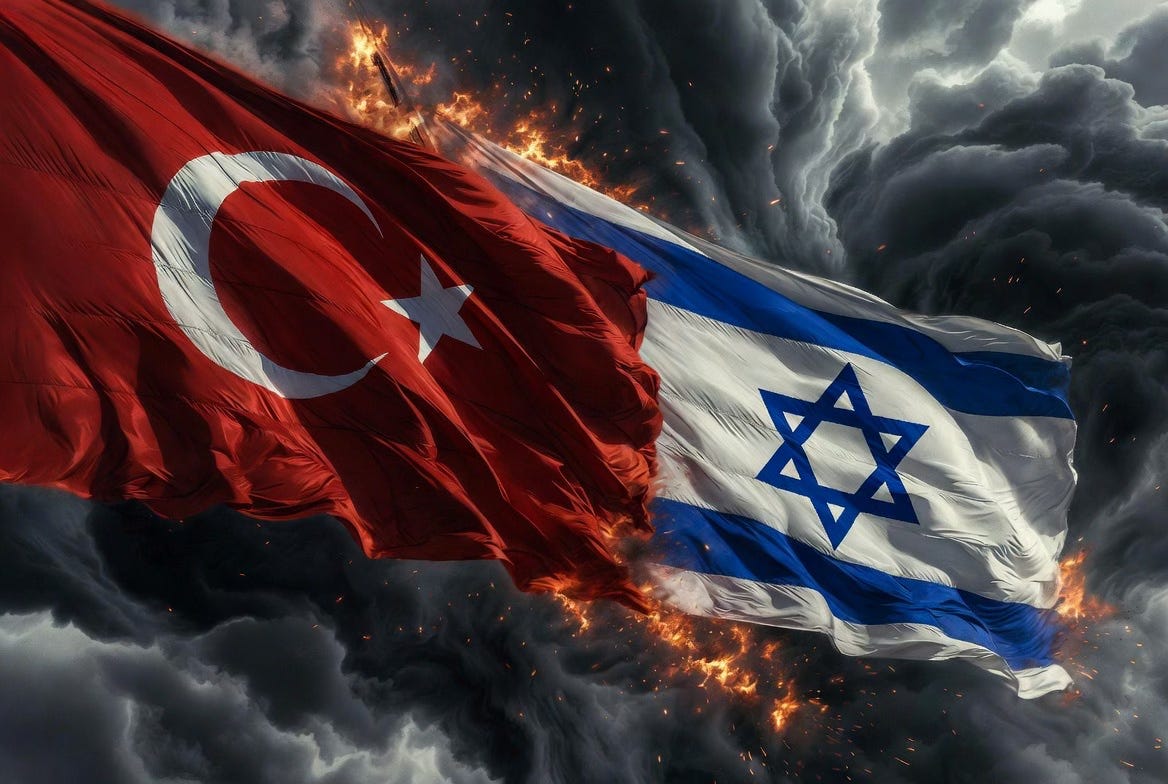
AI image credit: Grok. Turkish & Israeli flags clashing in a fast-shifting Middle East in the wake of the U.S.-Iran war.
Grasping it, in our view, requires taking an archaeological approach, digging up layer after layer of history, competing cultures & religions, and understanding how geopolitics — especially World War I, World War II & the Cold War — has shaped the Mideast.
Ditto the founding of the State of Israel in 1948, the emergence of 20th-century Arab nationalism — think Gamal Abdel Nasser, the president of Egypt, Hafez al-Assad, the president of Syria & Saddam Hussein, the president of Iraq — and the rise of the Islamic Republic of Iran in 1979 & its Axis of Resistance.
It is also a region that just in the last 78 years has fought its own wars, been ensnared by proxy wars between the U.S. & the Soviet Union and has devolved into civil wars & acts of terror chiefly brought about by religious infighting between Shias & Sunnis.
Plus, even at the granular level — its people — it gets even more layered. For example, the ongoing influence of tribal politics especially in the Gulf States. The parallel displacements of Palestinians & Jews, and the influx of European & U.S. immigration into Israel.
Now, the war in Iran is shifting that kaleidoscope again. Arguably, since 1979, the region has largely been shaped by Iran’s ongoing war — initially asymmetrical, now increasingly direct — against Israel.
If the regime falls in Tehran — or if it is severely weakened for some time to come — the vacuum it would create likely will shift the conflict to a regional military power struggle between Turkey and Israel.
Let’s get started examining how that shift has already begun.
***
DAVOS, SWITZERLAND
Hamas’ heinous attacks against Israeli civilians on October 7th, 2023, & Israel’s subsequent military operations in Gaza were the final breaking points between Ankara & Jerusalem. However, in reality, the regional rupture between Turkey and Israel — previously strong regional partners in areas of “intelligence sharing, military cooperation, tourism, and trade” — started as far back as 2009.
Turkish President Recep Erdoğan — then the Prime Minister of Turkey — angered by Operation Cast Lead, accused then Israeli President Shimon Peres in Davos, Switzerland during the World Economic Forum of killing “children on beaches.”
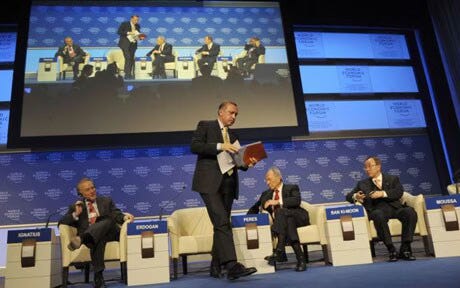
Photo credit: Reuters. The then-Turkish Prime Minister Recep Erdoğan storms out of a panel discussion at the World Economic Forum in Davos, Switzerland on January 30th, 2009.
Hamas had been indiscriminately firing missiles into Israel from Gaza. The 22-day Israeli military operation in Gaza ended on January 18th, 2009. That was 12 days before Erdoğan confronted Peres & stormed off the stage.
Unlikely as it was, Davos — 1,245 miles from Ankara and 1,850 miles from Tel Aviv —twisted the kaleidoscope that is the Middle East. Turkey & Israel were now on a collision course.
Later that same year — on October 25th, 2009 — Erdoğan met with Iranian President Mahmoud Ahmadinejad. Erdoğan referred to him & Iran by extension as a “friend.” He also asserted that Tehran wasn’t seeking to build nuclear weapons, not that “They are working on nuclear power for the purposes of energy only.”
Erdoğan — clearly — was aiming his words at Israel.
***
HAMAS & HAY’AT TAHRIR AL-SHAM
Erdoğan — after Davos — began actively pivoting his support to Hamas. Certainly, his maneuvering was domestically popular given Turkey’s populace is strongly pro-Palestinian. Yet — and we will get to this below — it was also Erdoğan’s first manifestation of his desire to reestablish Turkey’s influence in the Mideast as it once was during the Ottoman Empire.
Erdoğan — in essence — was determined to twist the Mideast kaleidoscope in Ankara’s favor & against Israel. One of his opportunities to do so was in the wake of Israel’s decision to interdict a Gaza aid flotilla in the Mediterranean that was sailing toward the strip in an attempt to break a joint Israeli-Egyptian blockade.
Gunfire erupted and ten Turkish activists aboard the Mavi Marmara — the lead vessel in the six-ship aid convoy — were killed.
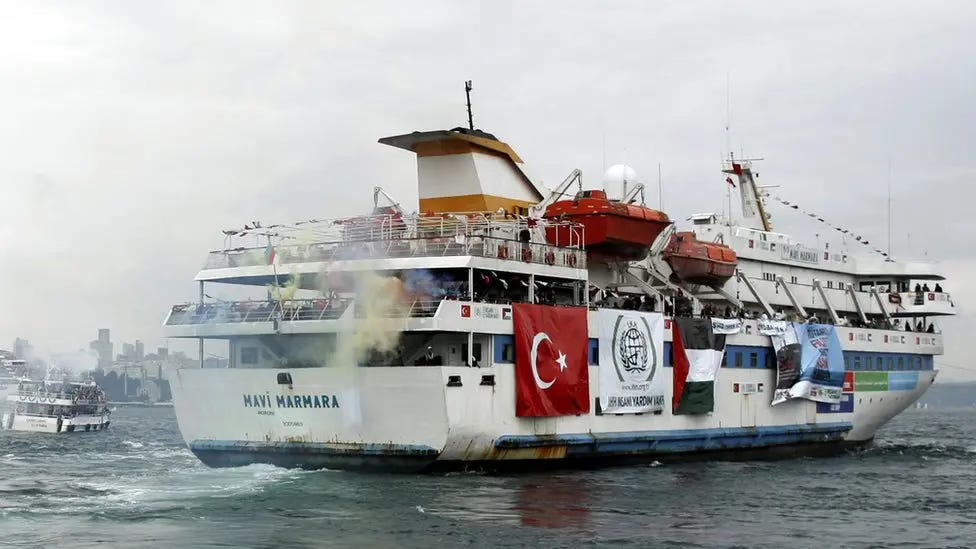
Photo credit: Reuters. The Mavi Marmara departing for Gaza in May 2010.
In response, Erdoğan called it a “bloody massacre” and a scheduled joint Turkish-Israeli military exercises were canceled. Ankara also withdrew its ambassador from Israel. Notably, Egypt — a participant in the blockade of Gaza — escaped Erdoğan’s wrath.
Nonetheless, the messaging was there to Cairo. Turkey was now openly supporting Hamas which was founded by Sheikh Ahmed Yassin — then widely known as the “Blind Sheikh” — who was an activist in the Muslim Brotherhood. Egypt has long since banned the Muslim Brotherhood as a terrorist organization seeking to overthrow the Egyptian government.
Now, Erdoğan was openly embracing it & Hamas. It was an alarming pattern that Ankara would continue to develop elsewhere in the Mideast. The Turkish president began supporting other militant Islamic groups — including Hay’at Tahrir al-Sham — to destabilize & eventually topple the Bashar al-Assad regime in Syria in December 2024.
Its leader — Ahmed al-Sharaa, initially a member of al-Qaeda — is now the president of Syria. For Turkey, it was a major strategic victory in the Mideast.
***
OCTOBER 7TH
In the aftermath of the October 7th Hamas attacks in Israel, as the Freedom for the Defense of Democracies noted, “Turkey’s position toward Israel has hardened into outright hostility.’ It has also devolved into abject antisemitism.
Ibrahim Karagul, who pens an influential column for the Yeni Safak newspaper in Turkey, wrote that Jews have “corrupted human genetics” in calling for an end to Israel’s right to exist as a sovereign state.
It doesn’t stop there. The Turkish Foreign Ministry recently compared Israeli Prime Minister Benjamin Netanyahu to Nazi Chancellor Adolf Hitler. Like or hate Netanyahu, the comparison is way over the top.
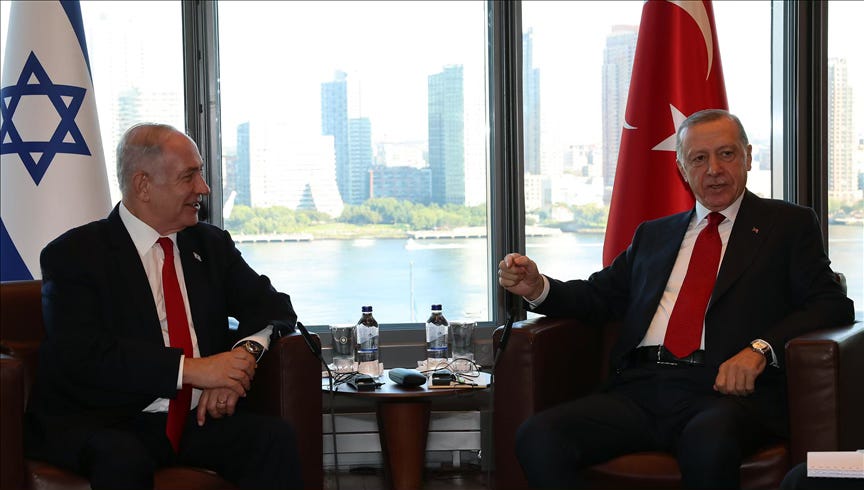
Photo credit: United Nations. Israeli Prime Minister Benjamin Netanyahu (left) meets Turkish President Recep Erdoğan at the United Nations on September 21st, 2023.
Especially since Erdoğan has aligned himself with Hamas. The same Hamas, whose founding covenant in 1988 — formally known as The Covenant of the Islamic Resistance movement — literally calls for the genocide of Israel.
Ever since October 7th, Turkey is now actively treating Israel as an existential regional threat to Ankara. That is an alarming and dangerous development given that Turkey is also a NATO ally of the U.S. To that end, Erdoğan has sought to isolate Jerusalem, including joining South Africa’s genocide case against Israel in the International Court of Justice.
Now — given the war against Iran — Erdoğan is trying to walk a tightrope by seeking some form of the regime’s continued survival in Tehran to act as a counterweight to Israel’s military preeminence throughout the Middle East.
Turkey, given Erdoğan’s Ottoman Empire aspirations — or at least the regional influence they once had — needs a weak Iran going forward, but ideally an Iran free to continue supporting Hamas, Hezbollah & the Houthis.
That’s a classic Mideast reality. The enemy of my enemy is my friend.
***
ERDOĞAN’S OTTOMAN EMPIRE
Erdoğan — similar to Russian President Vladimir Putin’s revival of Kievan Rus’ & Soviet-era history — is actively promoting the resurgence of the Ottoman Empire as the defining history of modern-day Turkey.
That has included converting the Hagia Sophia in 2020 back into a mosque. He has also mandated Ottoman Turkish be taught in schools. Turkey is also restoring its Ottoman era monuments throughout the country.
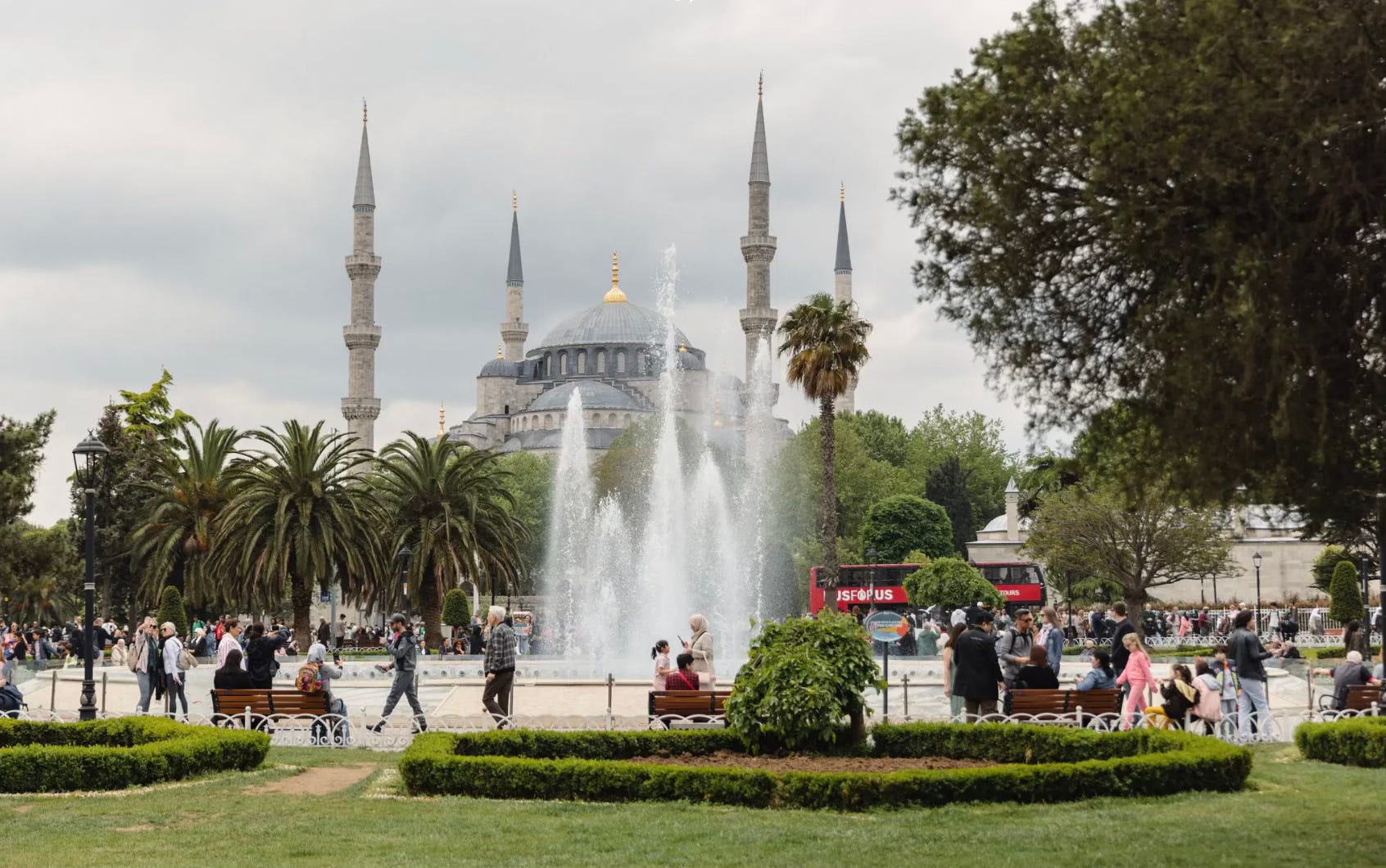
Photo credit: The New York Times. The Hagia Sophia in Istanbul, Turkey.
Erdoğan’s Ottoman push isn’t limited to inside Turkey’s borders. He is actively working to reestablish the spheres of Ottoman influence, including military interventions in Libya & Syria, as well as diplomatic outreaches as far as the Balkans & Qatar.
His ambitions do not stop there. Erdoğan wants Turkey — or at least its modern-day Ottoman-style of it — to be seen as the leader of the Muslim world. Thus, his embrace of Hamas & other Islamic militant groups.
Only Israel stands in his way.
***
TURKEY VERSUS ISRAEL
Ankara & Jerusalem are on a collision course. Iran is only the latest flashpoint. Post-Iran war — unless checked by NATO — it will only get worse. The U.S. — especially during the Trump Administration — is not going to abandon Israel.
That sets up this predicament.
What if Israel & Turkey clash — say an aerial dogfight over Syria? If so, what if Turkey invokes Article 5, NATO’s collective defense provision?
It is a very real risk. Turkey, after all, started down that path once before when a Turkish F-16 shot down a Russian Su-24M bomber that strayed into its airspace from Syria by invoking Article 4, NATO’s consultations clause.
That’s it for today. One twist of the kaleidoscope that is the Mideast is enough for any given 24 hours. Especially when it is — potentially — this ominous.
***
Thank you for reading. We will see you tomorrow. Please subscribe, comment & share. We truly appreciate it!
Jon & Mark
Follow Jon on X at @JESweet2022 or on Bluesky at @JonSweet.bsky.social. Follow Mark on X at @MCTothSTL or on Bluesky at @MarkToth.bsky.social.
I guess Turkey forgot about the help Israel provided to them during the earthquake.