

INTREP360 INTELLIGENCE REPORT
08.13.2026: THE VANCE CALL


August 13th, 2026
Greetings from Puerto Rico!
My wife and I departed Oahu Wednesday afternoon as news that Tropical Storm Lara is bearing down on the Hawaiian Islands – likely becoming a Category I Hurricane before it makes landfall on the Big Island on Saturday. Our thoughts and prayers are with Hawaii.
Puerto Rico could use the rain though. Two disturbances have formed in the mid-Atlantic that may offer some relief. It’s Hurricane season though – and you never really know when those disturbances will strengthen to tropical depressions, tropical storms or hurricanes.
Island life.
As we called it last week, Kilauea’s 53rd episode took place in spectacular fashion on Wednesday before a Witkoff, Kushner & Vance brokered ‘deal’ could be reached to reopen the Strait of Hormuz.
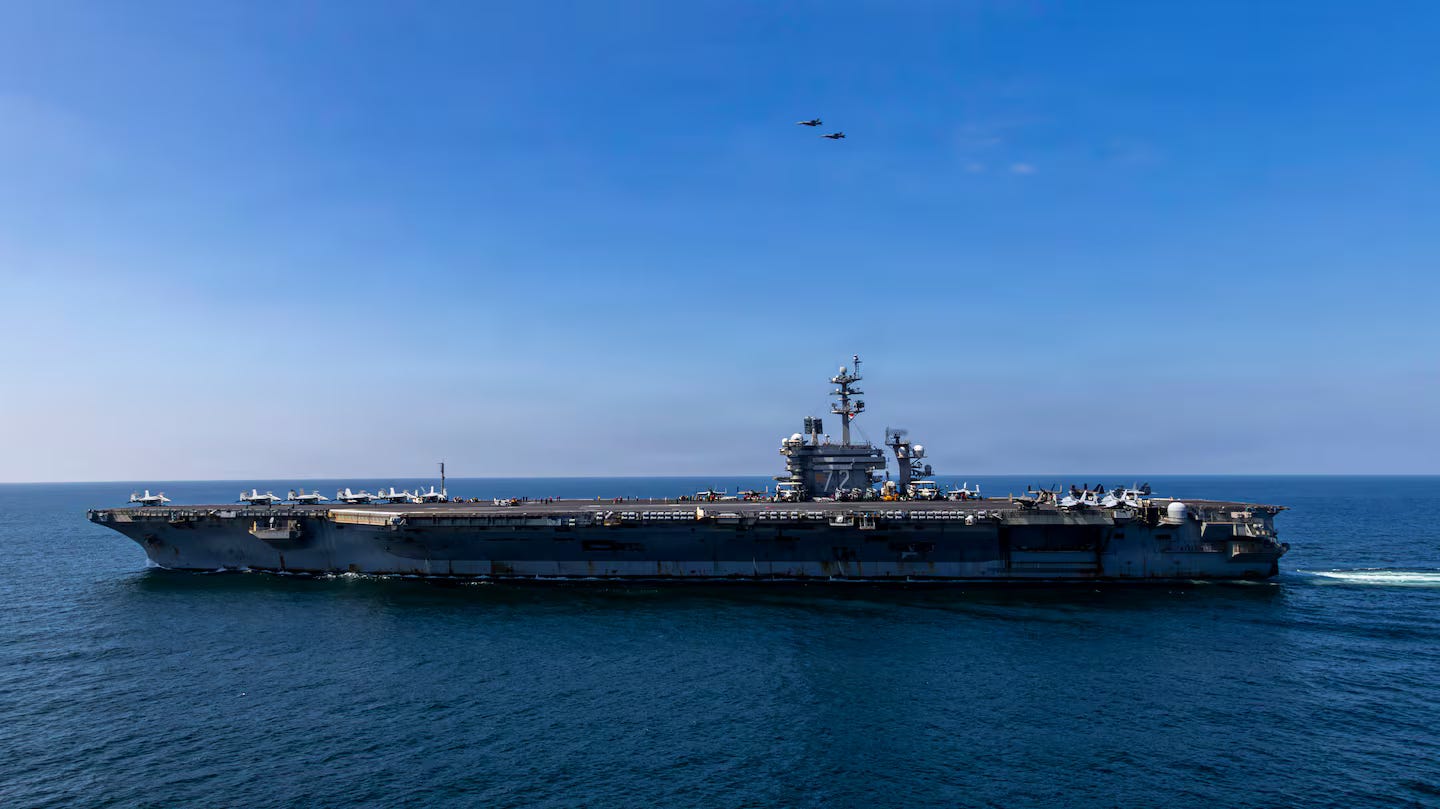
Photo Credit: U.S. Navy. The aircraft carrier USS Abraham Lincoln sails in support of Operation Epic Fury, March 3, 2026.
But the news coming out of the Persian Gulf today concerns the USS Abraham Lincoln and an article by the New York Times that reports multiple instances where sailors have tried to jump overboard amid its extended deployment.
The Lincoln has been deployed for more than eight months while supporting U.S. military operations in the Middle East against the Islamic Republic of Iran. Vice Adm. Joseph Cahill, commander of Naval Surface Forces, acknowledged the strain on sailors and their families during a virtual meeting.
President Donald Trump told us back in April he had “all the time in the World, but Iran doesn’t – The clock is ticking!”
Earlier this month he told reporters he had “a lot of patience” and “plenty of time” to reach a deal with Iran.
Maybe not.
The operational environment – stress under combat conditions – is having an effect on some service members. Something the White House – and the Pentagon – need to be mindful of.
***
MEANWHILE, IN UKRAINE
In the category of ‘you can’t make this stuff up’ – according to the Financial Times Vice President J.D. Vance asked Ukrainian President Volodymyr Zelensky during a phone call on July 31st not to “target tankers carrying crude piped from Kazakhstan to a Caspian Pipeline Consortium (CPC) terminal in the Russian port of Novorossiysk” for fear it would “further destabilize oil markets and harm U.S. companies.” Namely Chevron and ExxonMobil.
Ukraine agreed not to target CPC infrastructure or non-Russian vessels as long as those ships were not under Ukrainian sanctions and were not carrying Russian oil or other Russian cargo.
On the surface, it would appear that the Trump Administration is once again putting American interests first when it comes to Ukraine’s defense and their strategy to bring the war to an end by denying Russia revenue to fund their war.
Let’s be honest – the oil markets were destabilized back in February when the U.S. attacked Iran and the regime responded by shutting down the Strait of Hormuz. Keeping the ‘safety value’ open in the name of stabilizing the oil market – and allowing Russia to continue to generate revenue to fund their war is not the solution.
Reopening the Strait of Hormuz and bringing the war in Ukraine to an end will stabilize the oil markets. These cannot be treated as business deals, they are matters of national security.
Nowhere in the Financial Times article, or a similar article written by the Kyiv Post, was there any mention of the Vice President making a similar phone call to Russian President Vladimir Putin to stop bombing civilian targets in Ukraine.
Nor was there any discussion of a quid pro quo – Patriot interceptor missiles or any other air defense weapon systems to counter Putin’s ballistic missile, glide bomb and drone assaults on Ukraine, the establishment of a No-Fly zone, or the sharing of intelligence concerning the locations of launch sites, missile production facilities, storage facilities, command and control facilities for enable Ukrainian deep strikes into Russia.
Just the bottom line – profit – for American oil companies, with stability of the global oil market as a cover.
At the time of the phone call, Ukraine accepted Vance’s request partly because it was seeking U.S. authorization to manufacture interceptors for the Patriot air defense system.
Kyiv also hoped to purchase several hundred Patriot missiles before winter, when Russia is expected to intensify attacks on Ukraine’s critical infrastructure.
Early Wednesday morning Ukrainian missiles and drones struck the Russian naval base in Novorossiysk with Palianytsia jet-powered drones, Neptune missiles, and unmanned naval systems. Russia assumed they had sanctuary – Ukraine provided none.
After the strike, Zelensky described Novorossiysk as “the last major stronghold of the Russian fleet in the Black Sea.”
***
ICYMI #1. Our National Security column in The Hill went live this morning. Mark and I argue there is no negotiating with Iran — and that the Trump must stop trying.
You can read it here.
***
ICYMI #2. Mark made an appearance on India’s DECODE with Zunaira Azhar to discuss the latest developments in the U.S.-Iran conflict, the strategic battle over the Strait of Hormuz and growing questions over America’s missile and air-defense interceptor stocks.
***
Thank you for reading.
Hope to see you again tomorrow.
Please subscribe, comment & share. We truly appreciate it!
Follow Jon on X at @JESweet2022 or on Bluesky at @JonSweet.bsky.social.
Follow Mark on X at @MCTothSTL or on Bluesky at @MarkToth.bsky.social.
Somebody needs to tell Vance to go find a couch.