

INTREP360 INTELLIGENCE REPORT
03.05.2026

March 5th, 2026
Greetings! It is Day 6 of the war in Iran. The Islamic Republic of Iran’s ability to launch ballistic missiles continues to rapidly diminish.
It isn’t because of a lack of missiles. Rather, it is because—as Gen. David Petraeus, the former CIA director & commander of the Central Command (CENTCOM) noted—the U.S. & Israel have now achieved “air supremacy,” not just air superiority over the skies of Tehran & across the entirety of the country.
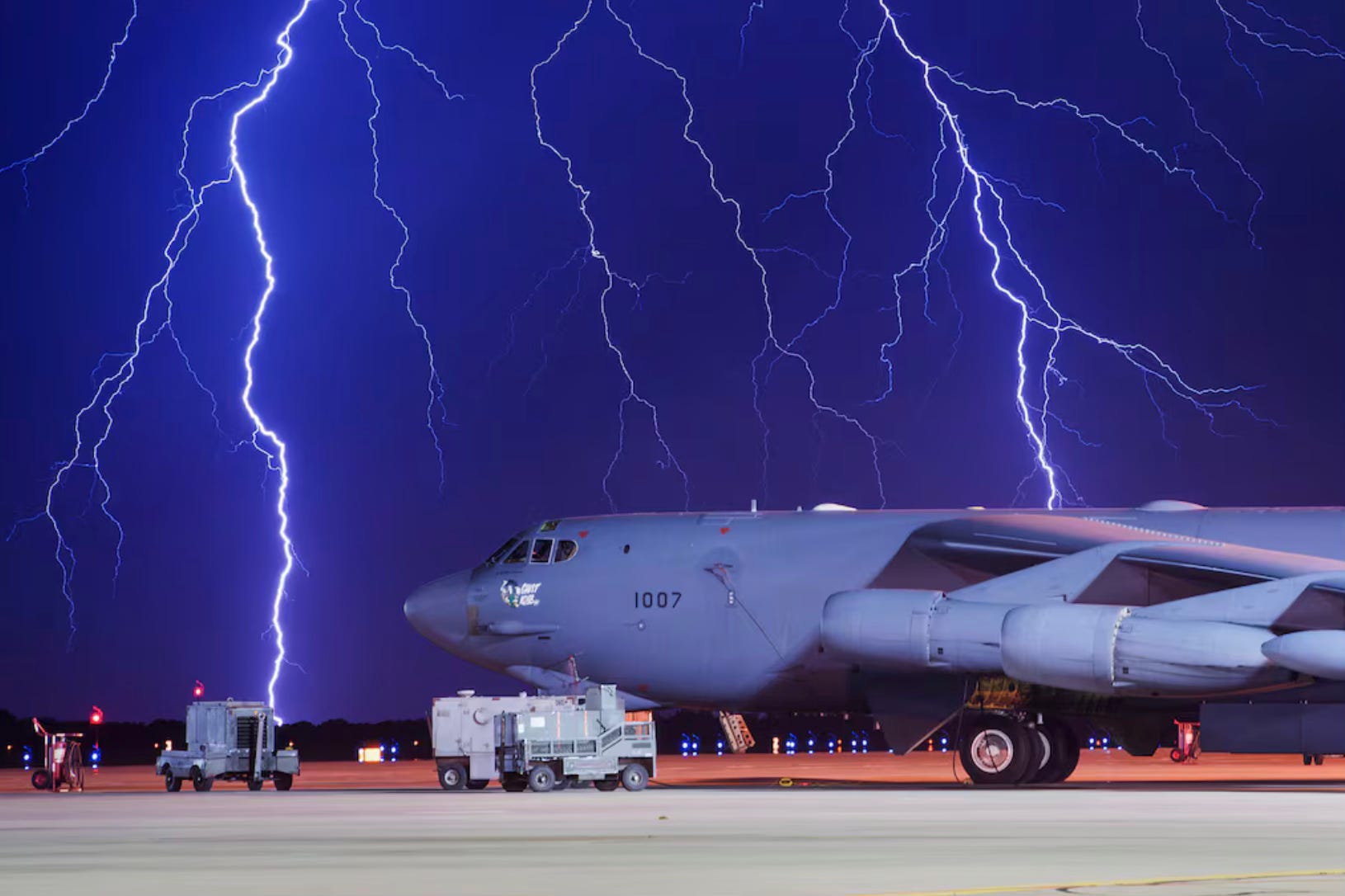
Photo credit: Senior Airman J.T. Armstrong / USAF. Boeing B-52H Stratofortress at Minot Air Force Base, North Dakota.
The difference is significant.
Air superiority is defined in U.S. military doctrine as control of air space after degrading “the aerial and anti-aircraft assets of the opposing belligerent.” Air supremacy means that the belligerent is completely incapable of interfering with the “adversary’s aerial activities.
U.S. & Israeli complete control of Iranian airspace means that coalition air assets can operate & loiter at will. It also allows conventional non-stealth fighter jets & bombers to operate freely in Iran.
Boeing B-52 bombers—as we write this—are conducting bombing runs. Earlier today, Adm. Brad Cooper, the CENTCOM commander, stated yesterday that “a B-52 bomber force struck ballistic missile and command and control posts.”
Significantly, control of the skies over Iran has negated—as reported by the Wall Street Journal today—the strategic value of Tehran’s so-called “missile cities.” These tunnel installations—buried deep underground or into mountainsides—house the vast majority of Iran’s ballistic missiles & launchers.
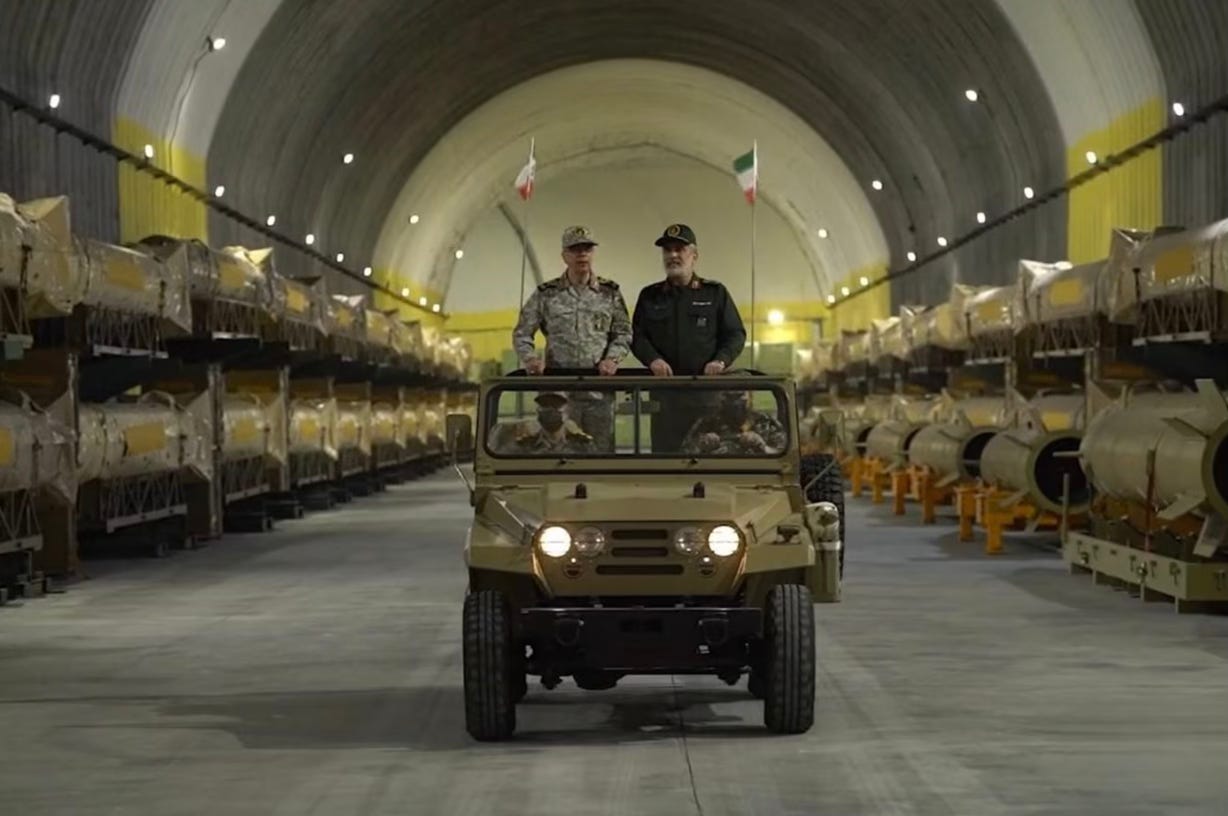
Photo credit: Sepah News. Iranian officials unveil a ‘missile city’ in Iran (2025).
Now, they are effectively bottlenecked. When Iranian battery crews attempt to exit to launch their ballistic missiles, they are—almost immediately—hit by loitering U.S. or Israeli warplanes & drones.
Plus—as CENTCOM works through & checks off its early target sets—“waves of heavy bombers have dropped munitions” on the missile cities. First, they were bottlenecked, now they are being “entombed.”
Numbers don’t lie. The U.S.-Israeli war strategy is working. On day one—as we noted before—Iran fired 350 ballistic missiles.
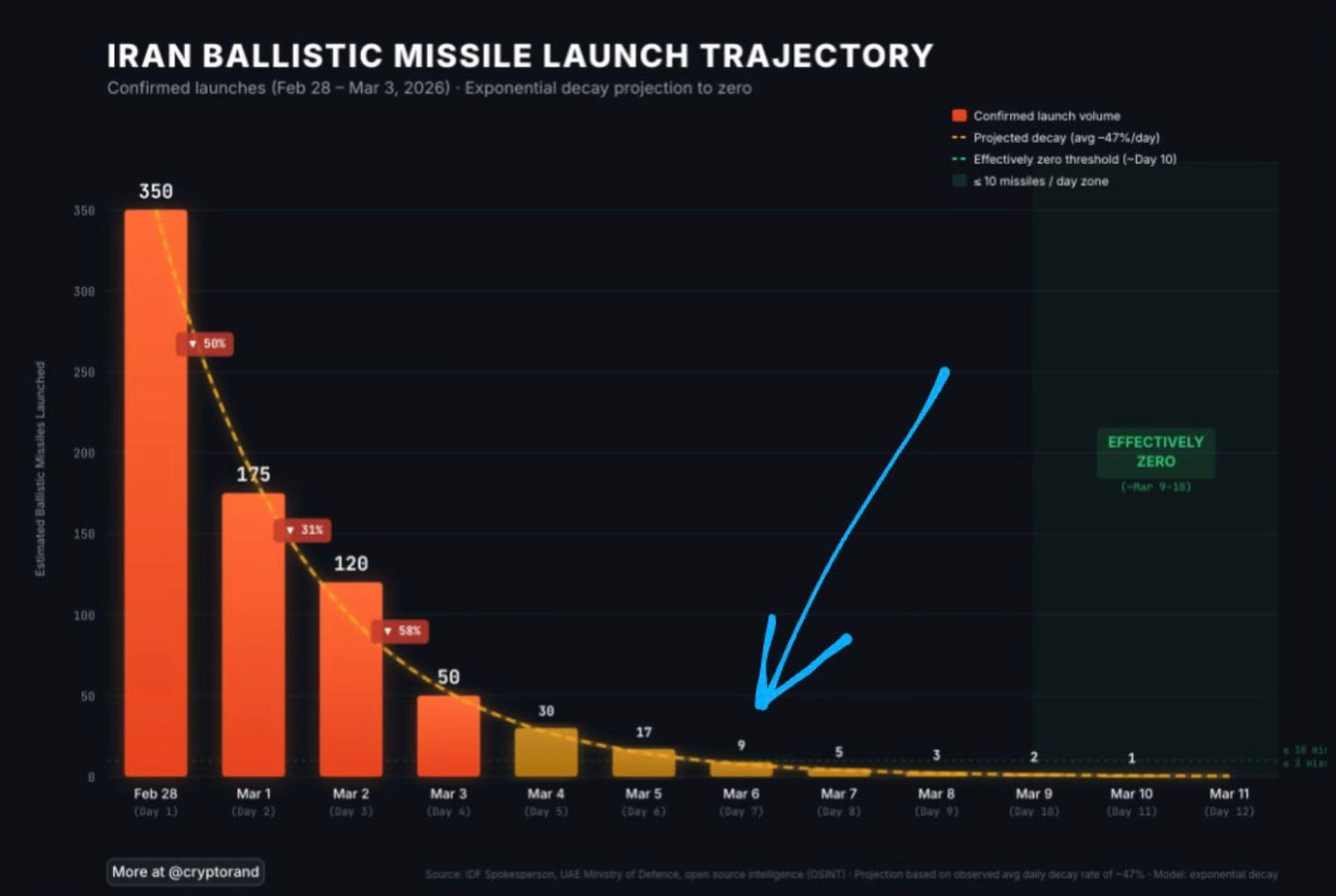
Graph credit: @cryptorand. Chart of actual & estimated Iranian ballistic missile fires since February 28th, 2026.
Today?
Essentially a handful or perhaps as high as 35 given Cooper’s assertion that Iran’s ballistic missile launches had fallen by 90% since day one. Based on the above Rand trajectory chart, the U.S. & Israel are effectively on target.
***
The fog of war is very real. Not just on the battlefield, but in the media ecosphere—especially in this day & age of social media.
Competing narratives—be they national, political or disinformation—often distort the reality of what is actually happening in the theater of operations. This war—especially given Iran’s evergreen abundance of false claims—is no different.

Thus, to cut through the fog—and the ever-present noise—we recommend paying attention to the U.S.-Israeli target sets as they play out. First & foremost, they are indicative of the coalition’s war strategy—especially their sequencing.
Secondly, they reflect conditions on the ground & whether or not the overall strategy is working or if adjustments—and there are always adjustments in war given the fact that the enemy always gets a vote—need to be made.
From our vantage point & based on all publicly available data—despite handwringing on Capitol Hill & in the media writ large—the war strategy is working & is indeed, from a military perspective, ahead of plan.
Initially the target sets were heavily focused on destroying Iran’s air defenses & the command & control structure that supports it. That began simultaneously to the Israeli decapitation strike on Ayatollah Ali Khamenei’s compound in Tehran that killed him & other key members of the regime’s leadership.
In developing their war strategy—or at least the opening stages of it—the U.S. & Israel had to factor in offensive versus defensive needs. Understandably—given the need to protect 50,000 U.S. troops in the region & our Gulf State allies—the number of available interceptors to shoot down Iranian ballistic missiles was a factor.
But it wasn’t the only factor.
You go to war with the army that you have. Not the army that you would like to have. That was something General George B. McClellan—who was in charge of the Army of the Potomac during the U.S. Civil War—never understood.
Strategy is how you bridge that gulf. Thus, the stockpiles of available interceptors—no doubt, arguably lower than what’s ideal—can’t be looked at in isolation. They have to be balanced by the stockpile of offensive munitions & how each is factored into the overall war strategy as it plays out.
It is not—by definition—a static relationship. It can be, if the offensive strategy fails but that is not the case in Iran.
If they invert—meaning more & more offensive weapons begin to be fired while fewer & fewer interceptors are needed—that is suggestive that the overall strategy is working. Meaning that—on an increasing basis—the U.S. & Israel are hitting Iran more than Iran can hit back at them & that ratio keeps getting worse for Tehran.
Thus far, that is indeed the case.
Especially since Iranian ballistic missile fires have diminished by 90% after only 5 days of fighting. That—in & of itself—is a remarkable achievement.
Bear in mind too that is also before you consider effectiveness. So far, the U.S., Israel & the Gulf States are intercepting approximately 90% of Iranian ballistic missile strikes, cruise missiles strikes & drone strikes.
Then consider that Iran—foolishly—has indiscriminately fired many of these volleys & that very few of those that get through are hitting U.S. or Israeli military targets. Initially, it was clear that Iran was trying to blind the U.S. by hitting radar systems but that’s largely been it.
Their strategy—irrationally, in our opinion—was to create asymmetrical pressure on the U.S. by getting the Gulf States to cry “Uncle!” But it didn’t work. Instead, it backfired & many of the Gulf States are considering undertaking offensive operations in Iran. You can’t defeat an opposing army unless you fight it.
Iran—stupidly—instead chose to make new enemies out of friends. It was clear to us from the beginning that was never going to work.
Plus, it is only going to get worse. As Adm. Cooper said, “ We will continue to conduct dynamic targeting operations. We’re hunting Iran’s last remaining mobile missile launchers to eliminate their launch capabilities. Iran’s ability to hit us, and our partners is declining, while our combat power is building.”
In this regard—eventually—interceptors will become the coalition’s fail-safe option to deter Iranian threats versus a primary line of defense as it was—and arguably still is—in the opening days of the war.
***
Equally telling is that the U.S. & Israel are now adding target sets. They are now aggressively targeting Iran’s ballistic missile & drone manufacturing capabilities. Ditto the Iranian navy which is effectively sunk. Plus, Israel has started hitting Iran’s nuclear weapons program—including in Tehran & Isfahan.
In a nutshell, Washington & Jerusalem are methodically destroying the Islamic Republic of Iran’s ability to wage war on any level. Up until now, Iran was—perhaps still is, to some extent—able to produce more missiles & drones than they lost. That window—however—is rapidly being slammed shut.
***
Nonetheless, bear in mind that it is early. Iran is a big country. It is 2.5 times the size of Texas. Rome wasn’t built in a day—as the saying goes—& Iran won’t be destroyed in a week or two or even likely three.
There is still a lot of work to be done. Iran’s kill chain—as Can Kasapoğlu detailed for the Hudson Institute is still operational (meaning Iran’s military command can still organize, order & effect operations including ballistic missile & drone strikes).
The Strait of Hormuz is still effectively closed. That means oil tankers on both sides of it are trapped. Plus, Iran is still able to continue launching drones at the Gulf States & U.S. forces albeit in diminishing numbers as well.
Lastly, regime change in Iran—thus far—is nowhere in sight. The regime—chiefly through the IRGC, the Basij, & Artesh (Iran’s army)—are still firmly in control of the streets despite the U.S. & Israel being in control of the skies.
Give it time. That likely will soon start to change. Until then, purely from a military standpoint—Washington, D.C.’s needless handwringing aside—it is clear to us that Adm. Cooper’s war plan is working.
***
ICYMI!
Earlier today, our weekly Thursday national security column at The Hill in Washington, D.C. focused on the positive effects Trump’s war on Iran is having on Russian President Vladimir Putin & Chinese President Xi Jinping’s so-called ‘Axis of Evil.’

Photo credit: Sergei Bobylev / Kremlin Pool. Putin (left) & Xi.
As we noted in our piece, Putin & Xi have argued that we now live in a multi-polar world. That may be the case when measured in economic terms, but this year’s events are showing that this is still very much a U.S. hegemonic world when it comes to military power.
***
Thank you for reading! We will see you tomorrow. Please subscribe, comment and share. We truly appreciate it!
Jon & Mark
Follow Jon on X at @JESweet2022 or on Bluesky at @JonSweet.bsky.social. Follow Mark on X at @MCTothSTL or on Bluesky at @MarkToth.bsky.social.
I agree with The Hill : "Trump’s attack on Iran has Putin-Xi axis of evil reeling"
But while Trump is effectively fighting some of the "axis of evil" – Venezuela and Iran – it's very difficult to understand his selective approach towards Russia, which is/was actively helping these enemy countries. It seems only personal financial interests can explain such choices, or ???
Tragically