

INTREP360 INTELLIGENCE REPORT
01.15.2026

January 15th, 2026
Greetings! Make no mistake. The U.S. military is a highly capable force. It remains in a class of its own—especially when it comes to force projection & its ability to take the fight to wherever the enemy is around the world.
Much of that strength, including many of its defining advantages—U.S. dominance in airpower, aircraft carriers, stealth platforms, top-notch training & a vastly superior battle network—is built atop C4ISR.
Think of C4ISR as the military’s nervous system.
Fully integrated, its core elements—command, control, communications, computers, intelligence, surveillance & reconnaissance—account for why the U.S. military is so potent when combined with ordnance, strategy & logistics.
Plus, it is rapidly evolving. Cyber defense & artificial intelligence nodes are being added to expand its capabilities.
Yet, good as it is, there is an Achilles’ Heel. While its eyes & ears—especially its vast network of satellites—can be everywhere at once, its fighting forces cannot be everywhere at once.

Tradeoffs are inevitable.
That works fine when hot spots remain few in number or small-scale. However, if simultaneous conflicts arise, then strategic vulnerabilities start to rise.
We are witnessing this now as the parallel crises in Venezuela & Iran create competing demands on U.S. military assets. U.S. actions in the Caribbean—at least in the short-term—limited President Donald Trump’s options in the Mideast.
The genesis of this strategic catch-22 began last August when Trump ordered the Pentagon to begin positioning U.S. naval & marine forces in & around Venezuela. Initially, the justification was to interdict drug-trafficking.
However, by December 16th, it had expanded into a full-scale blockade of Venezuela entailing U.S. operations in the Pacific Ocean & the Caribbean. It culminated—at least for now—in the capture of Venezuelan President Nicolás Maduro on January 3rd.
Significantly, the USS Gerald R. Ford aircraft carrier left the Mediterranean in October & began sailing westward to support Operation Southern Spear. That left the entire Mideast & Europe without a single U.S. carrier in or out of port.
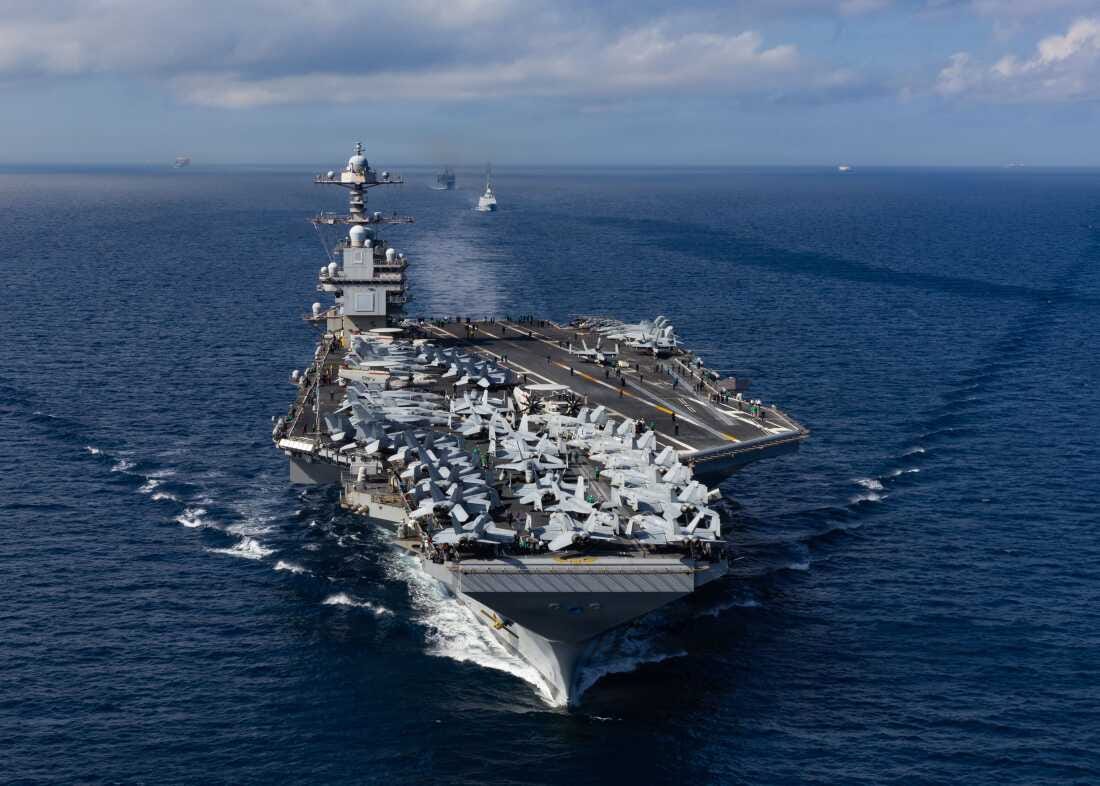
Photo credit: U.S. Navy. USS Gerald R. Ford transiting the Strait of Gibraltar in October 2025.
Contrast that to USS Nimitz & USS Carl Vinson that were on station in the region during the 12-Day War between Israel & Iran that ended with the U.S. bombing the Islamic Republic’s nuclear weapons facilities in Fordo, Isfahan & Natanz last June.
The USS Nimitz is being retired & the USS Carl Vinson is back at its home port in San Diego, California for refitting.
Consequently, while the U.S. still has considerable assets available at U.S. Central Command (CENTCOM)—be it in Europe or the Mediterranean—the lack of any carriers presently near Iran is a limiting factor.
How much?
Trump’s military advisers assessed that the U.S. didn’t have enough assets in the Mideast to protect U.S. military & national interests in the region. Nor, as Oman, Qatar & Saudi Arabia urgently warned Washington, to prevent Iran from retaliating against their oil & energy infrastructure & ports.
Likewise, Israel—purportedly—was concerned as well that it would be vulnerable to Iranian retaliatory strikes given that the Israel Defense Forces have not yet fully restocked its layered surface-to-air missile defenses.
Wittingly or not, Trump by focusing U.S. military assets on Venezuela had given––at least temporarily––Iranian Supreme Leader Ayatollah Ali Khamenei a “get out of jail free card.” To rectify it the Pentagon has ordered the USS Abraham Lincoln carrier & its strike group to sail from the South China Sea to the Mideast.
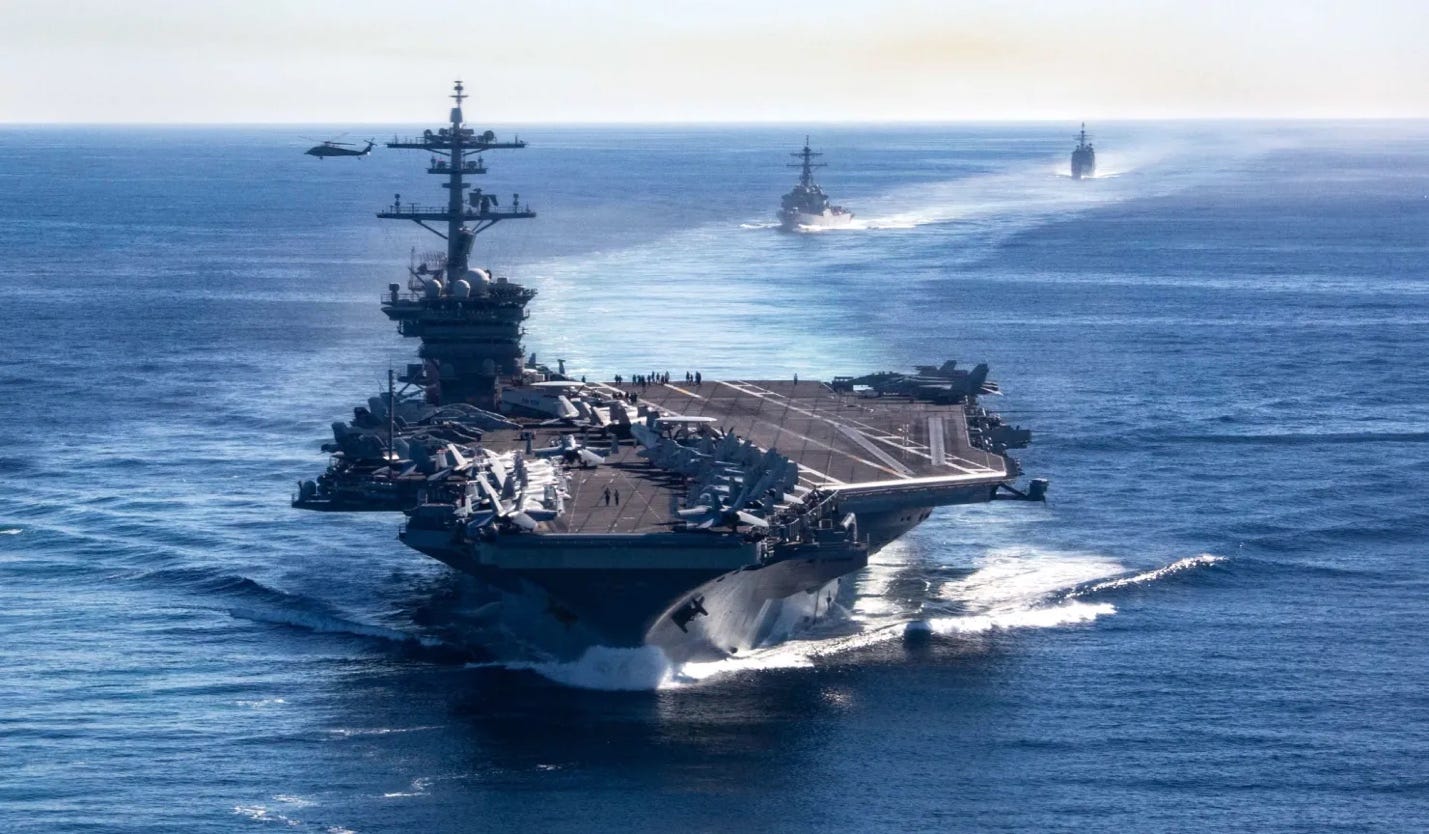
Photo credit: Mass Communication Specialist Third Class Lake Fultz/US Navy. USS Abraham Lincoln in the Pacific. 2021.
Yet this move—while needed—is creating its own potential vacuum in the Indo-Pacific at a time when China is increasingly threatening Japan & Taiwan. Our generals & admirals are trying but they can’t—as we mentioned at the top—be everywhere at once.
That brings us to the crux of this special Thursday edition of the INTREP360 Intelligence Report. While it is fair game to agree or disagree with Trump’s strategic decisions & uses of U.S. military assets, there is a much larger fundamental issue at play here that transcends any given president or administration.
Chiefly, our National Security Strategy continues to base military force sizing on one-and-a-half overlapping—or simultaneous—major conflicts. That simply doesn’t reflect the perilous reality of our times let alone the necessary scale of what is needed to ensure our nation’s security on a global basis.

Photo credit: White House.
Former U.S. President Joe Biden got it wrong. Ditto Trump. We repeatedly called out Jake Sullivan—Biden’s former national security adviser—at The Hill for this myopic approach to U.S. national security & are doing so here in regard to Team Trump.
Be assured, this is not a partisan attack. It wasn’t during Biden’s presidency, nor is it now. Our analyses & informed opinions are always apolitical. Truly, our only guiding star is U.S. national security.
Quite the opposite, bipartisanship is needed here to get it right. Getting there means understanding that we are in a third world war & have been since Russian President Vladimir Putin invaded Ukraine on February 24th, 2022.
No, it’s not Hollywood’s version of World War III. No mushroom clouds or day after nightmare radioactive scenarios.
It’s war by a thousand cuts.
Up until now—be it Team Biden or Team Trump—White House officials keep sidestepping this reality by falsely arguing the U.S. needs to “pivot.” Sullivan argued pivoting to China just as Elbridge Colby, the Undersecretary of Defense for Policy, is doing now.
There is no “pivoting” in national security. Pivoting is a fool’s errand that just results in exposing your back to existing or emergency threats.
We are seeing that play out right in real time in Venezuela & Iran. Plus, there are no guarantees that it remains binary. China or North Korea could escalate at any time. And Putin could expand his hybrid war against NATO member-states.
Bravado or not, Trump did start to take a step in the right strategic direction when he called for defense spending to be increased to $1.5 trillion or roughly 5% of GDP. But it can’t just be about spending money.
It must be about increasing troop strength & the capacity to fight—if ever needed—2 major kinetic conflicts at once (e.g., Putin & Chinese President Xi Jinping simultaneously attacking NATO & Taiwan).
But that’s not all. It also must enable the U.S. to fight & win—or at least come to the aid of regional allies—in the event of flareups like Iran or a border skirmish between South Korea & North Korea.
None of this will be fast or easy. It takes time to train troops as in years, not months—a lesson Putin is still finding out the hard way. It takes even more time to train them to the unmatched level & caliber of the men & women who proudly wear our nation’s uniforms.
Fortunately, however, we excel at this. Likewise, our servicemen & women excel at being the best in the world.
It’s time to get started. World War III is not yet won.
***
Thank you for reading! We will see you tomorrow. Please subscribe, comment and share. We truly appreciate it!
Jon & Mark
Follow Jon on X at @JESweet2022 or on Bluesky at @JonSweet.bsky.social.
Follow Mark on X at @MCTothSTL or on Bluesky at @MarkToth.bsky.social.