

INTREP360 INTELLIGENCE REPORT
04.02.2026

April 2nd, 2026
Greetings!
Last night, President Donald Trump addressed the nation from the White House. He explained why the United States was at war with the Islamic Republic of Iran, reiterated his military objectives, expressed gratitude to the Gulf states for their support, commended U.S. Central Command for their performance, & told us Operation Epic Fury would likely continue for another two to three weeks.
While his address was 32 days too late, he did share what drove his decision to launch Operation Epic Fury. Trump went on to encourage Americans to exercise strategic patience while CENTCOM finished the task. He also argued that short-term setbacks would lead to peace and prosperity—reminding us how long World War I and II, the Korean War, and the Vietnam War lasted in comparison.
Yet, equally as important is what he did not say. He did not tell us his end state, nor did he ever mention NATO. He implied it—perhaps—when he commended the Gulf Nation States, but he did not overtly criticize the alliance.
Cooler heads—at least for now—prevailed. Still the question remains, is the NATO alliance that won the Cold War in jeopardy?
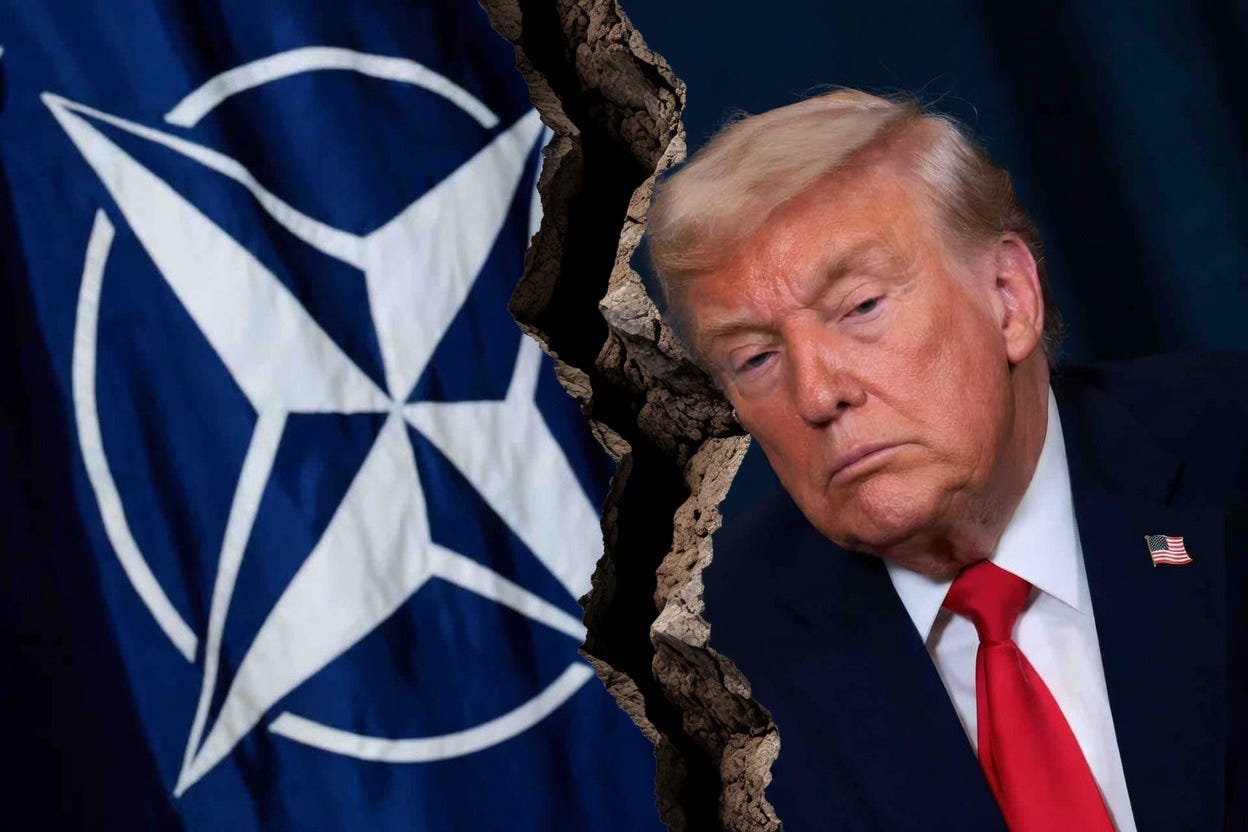
AI Image credit: Grok. President Donald Trump pictured beside a rupturing NATO flag.
Let’s get started analyzing that.
***
Many talking heads thought he would use this platform to announce the possibility of the U.S. withdrawing from NATO. There were plenty of indicators.
On Wednesday, Trump told Reuters he would state in his address to the nation that he was “absolutely” considering withdrawing from the alliance, citing “disgust with NATO.”
He also told The Telegraph that he was “strongly considering pulling the United States out of NATO after it failed to join his war on Iran.” He called the alliance a “paper tiger” and said removing America from NATO was now “beyond reconsideration” and that he was “absolutely” reviewing membership.
Trump was adamant that NATO should have come to the support of the U.S: “It should be automatic … We’ve been there automatically, including Ukraine. Ukraine wasn’t our problem. It was a test, and we were there for them, and we would always have been there for them. They weren’t there for us.”
His comments came on the heels of many other Truth Social rants attacking NATO. On March 26th, Trump accused NATO nations of doing “ABSOLUTELY NOTHING TO HELP WITH THE LUNATIC NATION [of Iran].”
Earlier on March 20th, he accused NATO of being a “PAPER TIGER” while accusing member-states of being “COWARDS” & vowing that the United States would “REMEMBER” their failure to act in Iran.
Earlier still, on March 17th, Trump attacked Japan, Australia & South Korea as well for being in his mind AWOL. He ended this rant by claiming “WE DO NOT NEED THE HELP OF ANYONE!”
***
Secretary of State Marco Rubio had strong comments for NATO as well. Rubio told Fox News journalist Sean Hannity on March 31st that, “We’re going to have to re-examine the value of NATO and that alliance for our country.” Rubio was angry that France, Spain, Italy & initially the United Kingdom had denied U.S. military forces “overflight.”
During the same show, retired U.S. Army Lt. Gen. & former Special Envoy to Ukraine Keith Kellogg told Hannity that, “NATO’s turn[ing] [out] to be cowards,” and “Maybe we need to have a new NATO, a new defensive establishment.” Former Deputy National Security Advisor Victoria Coates said NATO has proven itself “inconsequential.”
Former Secretary of State Mike Pompeo called the state of the NATO alliance heartbreaking, telling Hannity that “I’ve been someone who believed NATO was a very important set of allies for decades.” Yet now, he is calling for “a fundamental rethinking” of the alliance.
In Get Shorty terms, this interview felt like ‘Get NATO.’
***
That begs the question whether or not Trump can really pull the U.S. out of the alliance. The short answer is yes.
NATO’s Article 13 states that, “After the Treaty has been in force for twenty years, any Party may cease to be a Party one year after its notice of denunciation has been given to the Government of the United States of America, which will inform the Governments of the other Parties of the deposit of each notice of denunciation.”
***
Reuters published a great article on the subject yesterday—April Fool’s Day by the way—and put forth many valid points. They noted that experts are divided as to whether or not Trump can unilaterally withdraw from NATO.
Under the U.S. Constitution, “the president has the power to make treaties with the advice and consent of the Senate, provided two-thirds of the 100-member Senate concur.” However, it is silent on terminating treaties.
Notably, in 2023—as part of the 2024 National Defense Authorization Act—then-former President Joe Biden signed into law legislation that barred U.S. presidents from “suspending, terminating, denouncing or withdrawing the U.S. from NATO unless the withdrawal is backed by a two-thirds majority in the 100-member Senate.”
Significantly, Rubio was one of the legislation’s lead sponsors. Equally germane to this potential constitutional fight, in 2020—as noted by Reuters—Trump’s Department of Justice during his first term in office argued that the president—not Congress—had the exclusive right to withdraw from treaties.
Generally-speaking, under international law, heads of state usually have the authority to withdraw from treaties. U.S. law is less clear. Plus, Congress in the past has failed to stop other presidents from withdrawing from treaties, including in 2020 when Trump exited the 35-nation Open Skies Treaty that allow unarmed surveillance flights over member countries.
If Trump does withdraw from NATO, it is highly likely the U.S. Supreme Court will ultimately have the final say. Especially since this is unsettled constitutional law.
***
That said, is the alliance really in jeopardy? Or NATO just in need of an adjustment? Especially since the world has changed—and so too expectations of the pact.
Let’s remember that NATO was formed in 1949 with the aim of countering the risk of a Soviet invasion. It—chiefly due to NATO’s Article V—has kept Moscow honest for nearly three quarters of a century. It outlasted the Iron Curtain, the Warsaw Pact, & the Berlin Wall.
It was a defensive alliance—and the Soviet Union was the primary enemy. But after the “fall of the wall” in November 1989 and the break-up of the Soviet Union, Europe began to let its guard down believing the new Russian Federation would somehow embrace capitalism and play well with others.
They didn’t.
Military readiness was no longer a priority. Plus—so Europe thought—Russia was no longer the enemy. Investment went elsewhere, militaries downsized, & maintaining military equipment became an afterthought.
***
Trump took notice in his first term. In May 2017, during a NATO Summit in Brussels, he highlighted that 23 of the 28 member nations had failed to pay their 2% gross domestic product (GDP) financial obligation for their “collective defense.”
Many of them were still delinquent from previous years as well and owed what Trump deemed as “massive amounts.” The collective group of leaders smirked as he lectured them on paying their ‘fair share.’
Most telling, Trump said then that “over the last eight years the U.S. spent more on defense than all other NATO countries combined. If all NATO members just spent 2% of their GDP on defense last year, we would have had another $119 billion for “our collective defense.”
In 2020—alarmingly—only nine NATO member states met their 2% defense spending commitment. In 2024, 23 of the now-32 member countries, including the two newest members, Finland and Sweden, met the 2% defense spending commitment—two years after Russia had invaded Ukraine.
There was no apparent sense of urgency. Nor was there any penalty either.
***
Fast-forward to 2024. Only five countries exceeded the 3% threshold in 2024—Greece, Latvia, U.S, Estonia, and Poland.
Then, at the 2025 NATO Summit in The Hague, member nations finally made a commitment to invest 5% of their GDP annually on core defense requirements and defense-and security-related spending by 2035 – three years into the war in Ukraine and 10 years from now.
Spain opted out.
***
In reality—despite protestations from Europe now over Iran—NATO as an alliance has always been evolving, especially as threats have evolved. For example, 9-11 changed the NATO model. Osama bin Laden and al-Qaeda became the enemy; NATO invoked Article V to support the U.S. war on terrorism in Afghanistan & Iraq.
The Russian invasion of Ukraine on February 24th, 2022, changed it again. The principal fight was back in Europe. NATO’s eastern flank was under assault. Ukraine—notably, a NATO Partnership for Peace country that contributed troops to fight in Iraq and Afghanistan—was at risk of being overrun.
There was a growing fear as well—and it wasn’t misplaced in our view—that Putin was determined to reunite the Soviet Union alarmed NATO.
***
Ukraine was the very scenario NATO was established for: to counter a Russian invasion of Europe. But NATO drew a line at its border. They would defend NATO territory only and would not directly confront Russia.
The U.S. under President Biden rallied the allies to provide weapons, ammunition, intelligence & humanitarian assistance to help defend Ukraine. But defending Ukraine transitioned into the very ‘forever war’ Biden campaigned to avoid—and when Trump re-entered the White House, he wanted out.
This was now—in Team Trump’s view—Europe’s war. Trump believed—wrongly in our view—that U.S. had done enough and now he wanted to primarily focus on the Western Hemisphere: America First.
Yet, from a European view, the U.S. was a member of NATO. Therefore, from their perspective, it was NATO’s war & the defense of Europe’s eastern flank. The Trump administration reduced military support to Ukraine by 99% in 2025, turning instead to the Prioritized Ukraine Requirements List that allowed NATO partners to purchase U.S. weapons and munitions for Ukraine.
Fault lines in the alliance were beginning to show in Ukraine. Now, they’ve broken wide open in Iran.
***
Operation Epic Fury was launched without consulting the NATO partners. They were not part of the plan nor included in any of the branches or sequels. Rather, a necessity when the Strait of Hormuz was shut down.
NATO—in our opinion—was taken for granted by the Trump Administration. Chiefly because of NATO’s connection to the U.S. & Europe’s need for oil—especially as Brussels weans off of Russian oil & gas.
Iran is a U.S.-Israel planned & executed operation. Not a NATO one. An offensive campaign launched against a terrorist country that had been at war with the U.S. & Israel for over 47 years since 1979.
German spokesperson Stefan Kornelius told reporters that “the war had nothing to do with NATO—and that it was not NATO’s war.”
Technically he was correct.
Significantly, however, it wasn’t NATO that said no—it was individual NATO countries. The United Kingdom, France, Spain, Italy & Germany.
It also begs the question whether Gen. Alexus Grynkewich—the Supreme Allied Commander Europe who is dual-hatted as the Commander of U.S. European Command—was even read into the Iran plan.
***
Certainly––after the end of the Iran war—NATO’s role going forward needs to be reviewed & recalibrated to confront emerging threats—and to continue to protect against Axis of Evil aggressions on a global basis. Ditto bilateral relations with partner nations.
But now is not the time to point fingers and threaten to walk away from the NATO alliance. This is exactly what the Kremlin wants.
This only gets Russian President Vladimir Putin closer to achieving his ultimate objective. As Lt. Gen. Ben Hodges, former commander of the U.S. Army in Europe, put it in 2015, “Putin wants to destroy our alliance, not by attacking it but by splintering it.”
***
Assembling a naval task force to escort ships through the Strait of Hormuz is a priority. NATO in the lead is the best solution. Mitigating the Iranian threat before they arrive on station should be the goal.
Watching and complaining from the sidelines will not meet demand.
As the saying goes, “If you’re not part of the solution— you’re part of the problem.” It’s time for Washington & Brussels to roll up the sleeves & get to work.
***
ICYMI!
Today, our weekly 7:00 AM ET national security column at The Hill in Washington, D.C., focused on Europe & NATO being in Trump’s crosshairs.

Photo credit: Chip Somodevilla / Getty Images.
***
Thank you for reading! We will see you tomorrow. Please subscribe, comment & share. We truly appreciate it!
Jon & Mark
Follow Jon on X at @JESweet2022 or on Bluesky at @JonSweet.bsky.social. Follow Mark on X at @MCTothSTL or on Bluesky at @MarkToth.bsky.social.
A pyromaniac (Trump) sets fire to the gas station and firefighters (EU country) wait for the fire to be extinguished before intervening. I no longer believe in NATO as it currently exists. I believe much more in a union between Nordic countries bordering on Russia. I recall that the Finnish Minister of Defence had declared: "any Russian attack against a Baltic country will be considered by Finland as a declaration of war against it". The escalation with Putin does not come from our 'actions' (= conferences, meetings, blah-blah, declarations etc etc) but from our inaction.
Beginning to wonder what plan we're on with Iran. It changes so often it's hard to keep track.