

INTREP360 INTELLIGENCE REPORT
03.16.2026

March 16th, 2026
Greetings! It is Day 17 of the war in Iran. I am flying solo today as Mark is off. Washington—understandably—is fixed on the Strait of Hormuz.
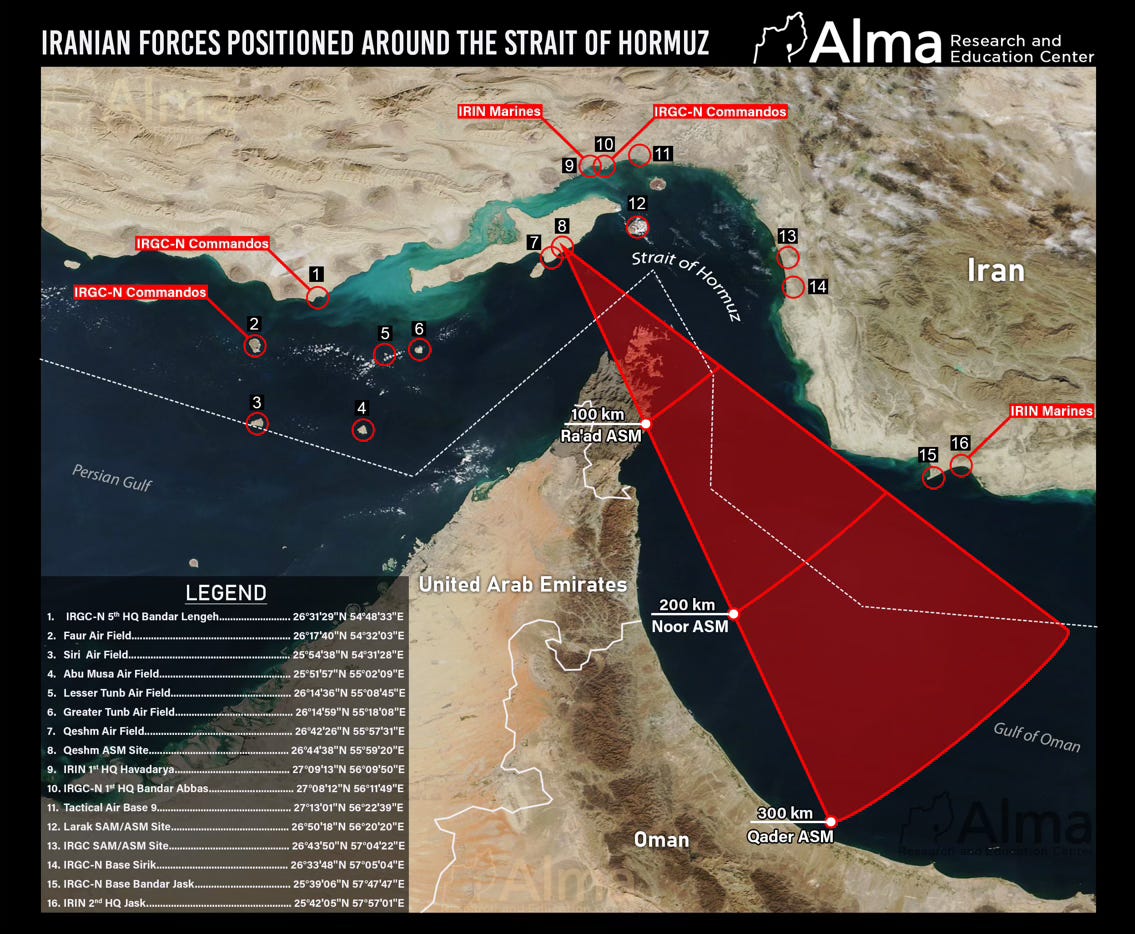
Photo credit: Alma Research and Education Center. The Iranian Threat to the Strait of Hormuz.
It is a strategic problem set that I am very familiar with by means of multiple deployments to the region over the course of my thirty-year career as a military intelligence officer and my time serving as a Branch Chief at the Defense Intelligence Agency.
Let’s get started understanding it & the challenges ahead.
***
Senator Tom Cotton (R-AR), who serves as the Chair of the Senate Intelligence Committee, posted on X Friday his frustration with a CNN article that said “Trump officials acknowledged to lawmakers during recent classified briefings that they did not plan for the possibility of Iran close the Strait [of Hormuz] in response to strikes.”
The Senator responded that the “U.S. has planned for Iran to try to close the strait for decades.”
Former U.S. Navy Seal and now Senator Tim Sheehy (R-MT) refuted the CNN story as well, posting on X that he “received a classified briefing from the administration. It is categorically false that they did not plan for Iran closing the Strait of Hormuz. Lawmakers and national security officials have known for years that this was Iran’s plan once their backs were against the wall.”
This is not a new problem set. U.S. Central Command (CENTCOM) has prepared for this challenge, as Cotton stated, “for decades.”
Notably, since 2002, when CENTCOM established a forward headquarters at Camp As Sayliyah in Doha, Qatar.
***
Sunday morning, retired U.S. Navy Adm. Kevin Donegan, who commanded the Navy’s Fifth Fleet during President Donald Trump’s first term, assured Martha Raddatz on ABC’s “This Week” that the Administration was not “taken off guard by Iran attempting to shut the Straits of Hormuz in response to U.S. air strikes.”
“We’ve been looking at this problem set for a long time, decades, to be honest. And so, we knew that if we were going to be involved in something in Iran from an offensive state – capability, that the Iranians would, at some point, leverage or try to attempt in some way to control the straits and put the pressure of the global community.”
***
Yet, as The New York Times succinctly—and rightly—observed on Saturday, “Of all the risks the global energy system has long faced, none was bigger or better known than the potential closure of the Strait of Hormuz.”
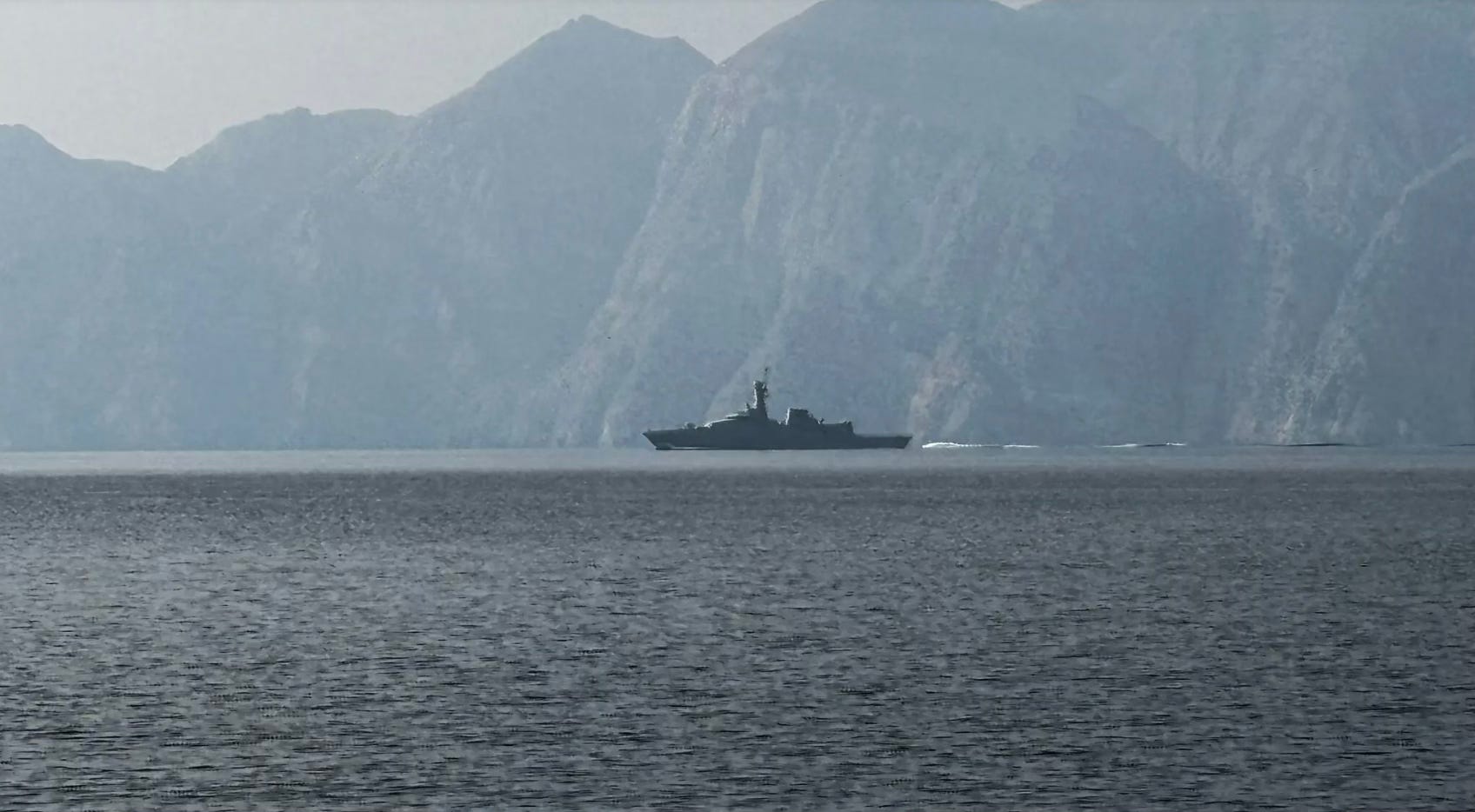
Photo credit: Sahar Al Attar / Agence France-Presse. Naval vessel transits the Strait of Hormuz.
***
The Strait of Hormuz is a natural choke point. It is a narrow channel – approximately 29 nautical miles wide – and it “consists of 2-mile-wide navigable channels for inbound and outbound shipping as well as a 2-mile-wide buffer zone.”
It connects the Persian Gulf to the Gulf of Oman, beginning at the Omani Musandam Peninsula that is jointly controlled by Oman & the United Arab Emirates (UAE), and ending – roughly – northwest of Dubai.
The Strait is deep enough & wide enough to handle the world’s largest crude oil tankers – and is one of the world’s most important oil bottlenecks. Large volumes of oil flow through the Strait – “an average of 20 million barrels per day (bpd) of crude oil and oil products transited the Strait in 2025.”
Nearly 80% – according to the International Energy Agency – was exported to the Indo-Pacific, including China. Very few alternative options exist to move oil out of the Strait if it gets shut down.
***
Therein lies the problem – Iran and the lack of alternative routes (indeed the lack of foresight for the need for alternatives).
Tehran was permitted to build an arsenal of options – unabated – for one purpose: To disrupt commercial shipping through the Strait of Hormuz at a time of its choosing. Iran was given the power to hold an oil-dependent world market hostage as well as its Arab nation neighbors who were meeting that demand.
The world saw this yet chose a path of nonconfrontation to avoid an inevitable conflict that became reality on February 28th.
Today – as the regime’s military, drone and missile programs, uranium enrichment and nuclear weapons program are systematically being destroyed by U.S. & Israeli airstrikes – Tehran’s survival may hinge on its ability to shut down the Strait of Hormuz for an extended period of time, and the survival of their Islamic Revolutionary Guards Corps (IRGC).
As we documented in The Hill last week, the IRGC is the regime’s center of gravity.
Iran can – and has – threatened shipping through the Strait for decades utilizing a vast array of weapon systems at their disposal. Naval vessels, mines, attack drones, IRGC fast attack boats, midget submarines, sea drones – surface & subsurface – global navigation satellite systems (GNSS) jamming, shore-based anti-ship cruise missiles fired from concealed coastal launch sites, and fishing boats laden with explosives. These are now CENTCOM high-payoff targets.
One key question is for how long can Iran hold the Strait of Hormuz hostage? Another – arguably far more important – is whether there is enough strategic patience in Washington to finish the task to eliminate Iran as a threat to the world’s oil supply.
***
The Gulf States are guilty of largely ignoring decades of foreseen problems & only undertaking partial solutions. Defending – as we are today – is one approach. Bypassing the Strait of Hormuz was & still should be another.
Presently, two separate pipelines provide alternatives. Together – at full capacity – they can only provide 42% – 8.5 million barrels per day (mbpd) – of the 20 mbpd averaged in 2025.
The first is Saudi Arabia’s East-West pipeline network commonly known as the Petroline. This is a 750-mile system that transports crude across Saudi Arabia, connecting the Abqaiq oil processing center near the Persian Gulf coast to the port of Yanbu on the Red Sea. It has an estimated capacity of 7 mbpd.
The second is a smaller pipeline in the UAE called the Abu Dhabi Crude Oil Pipeline (ADCOP). It runs about 248 miles from onshore oil facilities at Habshan to the Fujairah export terminal in the Gulf of Oman. It is estimated to handle 1.5 mbpd.
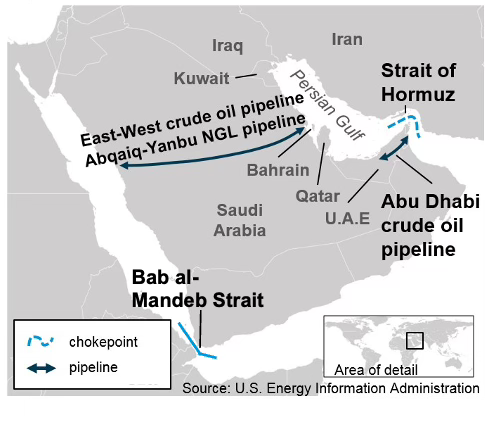
Photo Credit: U.S. Energy Information Administration.
While these alternative routes may provide some relief – it’s not clear how much more they could absorb – they are above-ground pipelines & oil processing centers and therefore are vulnerable to missile & attack drone strikes from Iran & its Houthi rebel proxies in Yemen.
***
Speaking of the Houthi rebels, Abdul Malik al-Houthi stated last week they could escalate militarily in support of Iran, calling it “a battle for the entire nation against the American and Israeli enemy.”
***
Oil tankers looking to gain access to the Red Sea port of Yanbu via the Gulf of Aden through the Bab al-Mandeb Strait – another strategic choke point – will likely face the same threats as those transiting the Strait of Hormuz.
The Bab al-Mandeb Strait is a little over 17-nautical miles-wide and 61-nautical miles-long. It is nested between the Horn of Africa and the southern tip of the Arabian Peninsula that “forms the southern entrance to the Red Sea from the Gulf of Aden.”
Eritrea and Djibouti border it to the west, Yemen to the east. In the strait, the “Perim island dominates the narrowest part of the Bab el Mandeb on the Yemeni side. The Seven Brothers Islands extend from Djibouti a few miles farther south.”
Under normal conditions, approximately 12% of global seaborne oil passes through Bab el-Mandeb, making it the world’s fourth-largest shipping chokepoint.
Oil shipments destined for the Indo-Pacific transiting the Bab el-Mandeb Strait would be forced to run a similar gauntlet as those transiting the Strait of Hormuz.
***
As the Trump Administration knows all to well, Houthi rebels can make securing the Red Sea, Bab el-Mandeb, and Gulf of Aden for commericial shipping a difficult task.
In March 2025, CENTCOM commenced Operation Rough Rider, “an intense and sustained campaign targeting the Houthi terrorist organization in Yemen to restore freedom of navigation and American deterrence” in the Red Sea and ending Houthi attacks on commercial shipping. Fifty-two days later the U.S. ended operations in Yemen following an agreement with the Houthis that the group would no longer target U.S. military vessels or U.S. flagged ships.
The Houthi won by not losing – and remained a threat.
The Combating Terrorism Center at West Point provided an excellent assessment of the operation: “U.S. strikes [1,000] had caused “some degradation,” but the Houthis were in a position to easily reconstitute, regroup, and rebound.”
Lesson learned:
“The goal of the operation was to end the threat of Houthi attacks on commercial shipping in the Red Sea, but that is a goal that can only be accomplished by defeating the Houthis and removing them from power … and that is not something that can be done through air power alone. For that, the United States would need ground troops.”
***
Israel & the U.S. are in the process of removing the Islamic Republic of Iran from power – but for many, not fast enough.
17 days into Operation Epic Fury, the regime still clings to power and as many as 150+ tankers were anchored in open waters outside the Strait of Hormuz and in the Gulf – static targets.
The Institute for the Study of War assesses that:
“CENTCOM clearly planned to suppress Iran’s maritime attacks, regardless of the administration’s reported surprise at the intensity of attacks in the Persian Gulf. The campaign to suppress maritime attacks has multiple phases that mirror the phases of the overall campaign: suppression of enemy air defenses along the coast to enable additional strikes and helicopter patrols; suppression of Iranian ballistic missile and drone attacks; destruction of Iran’s navy; and ultimately, the defeat of Iran’s anti-ship missile and drone capabilities.”
***
We can debate the ‘how we got here’ after the war, but for now completing the mission is the vital task at hand. That means the destruction of the IRGC and creating conditions for safe passage through the Strait of Hormuz.
Coalition building after the fact is a challenge – but it doesn’t change the current situation. Oil is not moving through the strait – costs are going up for everyone.
Trump’s call for countries to contribute to escorting tankers through the strait is reasonable – his delivery though, is not.
It calls for a persuasive argument. The bull in the china shop approach is wearing thin. Demanding support is not a good technique. Neither is threatening NATO. Building upon existing relations works best. Maybe that should be left to CENTCOM Commander Adm. Brad Cooper or the Chairman, Joint Chiefs of Staff Gen. Dan Caine.
***
As Adm. Donegan told Martha Raddatz, the U.S. Navy trains routinely with partner countries throughout the region. In Febuary, they participated in the Middle East region’s largest maritime exercise – International Maritime Exercise (IMX) 2025. The exercise involved more than 5,000 personnel from around 30 nations and international organizations, and was conducted in two locations, Bahrain and Jordan.
The exercise was described as “a 12-day naval training event … designed to enhance regional maritime awareness and the combined capabilities of partner nations to respond to maritime threats … to strengthen theater-to-theater coordination, reducing regional seams and strengthening U.S. and partner nation capabilities and interoperability.”
***
What is becoming increasingly evident is the requirement for a naval coalition – comprised of destroyers, frigates and mine sweepers from Arab states, NATO and the Indo-Pacific – to escort ships through the strait while CENTCOM continues to suppress Iran’s ability to conduct maritime attacks. The capability exists now.
Air superiority enables persistent surveillance along the Iranian coast for CENTCOM to Decide, Detect, Deliver, Access (D3A) and Fix, Finish, Exploit, Analyze, Disseminate (F3EAD) Iranian high-payoff targets threatening maritime traffic.
But as Team Trump learned during Operation Rough Rider, air power alone will not remove the threat or defeat the regime. That will require ‘boots on the ground’ to conduct raids on selected targets and to seize and hold key terrain along the Iranian coast. No one does this better than the U.S. Marine Corps.
On Friday, the Pentagon announced it was deploying an “element of an amphibious ready group [USS Tripoli] and attached Marine expeditionary unit, typically consisting of several warships and 5,000 Marines and sailors” to the region.
This isn’t ending anytime soon. The Strait of Hormuz has become the decisive terrain of this war.
Our money is on CENTCOM to win that fight.
***
ICYMI #1
Jon—on Saturday—appeared on the Main Edition of TVP World’s Evening News to talk about the latest on the war in Iran & its implications in Ukraine. You can watch it here.
***
ICYMI #2
Mark—on Saturday, as well—appeared on Al Qahera News to talk about the war in Iran & a potential Israeli land incursion into southern Lebanon. You can watch it here.
***
Thank you for reading! Jon will see you Monday & Tuesday as Mark will be caring for his brother who is having knee replacement surgery. Please subscribe, comment & share. We truly appreciate it!
Jon & Mark
Follow Jon on X at @JESweet2022 or on Bluesky at @JonSweet.bsky.social. Follow Mark on X at @MCTothSTL or on Bluesky at @MarkToth.bsky.social.