

INTREP360 INTELLIGENCE REPORT
07.04.2026: 250 YEARS OF U.S. NATIONAL SECURITY & WHAT'S NEXT


July 4th, 2026
Greetings!
Happy 4th of July!
We were both around for the Bicentennial in 1976, and since it is highly unlikely that we will be around for the Tricentennial in 2076, we thought we would use today’s INTREP360 Intelligence Report to look back over the past 250 years in the context of U.S. national security and then explore what the next 50 years may entail.
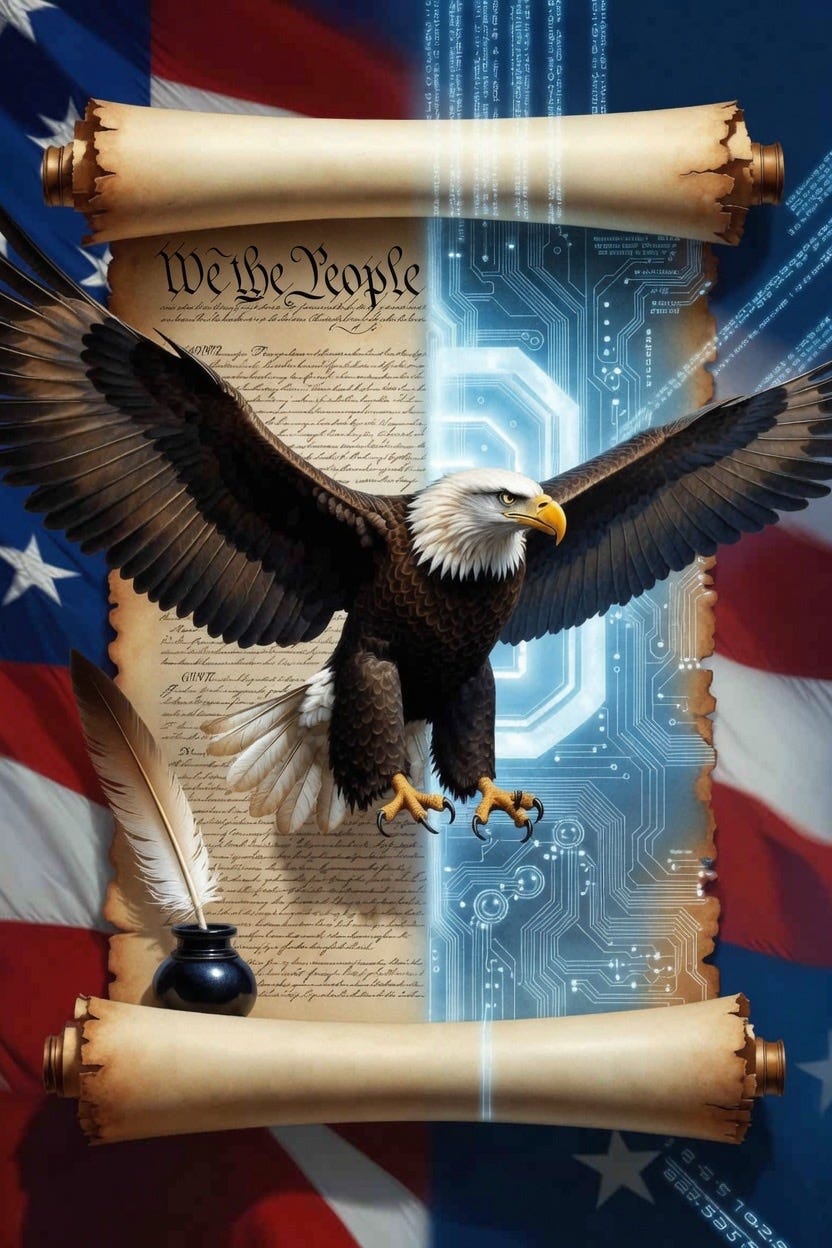
AI Image credit: Grok. Montage representing the history of the U.S. from the adoption of the Constitution in 1787, until now, and into the future.
Benjamin Franklin, after the U.S. Constitution was adopted, was asked what type of government had been created. He famously replied, “A Republic, if you can keep it.”
Thus far, we as a nation and as a people have kept it and often at a bloody and high price in lives and treasure. The spirit and national ethos that was born on July 4th, 1776, resulting in our Constitution eleven years later, are still alive.
So too are the risks to U.S. national security. They were there in 1776, and they are here now 250 years later in 2026.
Our focus today is simply to record how we as a country have addressed national security since its founding. We are not out to judge it, rather we are just aiming to understand it and what it portends for the next 50 years.
Full disclosure. We are children of the 1960s. Embracing new frontiers be it going to the moon or moving into the hi-tech age was seared into our DNA. Was it a God, flag, family and apple pie type upbringing?
Yes, but it also came with an ethos. Look forward and focus on what could be, and not backwards on what was not.
That outlook is very germane to U.S. national security. Our nation’s enemies are not behind us, they are ahead of us.
Let’s get started!
***
1776-1826: SECURING AMERICAN SOVEREIGNTY & THE WESTERN HEMISPHERE
U.S. national security was very much in doubt on July 4th, 1776. Independence from King George had been declared, but the country on day one found itself depending on the largesse of Louis XVI in France.
Essentially, we were very much like Ukraine today. In fighting an existential war, we needed the help of others to win it.
France ultimately gave it to us culminating in the British surrender at Yorktown. Yet despite winning, the security of our country was still very much in doubt given the weaknesses of the Articles of Confederation.
Shays’ Rebellion, albeit a domestic incident, was a stark warning that a weak central government imperiled the nation’s security. By adopting the Constitution, the Founding Fathers set in motion the foundation for future security by creating a stronger executive branch, defining the U.S. military, and creating taxing powers to pay for it all.
There were early challenges.
The first was the Quasi War from 1798-1801 between the U.S. and the French First Republic. It was largely fought at sea in the Caribbean and along the coastline of the U.S. The conflict is what prompted Washington to reestablish the U.S. Navy.
The second was the Barbary Wars from 1801-1805 and 1815-16. They were the U.S. first entry into a foreign war far from the shores of America and were fought against North African pirate states as well as Morocco.
They were the first reality check that U.S. national interests at home could — and often would be — imperiled by foes around the world.
Between those two wars, the U.S. fought a second war with Great Britain known as the War of 1812. It ended in 1815 in the signing of the Treaty of Ghent. Its lasting lesson? U.S. global trade was at risk.
Its result?
The Monroe Doctrine in 1823. President James Monroe during his 1823 message to Congress “warned European powers not to interfere in the affairs of the Western Hemisphere.” It was a start, however, as our nation’s history would prove, U.S. national security ultimately could not — and cannot — be secured in the Americas alone.
***
1826-1876: CONTINENTAL EXPANSION AND DISUNION
Slavery, beyond debate, was our nation’s original sin. The Indian Removal policies during this second 50 years of our history was our second national sin.
It was justified as Manifest Destiny, a destiny that also involved fighting the Mexican-American War from 1846-1848. President James K. Polk ran for president “on a Democratic platform that supported manifest destiny, the ideal that Americans were predestined to occupy the entire North American continent.”
The war ended with the U.S. gaining control of “California, Nevada, Utah, and parts of Arizona, New Mexico, Oklahoma, Colorado and Wyoming.”
The American Civil War erupted in 1861 and would end in 1865. More than 620,000 Americans died which was more than in World War II. It was a reminder, oft-repeated in history, that some of the greatest threats to national security come from within. The outcome, of course, was a far better, more free country.
However, it was at a terrible but necessary price.
Indian wars in the west would finish out these second 50 years and saw the forced resettlement of American Indian tribes onto reservations.
***
1876-1926: INDUSTRIAL RISE AND GLOBAL ENGAGEMENT
The Civil War helped accelerate the rapid industrialization of the U.S. economy. That in turn created a U.S. naval renaissance.
In 1898, the Spanish-American War resulted in the U.S. becoming a Pacific power. In addition to gaining sovereignty over Guam and the Philippines, the U.S. gained control of Hawaii as well as Cuba and Puerto Rico in the Caribbean.
President Teddy Roosevelt, in 1904, instituted what would become known as the Roosevelt Corollary to the Monroe Doctrine. It was soon described as a “Big Stick” approach to U.S. policy of Latin America.
Heavily influenced by Alfred Thomas Mahan, a strong proponent of U.S. sea power, the U.S. dispatched The Great White Fleet on “a global circumnavigation journey from 1907 to 1909, during the presidency of Theodore Roosevelt.” The 16 modern battleships were “painted in a dazzling white color scheme.”
In 1917, the U.S. entered World War I. President Woodrow Wilson’s decision to intervene in the European conflict led to U.S. isolationism in the 1920s. In theory, the U.S. was a superpower but chose to look inward.
Others would notice and eventually in the 1930s and 1940s they would imperil U.S. national security.
***
1926-1976: GLOBAL WAR FOLLOWED BY COLD WAR
The interwar isolationism of the 1920s led to the enactment by Congress of the Neutrality Acts in the 1930s. The laws, which “made it illegal to export “arms, ammunition, or implements of war” from U.S. territory to a belligerent state” would severely hamper President Franklin Roosevelt’s efforts to defend U.S. interests after World War II broke out in 1939.
In 1941, Roosevelt, trying to shake loose from the grip of U.S. isolationism, negotiated and agreed to the Atlantic Charterwith British Prime Minister Winston Churchill. The declaration “provided a broad statement of U.S. and British war aims” ahead of the U.S. actual military involvement in World War II.
The Japanese attacks on Pearl Harbor and U.S. forces in the Philippines ended the isolation and ultimately resulted in the U.S. emerging from World War II as a global superpower, and a nuclear one at that. It also led to the creation of the North Atlantic Treaty Organization (NATO) in 1949, which is still the backbone of U.S. defense.
The founding of the United Nations in 1945 was also a U.S.-led outcome of World War II, including the American role as one of the permanent United Nations Security Council members with full veto power.
Significantly, the postwar period led to a transformation of Washington’s approach to national security. The National Security Act of 1947 created the National Security Council, the Central Intelligence, and the Department of Defense.
It also witnessed the creation of the Truman Doctrine in 1947. Introduced by President Harry Truman during a Joint Address to Congress, it defined the country’s Containment Policy to stop and prevent the spread of Soviet-backed communism. It also introduced the notion of the Domino Theory that if one country fell to communism, then neighboring countries would be at risk of falling too.
Unlike after World War I, Truman made it clear the U.S. was going to stay on the global stage economically and militarily. Likewise, Truman made it clear that the U.S. was willing to assume global responsibilities.
Doing so resulted in the Korean War and later the Vietnam War. Both conflicts tested the limits of containment. Nonetheless, caught in a Cold War with the Soviet Union, the U.S., despite Vietnam War fatigue, persisted.
***
1976-2026: POST COLD WAR, ASYMMETRIC THREATS AND A RETURN TO GREAT POWER COMPETITION
The end of the Cold War in 1991 after the collapse of the Soviet Union witnessed the emergence of new asymmetric threats. The U.S., in effect, was the only remaining global superpower and yet, China was on the rise.
NATO expanded. The U.S. fought the Gulf War in 1990. And then, 9/11 changed everything. Suddenly, non-state actors proved they could be — and were willing to be — major threats to U.S. national security.
Washington, rightly in our view, became obsessed with the notion of Soviet-era briefcase nukes falling into the wrong hands. The fear of a nuclear 9/11 was very real and it still is for those of us who cover U.S. national security, especially the war in Iran, as well as the antics of a nuclear armed North Korea.
The global War on Terror led to the creation of the Department of Homeland Security and wars in Afghanistan and Iraq.
Through it all, China has loomed as an emerging military threat and today, it is now considered by the U.S. to be the country’s pacing threat. Both U.S. political parties have long tried to pivot U.S military focus to the Indo-Pacific, however, as we have long assessed, there is no real pivot to be made. The vast majority of threats facing the U.S. are all interconnected given the Dragon Bear alliance between Beijing and Moscow.
Then, Ukraine changed everything again. Ukrainian use of drones has created a revolution in military affairs. Russia’s invasion of Ukraine in 2022 has now also resulted in a growing divide between the U.S. and its NATO allies.
Plus, Iran, after 47 years of proxy wars against the U.S. via its Axis of Resistance proxies, finally turned into a direct war as President Trump has sought to militarily put an end to Tehran’s nuclear weapons program.
The ending to that war has yet to be written.
***
2026-2076: NEW FRONTIERS?
As we close out this special July 4th edition of the INTREP360 Intelligence Report, we cannot help but wonder what new threats will emerge to imperil U.S. national security. Certainly, country-to-country and asymmetrical threats will continue.
However, new peer-to-peer threats will emerge as well. Russia is beaten in Ukraine but still remains a formidable nuclear power. China, although not yet a force projection country, is rapidly expanding its military capabilities including its nuclear arsenal.
Our guess?
Space and deep-sea domains will increasingly create new threats to U.S. national security. Space, in part, because of a race back to the moon. But also, in part, because of U.S. reliance on military satellites for surveillance, targeting, and command and control.
Why the sea?
Deep sea mining and the continued development of sea drones will create new ways to project military or asymmetrical force on the U.S.
***
***
PROGRAMMING NOTE
Earlier today, Mark taped an episode of Ukraine This Week. It will air on TVP World this weekend and later will be available on YouTube.
The episode covered the latest developments on the war in Ukraine, including touching on the frontlines, and Kyiv’s efforts to take the war to Russia and render the Crimean Peninsula untenable for Russian forces.
***
ICYMI
Yesterday, in our weekday foreign affairs column at The Washington Star, we examined Russian President Vladimir Putin’s latest intentional attacks on Ukrainian civilians in Kyiv. If Putin thinks he is going to destroy their morale, he needs to think again.

Screenshot: Marii Pyatka / Threads. A man distracts an anxious cat with a kitten video during Russia’s massive Thursday attack on Kyiv.
Seeing cat carrier after cat carrier in the Kyiv Metro underground makeshift bomb shelter told us everything we need to know about Ukraine’s determination to defeat Russia.
You can read it here. It is not paywalled at our request.
***
That’s it for today! Ladies and Gentlemen, start your grills! Thank you for reading. We will see you Monday. Please subscribe, comment & share. We truly appreciate it!
Once again, Happy 4th of July!
Jon & Mark
Follow Jon on X at @JESweet2022 or on Bluesky at @JonSweet.bsky.social. Follow Mark on X at @MCTothSTL or on Bluesky at @MarkToth.bsky.social.