

INTREP360 INTELLIGENCE REPORT
07.15.2026: THE BATTLE FOR THE SEA OF AZOV

July 15th, 2026
Greetings!
Ukrainian President Volodymir Zelesnky on June 25th promised 40 days and 40 nights of hell for the Russian military. Ever since, the Armed Forces of Ukraine (AFU) have been delivering on that commitment deep inside of Russia, on the frontlines in the Donbas, in Russian-occupied Crimea, and in the Sea of Azov.
On Tuesday, intentionally or not, Zelensky sent Russian President Vladimir Putin an explosive reminder that today is only the halfway mark. The AFU, using a Ukrainian designed and built Sargan-3000 sea drone, “sank a Russian patrol ship docked in the Black Sea resort town of Gelendzhik.

Photo credit: Alexei Navalny / YouTube. Russian President Vladimir Putin’s purported palace near Gelendzhik.
It was only one vessel, but in sinking it, Zelensky sent Putin three distinct messages. One, it was a Russian Federal Security Service (FSB) ship. The FSB is the successor of the KGB and was Putin’s kingmaker.
Two, it was near his purported Black Sea palace, which is situated on a plot that “is 39 times the size of Monaco.” Three, the FSB boat – named the Izumrud – was used by Russia in 2018 to seize Ukrainian ships in the Kerch Strait.
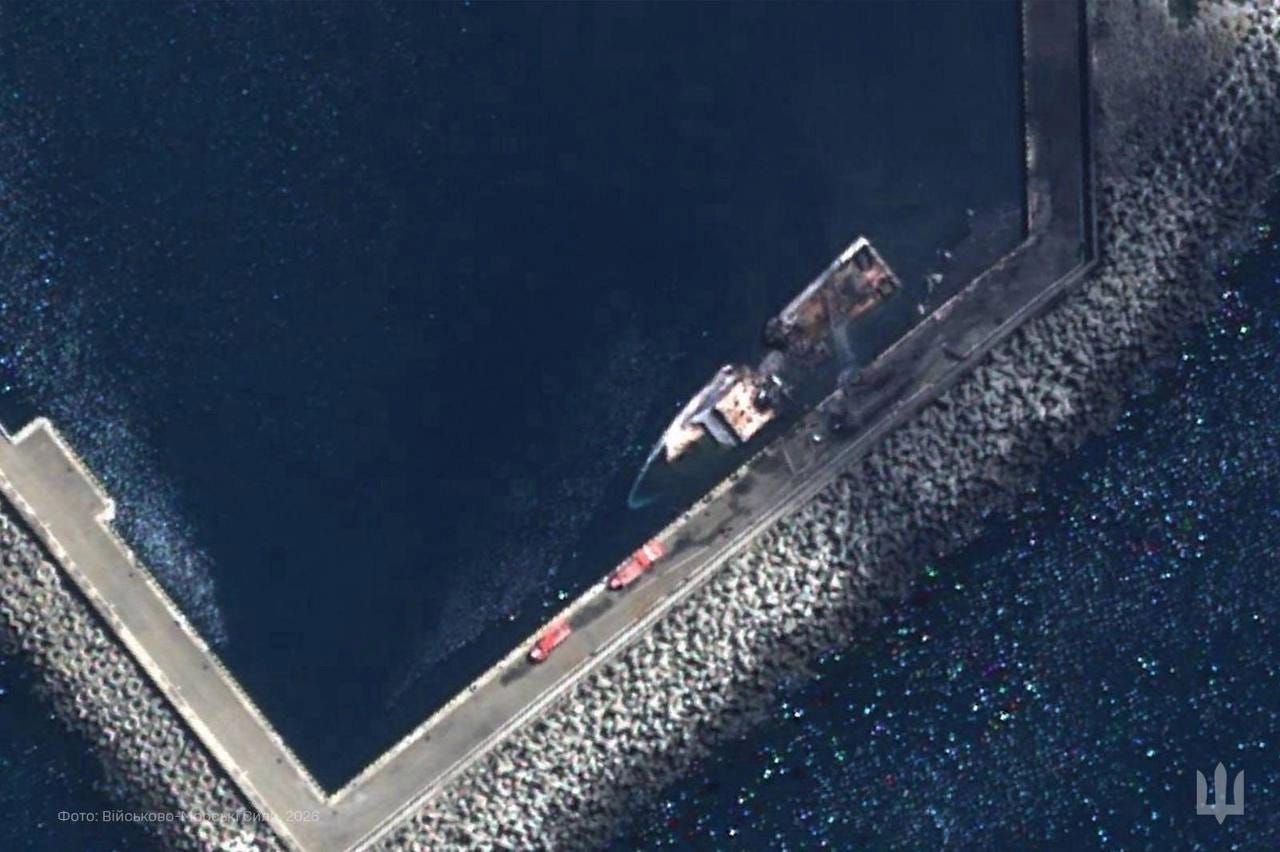
Photo credit: Ukrainian Navy / Telegram. Satellite image showing the wreckage of the Russian FSB patrol vessel Izumrud near Russia’s Novorossiysk, published by the Ukrainian Navy on July 14th, 2026
Essentially, whether he realized it or not, the strike was a reminder of Putin’s past (FSB), his present (the palace), and his future (the almost inevitable AFU dropping of the Kerch Strait bridge connecting the Crimean peninsula to the Russian motherland).
Symbolically, the Izumrud’s destruction is also indicative of the drone fight Ukraine is waging in the Sea of Azov. To date, as part of the AFU’s increasing efforts to render Crimea untenable for Russian military forces, Kyiv has disrupted Russian supply and logistics in the Black Sea and laid siege to its land bridge from occupied-Mariupol.
Now, in addition to by-and-large shutting down the skies over Crimea, Ukraine is taking away one of the Kremlin’s last re-supply routes: shipping via the Sea of Azov.
Let’s get started understanding the Battle for the Sea of Azov and its strategic implications to Crimea and the fate of Putin’s war against Ukraine.
***
BATTLE FOR THE SEA OF AZOV
The AFU – and now is as good a time as any to remind both ourselves and readers that Ukraine effectively no longer has a conventional navy – is in the process of accomplishing what it was able to do in the Black Sea: render it unsafe to Russian shipping.
Kyiv does not have to control the Sea of Azov. Rather, it simply has to deny its use to the Kremlin as a means of resupplying its military forces in Crimea.
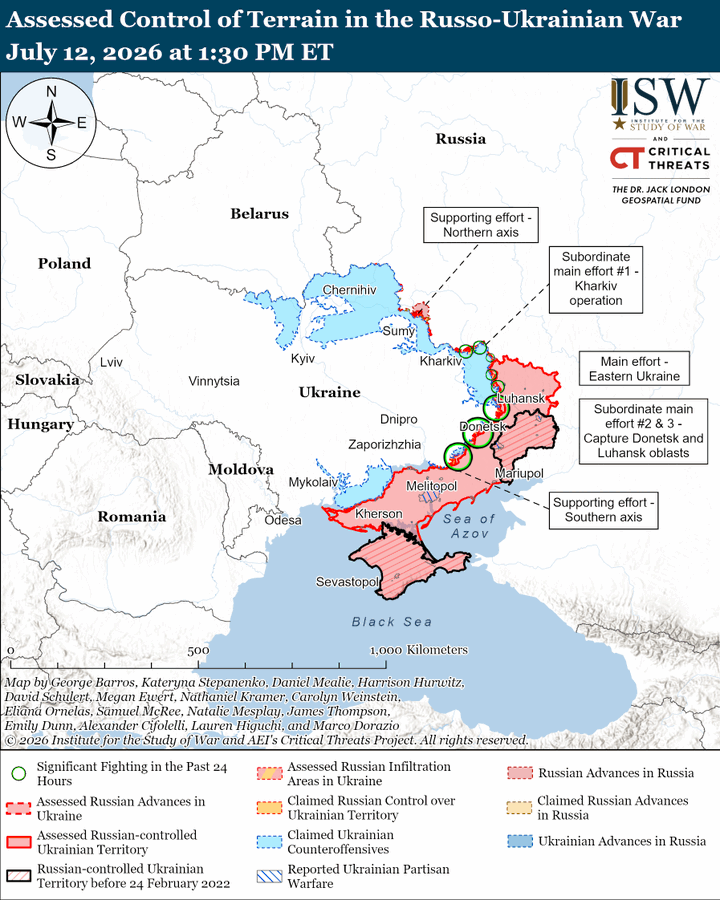
Used with ISW permission. Credit: Institute for the Study of War and AEI’s Critical Threats Project. ISW map showing Ukraine, surrounding countries, the Black Sea, and the Sea of Azov.
Plus, there is an added benefit for Ukraine. The fight over the world’s shallowest sea is also resulting in the sinking of large numbers of Russia’s shadow fleet. The tankers are crucial for supplying oil to Crimea and also for transporting oil to prop up Putin’s teetering economy as a result of AFU attacks on Russian oil & gas infrastructure.
Ukraine, for every tanker they hit, is killing two Russian birds with one stone, or drone as it is in reality.
Last week, on July 8th, Maj. Robert Brovdi, who is the commander of Ukraine’s Unmanned Systems Forces, and better known by his callsign “Madyar,” announced that the AFU had hit nine Russian shadow fleet tankers operating in the Sea of Azov.
One day earlier, Brovdi announced that eight Russian tankers had been struck in the same waters transiting to or from Crimea. He boasted that his unit was achieving “industrial-level results” and that “the battle for fuel for Crimea in the Sea of Azov continues.”
Brovdi listed the following Russian tankers: Venera-3, Sanar-1, Sanar-17, Climene, Teti, Aleksey Savrasov, and Penelope.
Taking his cue from Zelensky’s characterization of deep strikes against Russia as the best form of sanctions, Brovdi declared that “Sanctions from the skies by the Freedom-Loving Ukrainian Birds of the Unmanned Systems Forces are in effect.”
They are indeed. And, at least for now, they are winning the battle for the Sea of Azov. What had once – symbolically speaking – been a Russian lake, is now a target rich Ukrainian hunting ground for Russian tankers, container ships, and naval vessels.
Thus far, according to our friends at The Institute for the Study of War, “Ukrainian forces have struck 90 Russian oil tankers in the Sea of Azov since July 6th.”
***
414 MAGYAR’S BIRDS
AFU warriors serving and fighting on the frontlines are the true heroes of Ukraine’s defense against Russia’s illegal invasion. Yet, so far, its unsung heroes are the men and women with controller sticks in their hands as they guide Ukrainian unmanned drones to their targets in Crimea, the frontlines and deep inside Russia.
For every parent of our generation – including us – who cautioned our kids that playing Halo on Xbox too much would hurt their futures, we stand corrected. Those hand-eye coordination skillsets and problem-solving capabilities have arguably helped Ukraine save its national identity from Russian tyranny.
One such AFU unit, 414th Separate Unmanned Strike Aviation System Brigade, is a perfect example of why Ukraine’s drone war in the Sea of Azov has been so effective. The brigade, better known as Magyar’s Birds, has, as we noted in The Washington Star, been responsible for repeatedly turning the lights out in Crimea.
In addition to hitting electrical substations, Magyar’s Birds, using Ukrainian kamikaze deep-strike drones, have hit military bases, air defense systems, early warning and surveillance radar, and seaports throughout the Black Sea peninsula.
As a result, Russian forces on Crimea are enduring severe gas shortages, forcing occupation officials to ration petrol. Russian armies typical move in two ways: on rail and in trucks. Ukraine’s Magyar’s Birds are increasingly denying both to Russian troops throughout the Crimean peninsula leaving it more and more isolated.
Now, Magyar’s Birds are coming for Russia by land, sea, and air. Even more significantly, the Kremlin is failing to stop them.
***
LIGHTS OUT FOR PUTIN?
As we observed on June 25th in The Hill, Putin’s reign in Moscow may not survive the fall of Crimea. Its loss would likely be too much for him to explain away to the FSB kingmakers in Moscow who undoubtedly are already beginning to see him as a liability.
Nonetheless, dictators are hard to get rid of. Especially ones like Putin who has built a police state that serves to protect him.
Is Putin as scared as we think he is?
We say yes.
Need proof?
Today, his aide Nikolai Pastrushev – out of nowhere – announced that “Russia’s naval forces are on full alert.”
When Moscow pulls out its nuclear teddy bear – as we call it – you know Putin has had a bad day. Actually, in terms of 2026, he has had a bad day, bad week, bad month, bad first two quarters, and you get the drift.
How do we know?
A little bird named Magyar told us.
***
PROGRAMMING NOTE
Tomorrow, in our weekly 7 AM ET Thursday national security column at The Hill in Washington, D.C., we examine the walls closing in on Russian President Vladimir Putin as Ukraine keeps aggressively pursuing its advantage.
You can read it here when it goes live.
***
ICYMI #1
Mark appeared on Pakistan TV earlier today. He discussed the latest prospects for peace between the U.S. and Iran.
He also examined the potential economic impact of the Houthis – at Iran’s direction – closed the Bab el-Mandab Strait leading to the Red Sea and Suez Canal.
Mark also pointed out, as we argued today in The Washington Star, that the Islamic Revolutionary Guard Corps is likely miscalculating when it comes to weaponizing its so-called Axis of Resistance against the Arab world.
You can watch the episode here. It is in English. Due to a breaking news interview, Mark’s segment does not start until the 18:10 minute hash mark.
Program note: Due to a technical difficulty, Mark could not hear the co-panelist when he was answering questions.
***
ICYMI #2
Today, in our weekday foreign affairs column at The Washington Star, we urged the White House to seize the opportunity to stop Iran’s Axis of Resistance.
We also pointed out that there is an awakening in the Arab world – especially Lebanon and Yemen – that the Axis of Resistance is really a Shia Crescent aimed at the Sunni states, just as Jordanian King Abdullah II warned in 2004.

Photo credit: World Economic Forum. King Abdullah II speaks in Davos in 2003.
You can read it here. It is not paywalled at our request.
***
Thank you for reading. We will see you tomorrow. Please subscribe, comment & share. We truly appreciate it!
Jon & Mark
Follow Jon on X at @JESweet2022 or on Bluesky at @JonSweet.bsky.social. Follow Mark on X at @MCTothSTL or on Bluesky at @MarkToth.bsky.social.