

INTREP360 INTELLIGENCE REPORT
03.18.2026

March 18th, 2026
Greetings! I am flying solo for one more day. Mark will be back tomorrow. For those keeping track, we’re on Day 19 of the joint U.S.-Israeli Operation Epic Fury & Operation Roaring Lion—the war with the Islamic Republic of Iran.
Despite anti-Trump & Netanyahu backlash, U.S. Central Command (CENTCOM) & the Israeli Defense Forces (IDF) are making progress against a resilient regime.
The objectives are clear, the pathways are well defined, & they are being met. Too slow for some, which is hard for many to grasp. The Netflix generation can’t understand why this can’t be accomplished in one 60-minute episode.
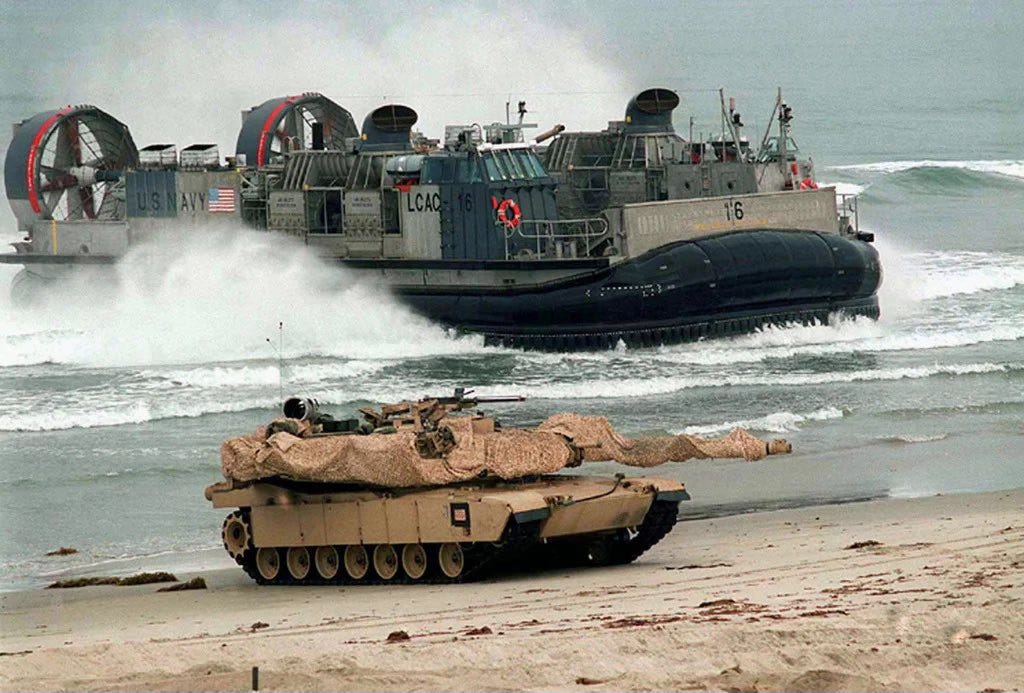
Photo credit: U.S. Navy. Amphibious landing craft & Abrams M1 tank.
We are becoming victims of our own success. But war isn’t a video game. It does play out in clearly defined chapters.
Condition setting is essential for progression to the next phase. Metrics matter. They determine whether or not conditions have been set—and not the passage of time. As I have said on many occasions, the enemy gets a vote.
Let’s take a closer look.
***
Stated or not by Washington & Jerusalem, there is one overarching political objective here: regime change
There are also several military objectives: destruction of the Iranian military; destruction of Iran’s ballistic missile and drone program; destruction of Iran’s ability to enrich uranium; destruction of Iran’s nuclear weapon program; and denying Iran’s ability to fund its extensive proxy network throughout the Middle East—most notably, Hamas, Hezbollah, & the Houthi rebels in Yemen.
The division of effort to achieve these objectives has been divided between the United States & Israel. The U.S. is taking on the military objectives while Israel takes on the political objective. They are complementary.
Between the two, the end state is an Iran—Persia—free from the autocratic Islamic theocracy and an Islamic Revolutionary Guard Corps (IRGC) that keeps them in power. A peaceful contributing partner with the other Gulf nation states, Israel, & the U.S.
***
On February 28th, Israeli Prime Minister Benjamin Netanyahu took his message to the Israeli people making his case for war and ultimately, regime change: “The aim of the operation is to put an end to the threat from the Ayatollah regime in Iran … Together with the United States, we will strike hard at the terror regime and create conditions that will allow the brave Iranian people to cast off the yoke of this murderous regime.”
Then the Israeli Air Force (IAF) proceeded to do just that, initiating the operation with a decisive strike on the security compound & personal residence of then-Supreme Leader Ayatollah Ali Khamenei in Tehran, killing him & as many as 40other senior Iranian officials.
So far, the kill list includes Ali Shamkhani, Secretary of Iran’s Defense Council; Major General Abdolrahim Mousavi, Chief of Staff of Iran’s Armed Forces; Brigadier General Aziz Nasirzadeh, Iran’s Minister of Defense; Brigadier General Mohammad Pakpour, Commander-in-Chief of Iran’s IRGC; & Mohammad Shirazi, Head of the Supreme Leader’s Military Bureau.
Three days later, the IDF bombed a building in Qom, where 88 members of the Assembly of Experts had gathered to elect Iran’s new supreme leader. Despite the attack, according to the Iran International, the clerics, “under pressure” from the IRGC, elected Mojtaba Khamenei—the son of Ali Khamenei—as the new Supreme Leader.
Mojtaba has not been seen since February 28th. It is believed he was seriously wounded in the opening strike—possibly even evacuated to Moscow for medical treatment—creating a significant leadership void. One that is likely to be filled by the IRGC.
But within the past 48 hours, Israel has killed Esmail Khatib, Iran’s Intelligence Minister; Brigadier General Gholamreza Soleimani, commander of the Basij paramilitary force of the IRGC; Brigadier General Ebrahim Mortazavi-Nasab, commander of the Sarallah IRGC Basij Resistance District in Shiraz; & Ali Larijani, the head of Iran’s Supreme National Security Council and the regime’s de facto leader after Ali Khamenei was killed.
Israel is removing the head from the Hydra—one senior Iranian leader at a time, and then their replacements.
Major General Shlomi Binder—the head of the IDF’s Military Intelligence Directorate—commented that regime leadership is “only now waking up to what’s been done to them and how badly they miscalculated us. Their command structure is shattered, their capabilities stripped down to the bone. What you’re seeing launched now is whatever scraps they can still push out. That’s their ceiling. Fighters are hiding under relentless pressure from our airpower and the U.S., others too scared or simply not capable. We’re sealing their tunnels day after day, cutting off any path to more missiles. They’re choking under the pressure; they are in distress”
But to ‘allow the brave Iranian people to break free from this murderous regime’ the IDF had to turn their attention to the regime’s center of gravity—the IRGC & their Basij paramilitary force—at the street level.
And that’s exactly where they took the fight. Yesterday, the IDF struck Basij force members at their checkpoints throughout Tehran—10 in total. They are relying in part on targeting information sent by ordinary Iranians for these strikes, which are “inflicting deep and ongoing blows to the capabilities of the Basij unit.”
According to Iran International, “around 300 Basij commanders and field officials were killed in a wave of overnight strikes.”
From the top of the food chain to the bottom, Israel is setting conditions for regime change by systematically eliminating senior leaders & the foot soldiers who carry out their orders.
***
On February 28th, President Donald Trump also delivered a message to the American people—telling them “Our objective is to defend the American people by eliminating imminent threats from the Iranian regime.”
To the Iranian people, his message was, “Finally, to the great proud people of Iran, I say tonight that the hour of your freedom is at hand. Stay sheltered. Don’t leave your home. It’s very dangerous outside. Bombs will be dropping everywhere. When we are finished, take over your government. It will be yours to take. This will probably be your only chance for generations.”
Then, the President turned to CENTCOM to prosecute the war––to achieve their military objectives. Less than 100 hours into the war, the CENTCOM Commander, U.S. Navy Admiral Brad Cooper, provided a clear and concise operational update, detailing the threat environment, the phases of the operation, their task and purpose, providing a battle damage assessment, and the way ahead.
He concluded by assuring the American public that “We will continue to conduct dynamic targeting operations. We’re hunting Iran’s last remaining mobile missile launchers to eliminate their launch capabilities. Iran’s ability to hit us and our partners is declining, while our combat power is building. My overall operational assessment is that we are ahead of our game plan.”
But for some, not fast enough as oil tankers were beginning to stack up in the Persian Gulf, & the cost of gas was going up. CNN reported that the “Pentagon and National Security Council significantly underestimated Iran’s willingness to close the Strait of Hormuz in response to U.S. military strikes while planning the ongoing operation.” And that the President’s national security team failed to fully account for the potential consequences of what some officials have described as a worst-case scenario now facing the administration.”
The report was immediately rebuffed by Senator Tom Cotton (R-AR), who serves as the Chair of the Senate Intelligence Committee, and Former U.S. Navy SEAL and now Senator Tim Sheehy (R-MT).
The Institute for the Study of War added that, “CENTCOM clearly planned to suppress Iran’s maritime attacks, regardless of the administration’s reported surprise at the intensity of attacks in the Persian Gulf. The campaign to suppress maritime attacks has multiple phases that mirror the phases of the overall campaign: suppression of enemy air defenses along the coast to enable additional strikes and helicopter patrols; suppression of Iranian ballistic missile and drone attacks; destruction of Iran’s navy; and ultimately, the defeat of Iran’s anti-ship missile and drone capabilities.”
CENTCOM would have to adjust its battlefield calculus—known as a branch—and begin applying additional pressure on the political objective—the Strait of Hormuz and the Iranian forces that could affect safe passage through the strait. Namely naval vessels, mines, attack drones, IRGC fast attack boats, midget submarines, sea drones—surface & subsurface—global navigation satellite systems (GNSS) jammers, shore-based anti-ship cruise missiles fired from concealed coastal launch sites, and fishing boats laden with explosives.
Yesterday they dropped “multiple 5,000-pound deep penetrator munitions” on hardened Iranian missile sites along Iran’s coastline by the Strait of Hormuz. Soon, 5,000 Marines will be available to conduct raids and secure key terrain along the coastline – if required.
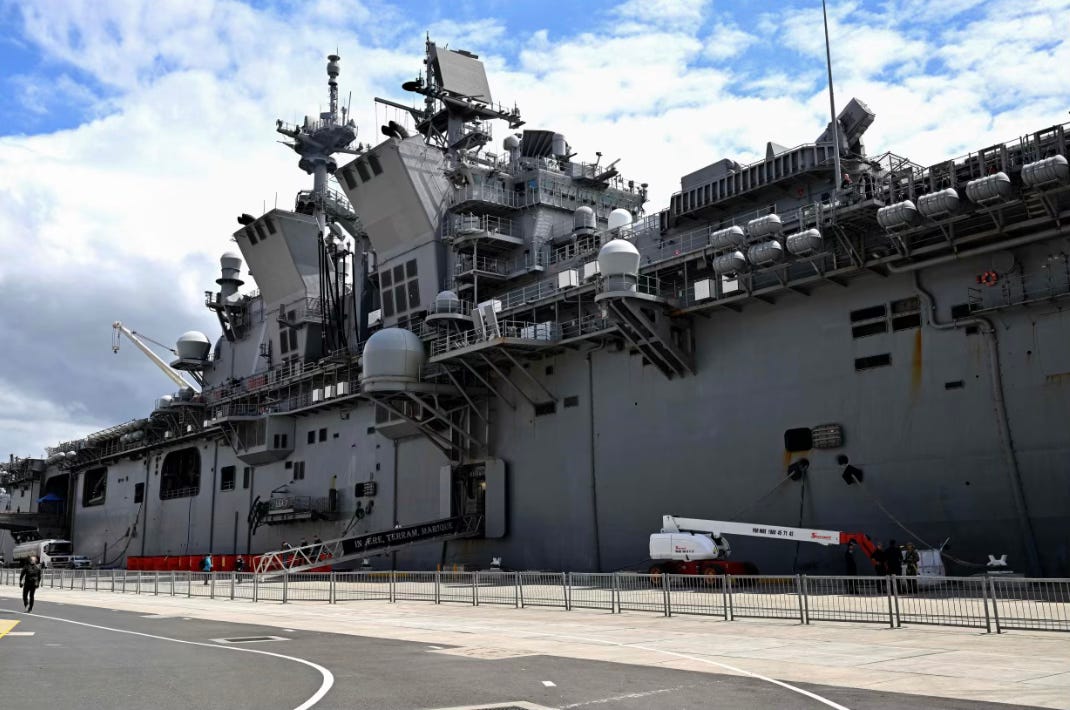
Photo credit: Saeed Khan / AFP. USS Tripoli amphibious assault ship.
CENTCOM is also setting conditions by rendering the Islamic Regime of Iran & its military combat ineffective.
***
So, is the U.S.-Israel coalition winning? As a matter of metrics—yes.
But metrics don’t win wars as North Vietnamese Colonel Tu reminded Colonel Harry Summers in July 1974 when he returned to Vietnam as chief of the Negotiations Division of the Four Party Joint Military Team. Summers told Tu, “You know, you never beat us on the battlefield.” Tu’s response was rather pointed, “That may be so, but it is also irrelevant.”
The Strait of Hormuz could become Trump’s Tet Offensive—and he needs to get in front of it.
***
That said, not everyone agrees that Trump’s strategy is losing. A recent opinion article written by Muhanad Seloom in Al Jazeera—yes, that Al Jazeera—concludes that the US-Israeli strategy against Iran is actually working, and that critics are using the wrong metric. “They are cataloguing the price of the campaign while ignoring the strategic ledger” and “treating the costs of action as if the costs of inaction were zero.” He backs his position by saying:
“When you look at what has actually happened to Iran’s principal instruments of power—its ballistic missile arsenal, its nuclear infrastructure, its air defenses, its navy and its proxy command architecture—the picture is not one of U.S. failure. It is one of systematic, phased degradation of a threat that previous administrations allowed to grow for four decades … What I see in the current campaign is a recognizable military operation proceeding through identifiable phases against an adversary whose capacity to project power is collapsing in real time.”
Concerning the regime: “This is a force [Iran] managing decline, not projecting strength.”
He concludes by saying “the absence of a public diplomatic blueprint [post-conflict framework] does not mean the military campaign is failing. It means the campaign is ahead of the diplomacy, a sequencing problem, not a strategic one. The military conditions for a durable settlement—Iranian missile capacity too degraded to rebuild quickly, nuclear infrastructure inaccessible, proxy networks fragmented—are being created right now.”
This really is a good read. It is a simple observation from one man on the ground devoid of any political slant.
***
PROGRAMMING NOTE!
Tomorrow, our weekly 7:00 AM ET national security column at The Hill in Washington, D.C., focuses on the U.S. military’s Achilles’ heel.
You can read it here when it goes live.
***
ICYMI!
I was on Al Qahera News earlier today in Cairo, Egypt to discuss the latest on the war in Iran. The other guest panelist––to say the least––didn’t share my assessment.
You can watch it here.
***
Thank you for reading! We will see you tomorrow. Please subscribe, comment & share. We truly appreciate it!
Jon & Mark
Follow Jon on X at @JESweet2022 or on Bluesky at @JonSweet.bsky.social. Follow Mark on X at @MCTothSTL or on Bluesky at @MarkToth.bsky.social.
Thank you for reminding us what all the objectives are !