

INTREP360 INTELLIGENCE REPORT
03.04.2026
March 4th, 2026
Greetings! It is Day 5 of the war in Iran & we thought it would be a good idea to pause & reflect upon where we are at. Jon takes the lead tonight & thus what follows is strictly from a warfighter’s perspective.
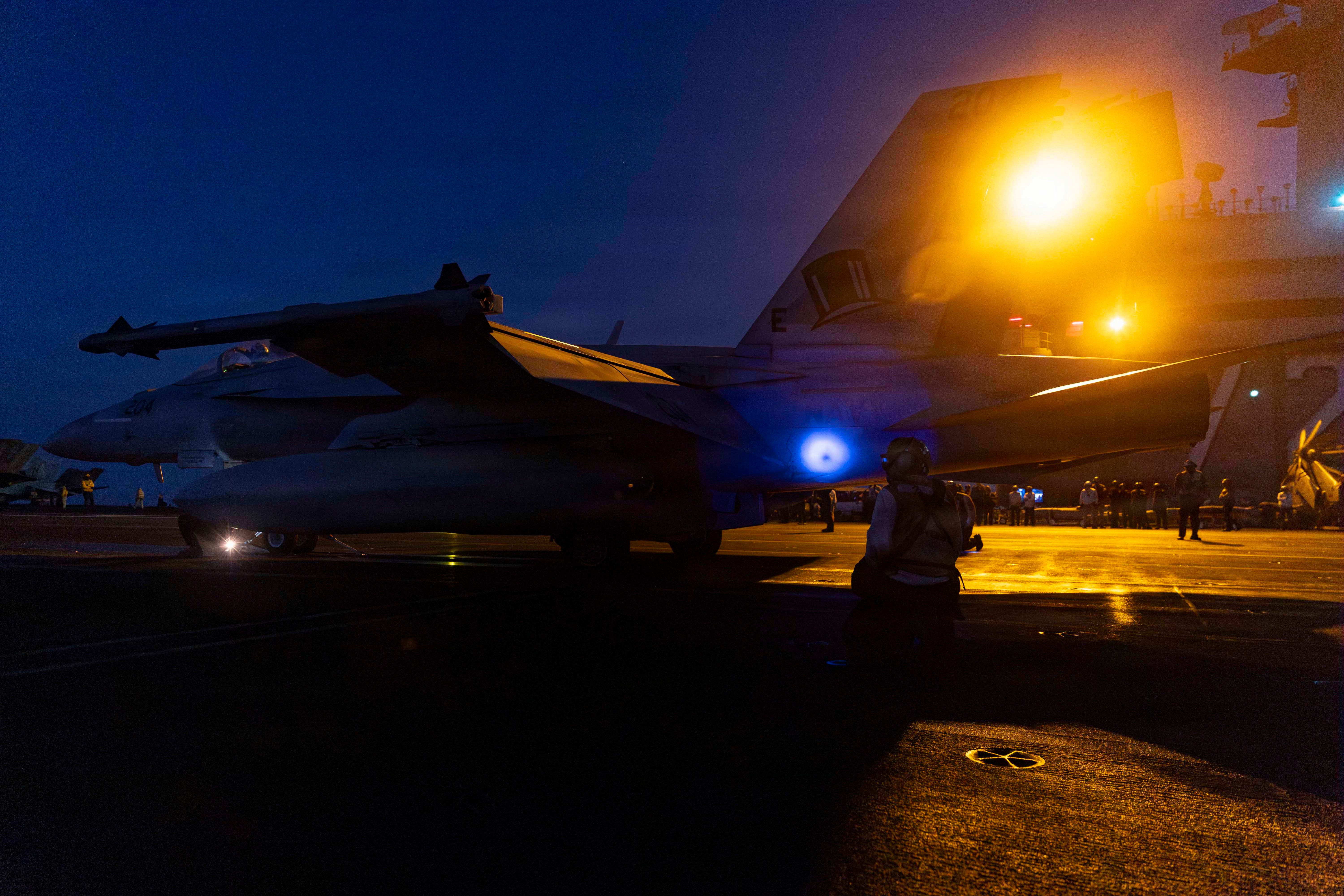
Photo credit: U.S. Navy. F-18 prepares to launch off of the USS Abraham Lincoln as part of Operation Epic Fury.
Mark posed this question earlier to Jon: Is the U.S. any closer to achieving its objectives in Iran & across the Middle East?
Let’s get started! Jon’s answer follows!
***
The short answer is yes––but is that good enough? U.S. Central Command (CENTCOM) Adm. Brad Cooper started answering that caveat yesterday. He delivered an operational update on the war in Iran to the American people via a video update.
Cooper described Operation Epic Fury as an “unprecedented operation to eliminate Iran’s ability to threaten Americans.”
He highlighted the successes—including—2000 targets struck in less than 100 hours; severely degrading Iran’s air defenses and destroying hundreds of Iran’s ballistic missiles, launchers & drones.
17 Iranian naval ships—actually, now 20 plus—were sunk in the first four days of the war that began on February 28th with the killing of Iranian Supreme Leader Ali Khamnenei as his top military aides gathered to meet at his compound in Tehran.
Consequently—per Cooper—there is not a single Iranian ship underway in the Arabian Gulf, Strait of Hormuz or Gulf of Oman.
Cooper assured Americans that, “We will continue to conduct dynamic targeting operations. We’re hunting Iran’s last remaining mobile missile launchers to eliminate their launch capabilities. Iran’s ability to hit us and our partners is declining, while our combat power is building. My overall operational assessment is that we are ahead of our game plan.”
The CENTCOM commander concluded by saying, “We, alongside our partners, will absolutely achieve our military objectives.”
***
Nonetheless, as we enter the 5th day of Operation Epic Fury, a few time-honored realities of warfare have resurfaced. As Helmuth von Moltke—Chief of the Prussian and German General Staff surmised in the 1800s—“No plan survives first contact with the enemy.”
Supreme Allied Commander Gen. Dwight D. Eisenhower would add nearly a century later during World War II, that “In preparing for battle, I have always found that plans are useless, but planning is indispensable.”
Then on Monday, Rajan Menon and Daniel R. DePetris reminded us that “War, once unleashed, can produce all manner of unintended consequences, including some that prove uncontrollable and enduring.”
So yes—as we have stated on many occasions—the enemy always gets a vote & the Islamic Republic of Iran is no different.
Iran got its vote & chose to attack its Arab nation neighbors, oil refineries, commercial shipping and U.S. facilities––namely Embassies & bases throughout the Middle East––with ballistic missiles and drones.
***
That begs the question whether those strikes have any unintended consequences for Iran. If so, did they serve to further isolate Tehran from the Arab world?
Simply put, yes. Iran—as both of us noted on Al Qahera News in Cairo, Egypt—miscalculated & failed to read the region.
The Gulf states expressed outrage—indeed, condemned—the Iranian attacks in what Laura Kelly described as a “rare show of unity in pushing back against Tehran in the wake of U.S. and Israeli strikes against the country.”
Soon after, Saudi Arabia—seen as the primary leader of the Arab nations—announced it would aid countries in repelling Iranian attacks. They were not alone. Others quickly followed in fighting back against Iran.
Today, Qatar Emiri F-15 fighter jets shot down two Iranian Soviet-era Su-24 tactical bombers en route to bomb al-Udeid Air Base—a key strategic regional base that houses 10,000 U.S. service members. Qatar Emiri air defense systems also intercepted seven ballistic missiles, while Air Force & Naval forces intercepted five drones.
***
Iran clearly had not achieved its objective—to create a regional war—so today it launched a ballistic missile towards Turkey, which was destroyed by a NATO air defense system stationed in the eastern Mediterranean.
The net effect?
Tehran—wittingly or not—foolishly united NATO & the greater Arab world against Iran in a way not witnessed since the first Gulf War. Iran—needing allies—is only succeeding in making new enemies.
Even Russia & China—their putative allies—likely now view the Islamic Republic of Iran as a lost cause.
***
Militarily speaking, Iran has been conventionally routed. Its top leadership is dead. The U.S. & Israel achieved air superiority in less than two days. Its navy is now largely sunk. Plus, military bases, critical infrastructure, & mobile missile launchers are being methodically destroyed by Washington & Jerusalem.
Plus—significantly—the Islamic Revolutionary Guard Corps and their affiliates, including the Basij, are being neutralized. Even its external support—chiefly from Russia & China—has been effectively marginalized.
***
Indeed, as Adm. Cooper explained, all of the items on Washington & Jerusalem’s checklists are systematically getting checked off—save one. The regime—Khamenei’s legacy—remains in place.
Plus—equally importantly—the Iranian people have not yet risen to ‘take back their country’ as President Donald Trump encouraged them to do.
Asymmetrically, the regime remains intact & is wreaking havoc. For now, ballistic missiles & attack drones continue to significantly restrict commercial traffic through the Strait of Hormuz, while the threat of Iranian terrorist attacks throughout Europe and possibly the U.S. remains a viable option for Iran.
Nonetheless, the walls are closing in though—albeit slowly. For Iran, the longer Tehran can drag out the war, the better.
Iran’s techniques are not designed to win a shooting war; rather, to survive long enough to win the war of public opinion. To divide support, create friction amongst allies—the United Kingdom, France, and Spain to date—and influence public opinion across the world against the U.S. and Israel.
Or—more succinctly—to create the illusion that this is yet another unwinnable ‘forever war’ that the Mideast too often produces. To that end, Mohammad Mokhber—a senior aide to the former Supreme Leader Ali Khamenei told reporters today––that Iran has no intention of negotiating with the U.S.
Significantly, he claimed that Iran can continue fighting across the Middle East for as long as needed.
The question remains. What happens when the U.S. & Israel accomplish their military objectives? What is the forcing function––the defeat mechanism––to get surviving regime leadership to cry ‘no más?’
Can the regime remain in power if all the U.S. & Israeli military objectives are accomplished? What level—if any—of Iranian regime diminishment is acceptable?
If so, does Trump declare victory? And if he does, will Israeli Prime Minister Benjamin Netanyahu let him?
Stay tuned!
***
PROGRAMMING ALERT!
Tomorrow, at 7:00 AM ET, our weekly Thursday national security column goes live at The Hill in Washington, D.C.
We argue that with Iran under fire, the Putin-Xi Axis of Evil is reeling. You can read it here when it goes live.
***
Thank you for reading! We will see you tomorrow. Please subscribe, comment and share. We truly appreciate it!
Jon & Mark
Follow Jon on X at @JESweet2022 or on Bluesky at @JonSweet.bsky.social. Follow Mark on X at @MCTothSTL or on Bluesky at @MarkToth.bsky.social.
" What level—if any—of Iranian regime diminishment is acceptable? " : the Iranian people will eventually decide, not us.