

INTREP360 INTELLIGENCE REPORT
04.10.2026

April 10th, 2026
Greetings!
Earlier today, President Donald Trump—in response to a question about Iran & the prospects for a peace deal—told the New York Post that, “We’re going to find out in about 24 hours. We’re going to know soon.”
Indeed, we will.
Especially about Team Trump’s negotiating posture. Is Vice President JD Vance going to dictate terms for Iran’s unconditional surrender—as Trump has called for several times—or is he there to negotiate a deal?
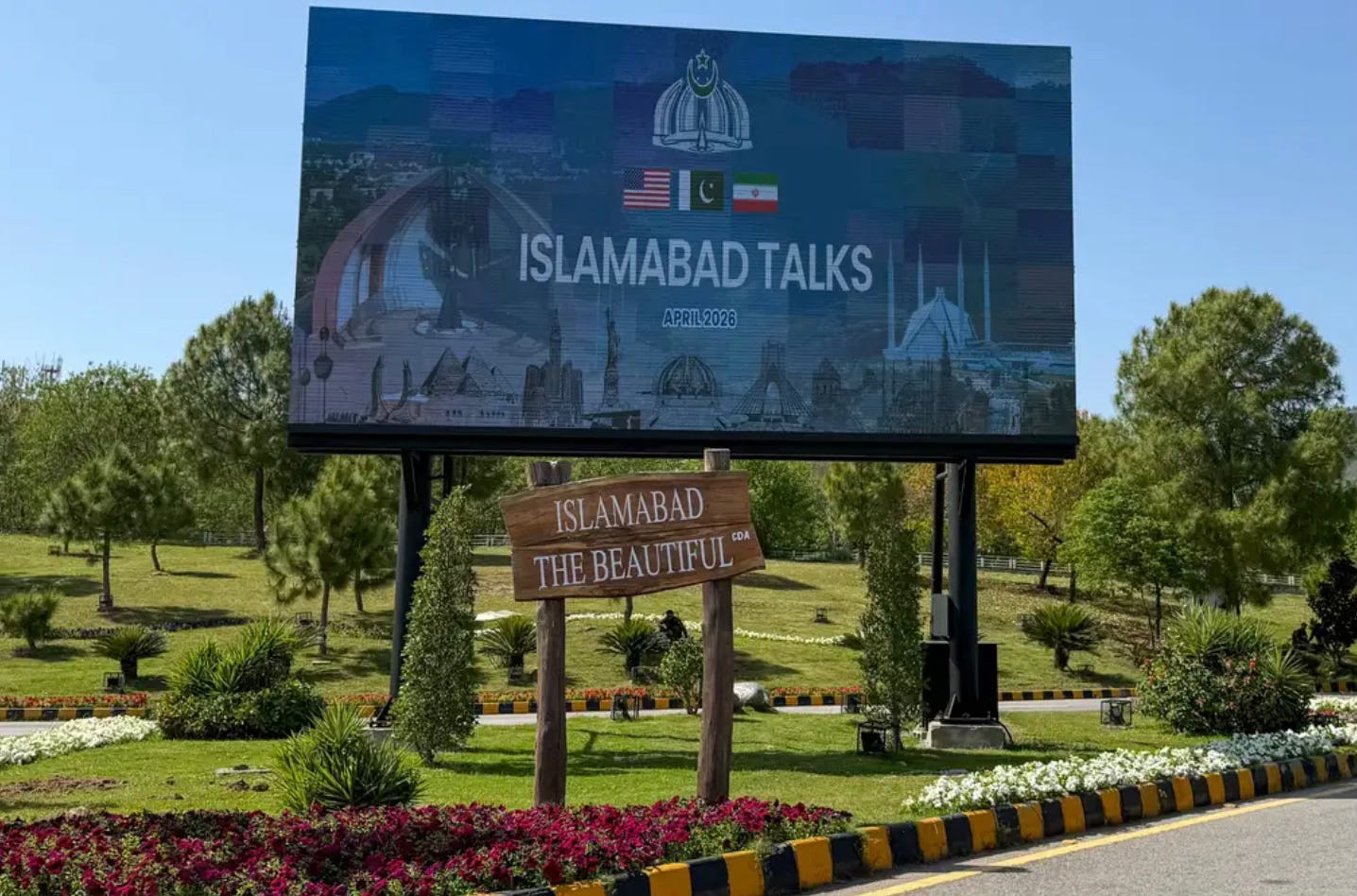
Photo credit: Ilya Ryzhovi / ITAR. Sign in Islamabad, Pakistan welcoming the peace delegations from the U.S. & Iran on April 10th, 2026.
We also will likely learn more about who—if anyone—is really in control in Iran or if, as some analysts are speculating, there is a growing divide between the Mullahs, the Islamic Revolutionary Guard Corps (IRGC) & the political leadership.
Ahead of tomorrow’s peace talks in Islamabad, Pakistan, we thought it would be helpful to our readers if we prepared a background primer. There is a lot of noise out there coming from all sides. We will do our best to sift through it for you.
Let’s get started!
***
SETTING CONDITIONS
Today, predictably, was a day of each side setting conditions. Iran, somewhat childishly, played a game of threatening not to participate unless the U.S. imposed a ceasefire between Hezbollah & Israel in Lebanon & unblocked all Iranian assets.

Mohammad-Bagher Ghalibaf, the Speaker of the Iranian Parliament, knows Team Trump is unlikely to agree to both. Yet in playing his game, that tells us that Iran views saving Hezbollah as a regional strategic check on Israel is one of its main priorities. Sanctions relief—while clearly needed by Iran—is just distraction.
It also tells us that Ghalibaf fully understands that the IRGC’s chief priorities—continued uranium enrichment, support for Iran’s Axis of Resistance proxies, and control of the Strait of Hormuz—must be his own in Islamabad.
Getting there won’t be easy. Especially since earlier today, Trump clearly had enough of Ghalibaf’s gamesmanship. In a Truth Social post, he stated that, “The Iranians don’t seem to realize they have no cards, other than a short-term extortion of the World by using International Waterways.”
Trump then proceeded to set conditions too. He essentially told Ghalibaf to show up or die, noting “The only reason they are alive today is to negotiate.”
***
SHIPS PASSING IN THE NIGHT
Yet, going into these negotiations—as Mark noted earlier today on Al Qahera News in Cairo, Egypt—there is a fundamental disconnect between Washington & Tehran. Team Trump believes it has already won the war because in large part the U.S. has substantively destroyed much of Iran’s conventional military capabilities.
Conversely, Iran believes it is winning for two reasons: (1) the regime, even if faces are changing due to targeted U.S. & Israeli killings, remains in control of Iran and (2) Tehran remains in control of the Strait of Hormuz.
Each side has a different definition of winning & that is likely to create problems at the negotiating table tomorrow in Islamabad. Trump—in our view—is unlikely to get the deal he wants unless he can defeat Iran on terms the IRGC will understand.
***
GENERATIONAL DEFEAT
Make no mistake. Iran has—as Adm. Brad Cooper, the Commander of U.S. Central Command (CENTCOM) asserted today—suffered a “generational military defeat.” As he noted, the US. & Israel during Operation Epic Fury have “systematically destroyed Iran’s ability to conduct large-scale military operations for years to come.”

Essentially, in 40 days, the joint force has destroyed 40 years of Iran’s build-up of military assets & power. Nonetheless, until the U.S. destroys Iran’s will to rebuild—and that means destroying the regime either kinetically or at the negotiating table in Islamabad tomorrow—Iran will remain a threat.
Iran’s military is largely defeated. Its ideology is not. Nor is the regime.
***
DECISIVE TERRAIN
The Strait of Hormuz, as we have long argued, will be the decisive terrain of this war. If Iran is able to retain control of it, then the U.S. will suffer a strategic defeat despite winning the war on a purely military basis.
Despite Trump’s claim that Iran has no cards, the reality is different. They have a big card in the form of the strait.
As charted by the Institute for the Study of War (ISW), there is minimal maritime traffic transiting the Strait of Hormuz. Traffic, as they note, “remains low amid Iran’s threats and [ongoing] restrictions.”
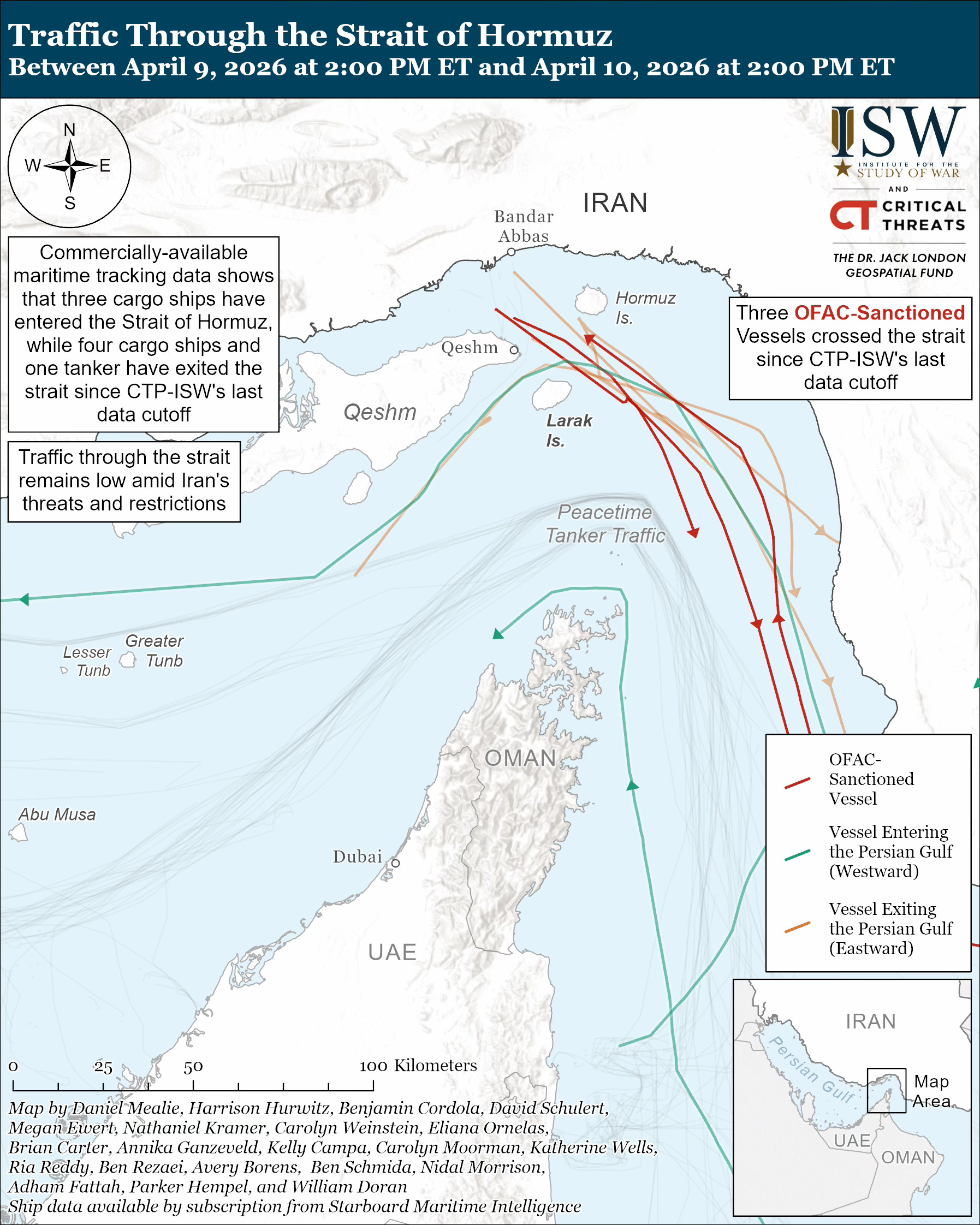
Used with ISW permission. Credit: Institute for the Study of War and AEI’s Critical Threats Project.
The strategic passageway is Iran’s best card. Plus, as evidenced by Ghalibaf’s gamesmanship earlier today, it is highly likely the IRGC won’t relinquish it unless it is used to (a) ensure regime survival in Iran and (b) ensure the survival of Hezbollah.
That is significant.
Why?
The regime has no intention whatsoever of changing its stripes. They have not—as Trump has implied publicly—seen the light.
***
IRAN’S NEGOTIATING TEAM
Faces indeed have changed and changed fast & repeatedly due to U.S. airstrikes in Iran since the start of the war on February 28th. ـــه, an account on X, put together a chart detailing how many regime figures have been killed as of April 6th.
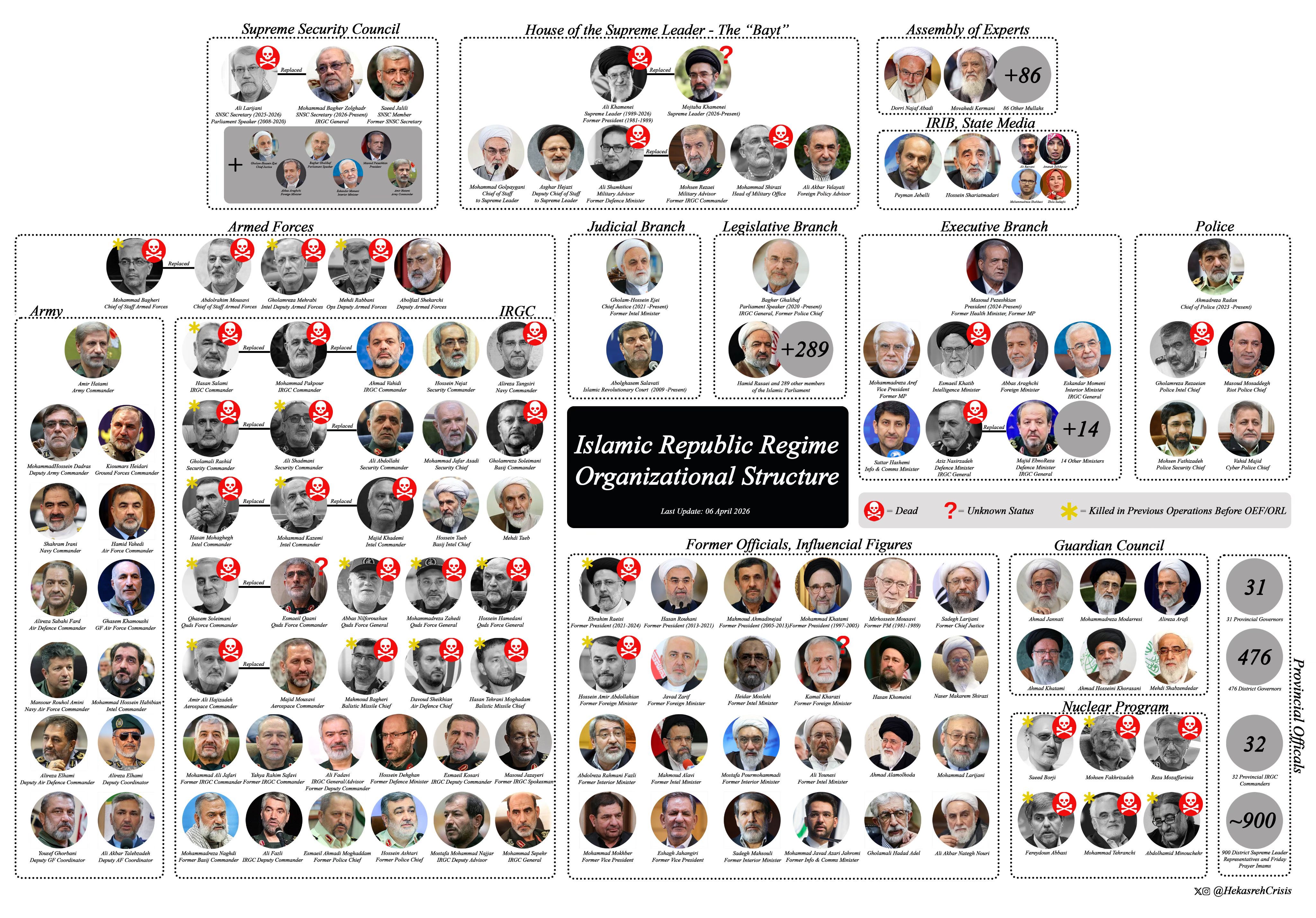
Chart credit: @HeKasrehCrisis on X.
Ghalibaf—one of the remaining faces—is heading the Iranian delegation. While he is certainly ambitious, he is nonetheless a hardliner. He is a former IRGC commander who rose rapidly during the Iran-Iraq War. The late Ayatollah Ali Khamenei directly appointed Ghalibaf to key positions, including as the IRGC head of air force & head of Iran’s police.
He is joined by Abbas Araghchi, Iran’s foreign minister. He is considered more of a hardline loyalist than a hardliner himself. Meaning, of all of Iran’s negotiating team, he is the most likely to be pragmatic in negotiations with the U.S. followed closely by Ghalibaf.
Ali-Akbar Ahmadian, the Secretary of Defense Council, is a senior IRGC admiral & very much a regime hardliner. Having also served as the chief of the IRGC Joint Staff, he also understands the military power structure in Tehran. Notably, Ali Khamenei appointed him personally to his current role.
Abdolnasser Hemmati is the Governor of the Central Bank of Iran. He is largely viewed as a pragmatist. His appointment, arguably, is Iran taking a page of out Russian President Vladimir Putin’s book by tapping a businessman—in his case Kirill Dmitriev—to negotiate with Team Trump.
Kazem Gharibabadi, a deputy foreign minister for legal & international affairs, is another hardliner, far more so than his boss Araghchi. Notably, he is the son-in-law of Mohammad-Bagher Zolghadr, the new Secretary of Iran’s Supreme National Security Council. He has also been described by a Western diplomat as “the rudest and most lecherous Iranian diplomat.”
Iran’s negotiating team in Islamabad is rounded out by Ali Bagheri-Kani, the Deputy Secretary of Iran’s Supreme National Security Council. He too is a hardliner and comes from a clerical family that was close to the late Ayatollah Ali Khamenei. Notably, his brother was married to Khamenei’s daughter Hoda who was killed alongside her father on the first day of the war.
In sum, they are general hardliners. Team Trump is not facing off against doves. They are hawks in every sense of the word.
Equally significant is who isn’t participating. Especially two men. One is Iranian President Masoud Pezeshkian who has been effectively sidelined by the IRGC. The other missing person is arguably the most powerful person in Iran—and no, we are not referring to Supreme Leader Ayatollah Mojtaba Khamenei (who may or may not be alive or conscious).
The missing man is Ahmad Vahidi, the IRGC Commander-in-Chief. He is the one who will get the final say on what is agreed to or not in Islamabad.
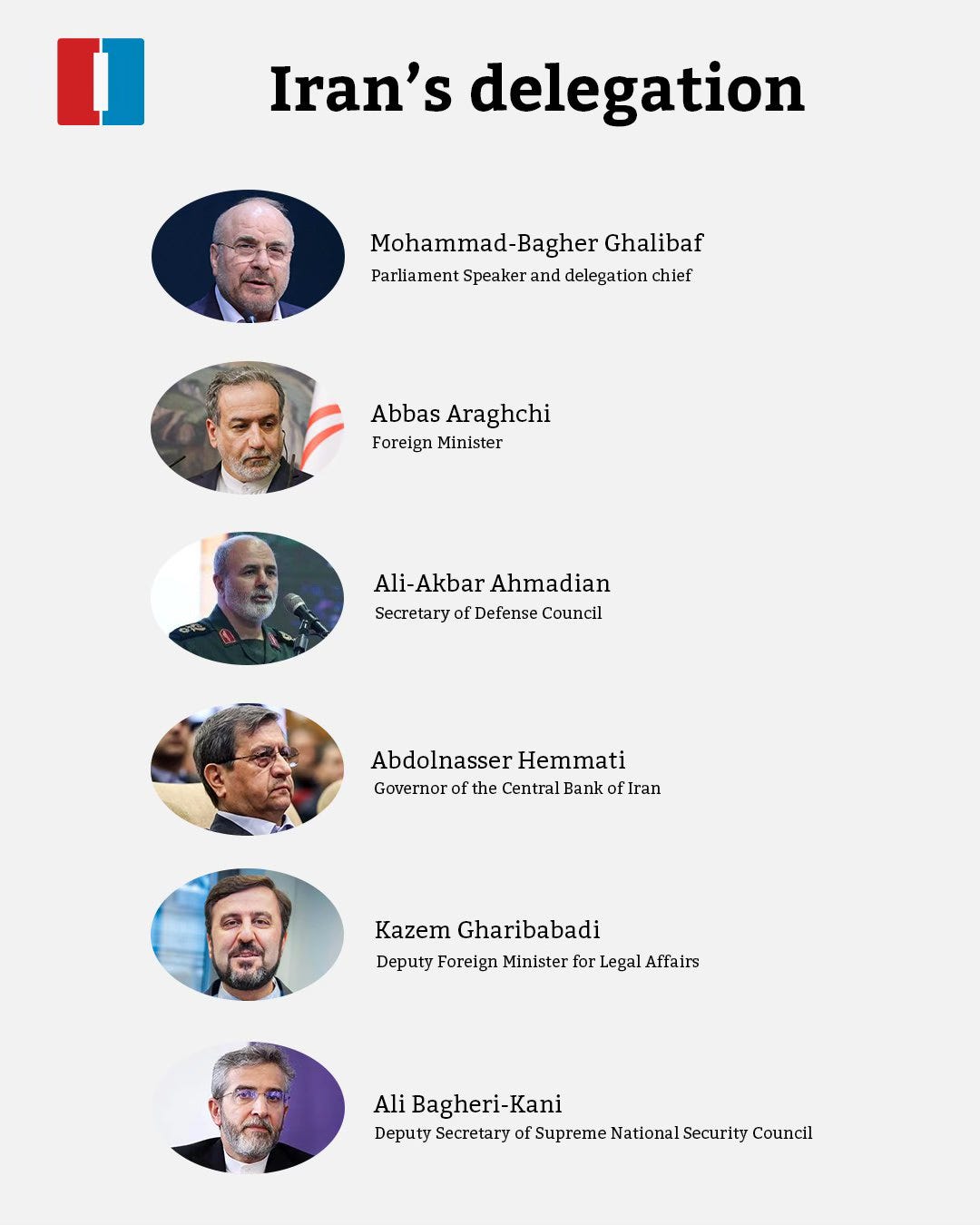
Image credit: Iran International.
***
TEAM TRUMP
Vice President JD Vance is heading the U.S. delegation. He is perceived by the Iranians as being more of a dove than a hawk. That’s a fair take & an interesting situation given that he is going to be an American dove surrounded by Iranian hawks.
Plus, Vance, at least on the American side, has the most to gain or lose politically as a leading Republican presidential candidate in 2028. While we intentionally avoid all U.S. domestic politics in our INTREP360 Intelligence Reports—we never push our own political views on our readers—we can’t ignore the potential impact 2028 might have on Vance in 2026.
Steve Witkoff & Jared Kushner are also joining Vance in Islamabad. They are—as we’ve argued many times—way out of their league. Two businessmen with no military or seasoned diplomatic experience should not be facing off with a group of Iranian hawks.
Notably, Secretary of State Marco Rubio & any senior U.S. military advisor or staff officer are missing from Team Trump. That said, there are some reports indicating Adm. Cooper may be participating in the talks. If he is, then that is a good thing. If he isn’t then—in our view—that is a huge mistake.
Someone is needed to explain to the Iranian hawks the military reality on the ground as it is—and how it could get far worse if the U.S. resumes military strikes against Iran. Witkoff & Kushner are incapable of doing that.
***
THE MISSING JOINT FORCE PARTNER
Significantly, Israel is missing from the negotiating table. Notably, given that Pakistani Prime Minister Shehbaz Sharif is hosting the peace talks, Pakistan does not recognize Israel as a country, nor does it have any official diplomatic ties with Jerusalem.
Many in Washington may argue that Israel should operate as a client state of the U.S., however, as Mark pointed out on Al Qahera today, that isn’t the nature of the relationship between the two allies.
Israel will not cave to the U.S. or Iran on matters it believes are existential. That includes Iran’s nuclear weapons & ballistic missile programs. It also includes Tehran’s supporting, funding & training of its Axis of Resistance proxies, including Hezbollah, Hamas & the Houthis. From Israel’s perspective, Iran must give up all of them.
Notably, for now, Trump has said the same thing.
***
AXIS OF EVIL
Team Trump also needs to bear in mind that the negotiations in Islamabad are not happening in a vacuum. CNN is reporting that according to unnamed U.S. officials, China is purportedly, sending Iran new air defense assets, including shoulder-fired MANPAD systems. These deliveries—if real—reportedly could arrive in the next few weeks.
Operational pauses—meaning a cessation of offensive military actions—benefit both sides. They can also create new risks for each side.
Iran will have had a chance to learn from what worked & what didn’t. Team Trump must be careful not to let negotiations drag out in Islamabad that would allow the IRGC to implement lessons learned.
***
HIGH STAKES
Time will tell how tomorrow turns out. The things we will be watching for during the talks include whether there is any divide between the politicos in Iran & the IRGC or not. Ditto whether Iran—as Trump claimed—is really willing to give up all uranium enrichment. Likewise, whether or not the U.S. follows through on vastly curtailing Iran’s ballistic missile program.
Especially since Rubio claimed its acceleration is why the U.S. had to militarily act now & not later when Iran might have become conventionally impenetrable. That is key, because if Iran is allowed to continue enriching & if the IRGC is allowed to remain in control of Iran, beyond doubt they will seek a nuclear weapon & the means to deliver it.
Lastly, we will also be looking to see whether or not Team Trump demands human rights reforms in Iran. They are desperately needed. Trump himself has repeatedly stated that he will not forget the Iranian people.
Tomorrow, Vance has a chance to prove that. He can either negotiate a deal—likely in vain, if not now, then later on when it falls apart—or he can dictate unconditional surrender terms. Our strong preference?
The latter.
***
ICYMI #1
We were honored to make our debut today in USA Today. It was a much-appreciated opportunity to work again with a respected former colleague.
Time will tell if we got it right, but for today, we argued that Trump’s ceasefire in Iran is a path to nowhere & that Tehran knows it.
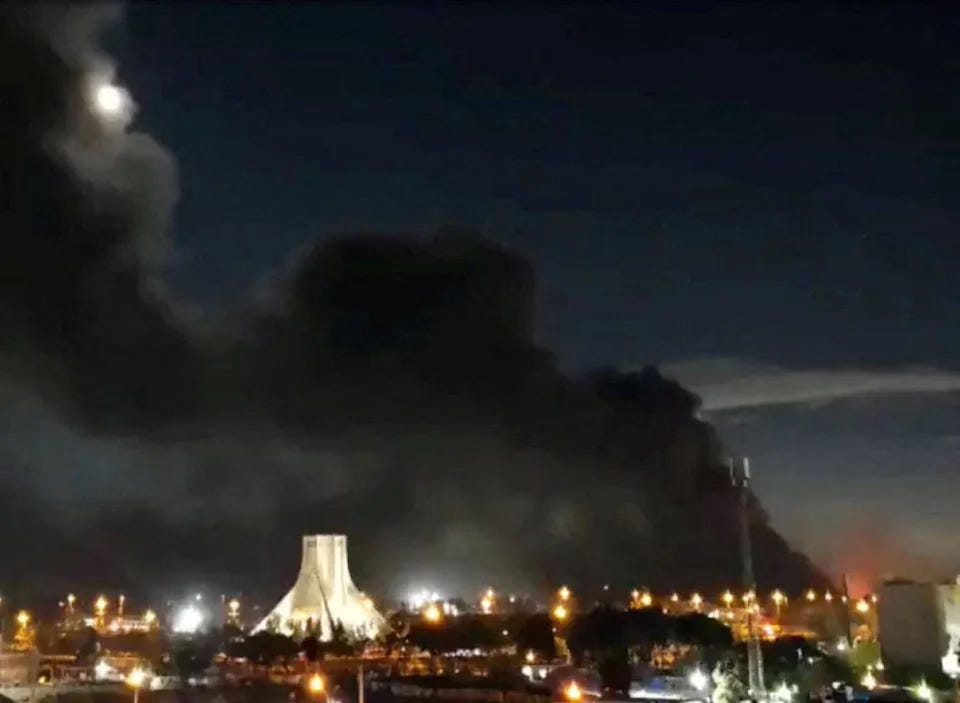
Photo credit: Social Media via Reuters. Smoke rises over Azadi Square following a strike, amid the U.S.-Israeli conflict with Iran, in Tehran, on April 6th, 2026.
You can read it here.
***
ICYMI #2
Mark appeared on Al Qahera News in Cairo, Egypt today for an hour-long special examining tomorrow’s peace talks between the U.S. & Iran in Islamabad. When asked if Trump urgently needed a deal, Mark observed that it was less of a case of urgency—despite real domestic economic & political pressures—and more of a question of Trump’s persistent lack of strategic patience in foreign affairs.
You can watch it here.
***
Thank you for reading! We will see you Monday. Please subscribe, comment & share. We truly appreciate it!
Jon & Mark
Follow Jon on X at @JESweet2022 or on Bluesky at @JonSweet.bsky.social. Follow Mark on X at @MCTothSTL or on Bluesky at @MarkToth.bsky.social.