

INTREP360 INTELLIGENCE REPORT
02.10.2026

February 10th, 2026
Greetings! Tomorrow—February 11th—will mark the 47th anniversary of the Iranian Revolution in Iran that ended the reign of Shah Mohammad Reza Pahlavi. Since its founding, the Islamic Republic of Iran has—simply put—been a force for evil.
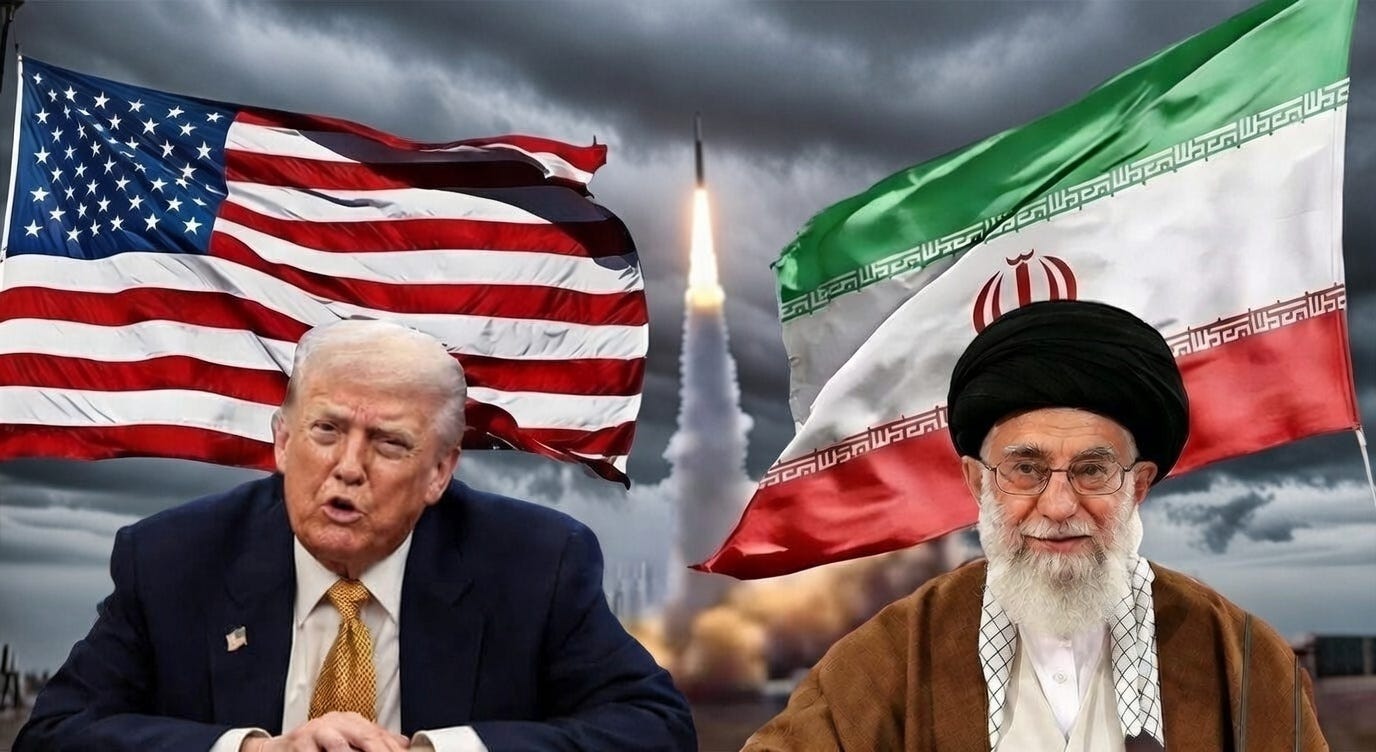
Photo credit: Grok. Trump, left, Khamenei, right.
Estimates are tricky; however, it is likely that the regime has—conservatively speaking—murdered 70,000+ Iranians.
4,000 were executed in the first three years. 3,400 Iranian dissidents were butchered during the 1981 massacre.
In 1988, according to Amnesty International, 5,000 more were killed. Between 1990 & 2009: 7,000. Between 2010 & 2026: 12,000.
That’s just state-ordered executions—some 31,400.
It is estimated that the mullahs have killed 38,600 Iranian street protesters since 1979—3,000 leading up to 2025 & another 35,600 since the street protests broke out in the bazaars on December 28th.
Bear in mind, those are just conservative estimates. Iranian opposition groups claim the real number is in excess of 120,000 dead since 1979.
Tragically, the killing is continuing. The New York Post is reporting that Iranian “security forces [are] raiding hospitals” & killing suspected protesters.
***
Remember as well that Iran has killed—directly or indirectly through its proxies—over 1,600 Americans (if not more).
This includes—among others—the 1983 Beirut U.S. Embassy bombing that killed 17 Americans, the 1983 Beirut Marine Barracks bombing that killed 241 U.S. service members, & the 1996 bombing of the Khobar Towers in Saudi Arabia that resulted in 19 deaths.
Between Iraq & Afghanistan, it is estimated that Iran’s Islamic Revolutionary Guard Corps (IRGC) has been responsible for 1,100 U.S. deaths via Tehran’s network of Shiite militias. Add to that another 40 Americans killed by IRGC-backed Hamas on Oct. 7.
‘Death to America!’ isn’t just a slogan in Iran. It has—for far too long—been a bloody call to action that has resulted in real deaths.
***
The Islamic Republic of Iran—however—has not just been a threat to its own people. It has caused widespread instability throughout the Middle East.
To achieve that aim, Iran has assembled a group of armed militias to foment unrest throughout the region. Hamas, Hezbollah & the Houthis are the usual named suspects, however, as Bill Roggio & Joe Truzman detailed for the Foundation for Defense of Democracies, there are at least a dozen other IRGC-sponsored militias.
Their purpose? To act as a “force multiplier” to fight against Israel, the U.S., & Arab countries that opposed the regime of Iranian Supreme Leader Ayatollah Ali Khamenei. In the process of doing so, these IRGC-controlled militias have left widespread devastation in Gaza, Southern Lebanon, Iraq, Syria & Yemen.
***
Tehran is also hell-bent on becoming a nuclear power. Prior to last June, Khamenei was getting close. Iran had already enriched enough uranium to 60% (HEU) to build eleven or so nukes within four to six months.
As we warned on Christmas Eve 2023 at the New York Post, Khamenei was close to building a nuke. By then, Tehran had the added centrifuge capacity to further enrich its 60% stockpiles to a weapons-grade 90% HEU within weeks—not months or years.
He was still working on a launcher—land-based & reportedly a submarine—as well as on detonation devices.
Despite last June’s strikes on Fordow, Isfahan & Natanz, Iran still possesses the know-how to build all three. Equally dangerous, Khamenei has the will to do so as evinced by his refusal to give up his enrichment & ballistic missile programs.
Khamenei is also refusing to end his backing of the IRGC-backed militias––armed militias that, as we noted above, have the blood of Americans on their hands.
***
It is clear that President Donald Trump & Khamenei are on a collision course. Khamenei—as we have noted in multiple INTREP360 Intelligence Reports—is betting that he & his regime can survive any U.S. military strike like he did last June.
How confident is Khamenei?
He’s been willing to butcher thousands—likely tens of thousands—of Iranians over the past 44 days while the whole world watches.
***
We are likely in regime change territory here. Trump made it clear earlier today on Fox Business that his three redlines are “no nuclear weapons, no missiles, no this”––with ‘this’ likely referring to Iran’s IRGC-backed militias.

Khamenei won’t budge either. Unless there is a breakthrough, this looks & feels like a classic game of chicken that has begun.
Israel—however—gets a vote too. Tomorrow, Israeli Prime Minister Benjamin Netanyahu meets Trump at the White House. It will be their 7th meeting since Trump began his second term on January 20th, 2025.
***
If it comes down to regime change, it won’t be easy. Regime change may brief well in the White House Situation Room, but it is graduate-level business.
That, and the U.S. track record with regime change has been pretty abysmal. Not the taking down part—we are really good at that; rather, the putting it back together again part. It requires a whole-of-government (WofG) approach––not to mention the cost.
As then-Secretary of State Colin Powell warned President George W. Bush in August 2002 prior to the U.S. invasion of Iraq, “If you break it, you own it.”
The problem is that the U.S. military & intelligence services made the removal of Venezuelan President Nicolás Maduro look easy—almost routine. That’s a testament to their training & professionalism.
However, it was quite intricate. Many conditions had to be set to get U.S. Special Operators in position to capture Maduro. Air defense networks, weapons systems, command & control networks, Maduro’s Cuban security detail, reaction forces—all had to be planned for. Not to mention the day after.
Ditto factoring in support from within Venezuela. Removing Maduro, while leaving the rest of the government intact, paid off. The U.S. did not need to break it—and that was a testament to our intelligence services & career diplomats.
The Iranian problem set is much more complex. It will need to be broken in several pieces. That includes the governing body of the Islamic Republic of Iran—Khamenei & his mullahs—and the IRGC—whose primary mission is to defend the regime.
The IRGC is composed of ground, naval, & air forces, an internal security militia (the Basij), and an external operations force, the IRGC–Qods Force (IRGC-QF), which are responsible for conducting covert lethal activities outside Iran, including asymmetric & terrorist operations. They fund, equip, train, and task Hamas, Hezbollah, and Houthi rebels.
Trump was leaning hard on Khamenei in the foxhole after his Venezuelan success. On January 13th, he encouraged Iranian protesters on his Truth Social account to “KEEP PROTESTING – TAKE OVER YOUR INSTITUTIONS!!!” And that “HELP IS ON ITS WAY. MIGA!!!”
But Trump’s military advisors could not assure him they could “topple the [Iranian] regime with a quick flurry of airstrikes alone.” Per reporting in the Wall Street Journal, “it was unclear that bombing Iranian military and civilian sites would help the uprising and weaken the government.”
The U.S. did not have enough military assets in the region to both “launch a large and sustained attack that could put the regime on its heels and protect American forces and allies in the Middle East.” That, and officials in Israel and Arab countries throughout the region advised Washington that the time was not right for a strike.
So, the order to ‘stand down’ was issued to gain time to reposition assets from the Caribbean and Europe, build consensus––and to give Iran an opportunity to reconsider its nuclear program, its ballistic missile program, support to its proxies, and excessive violence being used to suppress the government demonstrations.
Yet all to no avail. And now, on February 11th—the anniversary of the 1979 Islamic Revolution—all of the essential parts may be in place to begin setting conditions for regime change.
Unlike Venezuela, this will be a campaign, not a raid. It will take weeks, possibly months in duration, but certainly not a couple of days.
Notably, the battlefield conditions established by Israel—dismantling Iran’s air defense system—during their 12-Day War in June 2025, which enabled U.S. B-2 bombers to strike Iranian nuclear facilities during Operation Midnight Hammer, no longer exist.
It will be a much harder set of targets.
Both Russia & China have assisted Iran in rebuilding its air defense network. Tehran likely hardened its cyber vulnerabilities as well. Iran has also rebuilt its ballistic missile program with as many as 2,000 missiles in its inventory.
Regime change begins with the destruction of the IRGC & their leadership. But to get to them, the Iranian air defense network will have to be—yet again—destroyed.
So, too Khamenei’s ability to retaliate, and that means destroying his ballistic missile capability. That must happen concurrently—not sequentially—with destroying Iran’s air defense network across a lot of real estate.
Iran cannot be afforded the opportunity or retain the capability to retaliate against Israel or U.S. bases in the region. That requires destroying its missile storage facilities and fixed/mobile launch sites. The missiles Iran are able to launch—likely, just by the hundreds—can be defeated by Israel’s integrated air defense system and U.S. Patriots and THAADs deployed throughout the Persian Gulf.
Iran’s other two courses of action will be to try to shut down the Strait of Hormuz & attack commercial shipping in the Persian Gulf. Sufficient U.S. military assets must be allocated to destroy the IRGC Navy.
Certainly, wild cards exist. Iran might follow through on its threats to attack oil & energy targets in Gulf States to create a global energy crisis. Khamenei likely will try to strike Israel to once again turn it into a regional war.
***
An IRGC in survival mode cannot continue to suppress Iranian protesters. And without IRGC protection, Khamenei & the mullahs are vulnerable. This is the help Iranian protesters need to rise up and retake their country.
But when that happens—perhaps with Khamenei & his regime fleeing to Moscow along with the surviving IRGC leadership—Some form of governance must be ready to run an Iranian transitional government. That could be the Iranian Army or—as many in the Iranian diaspora strongly prefer—the return of Crown Prince Reza Pahlavi.
Yet like Venezuela, the U.S. must be careful not to break the very institutions necessary to govern the country. Setting conditions—kinetic & non-kinetic—is essential to mission success. So too is follow-through.
This must be an ‘all in’ mission.
If not, Khamenei might survive. That cannot be allowed to happen. 47 years ago, his predecessor—Ruhollah Khomeini—held 52 Americans hostage for 444 days. Ever since, Iran has held an entire region hostage.
Enough is enough.
***
Thank you for reading! We will see you tomorrow. Please subscribe, comment and share. We truly appreciate it!
Jon & Mark
Follow Jon on X at @JESweet2022 or on Bluesky at @JonSweet.bsky.social.
Follow Mark on X at @MCTothSTL or on Bluesky at @MarkToth.bsky.social.