

INTREP360 FLASH SIGNAL
LIVING IN THE PUTINSPHERE

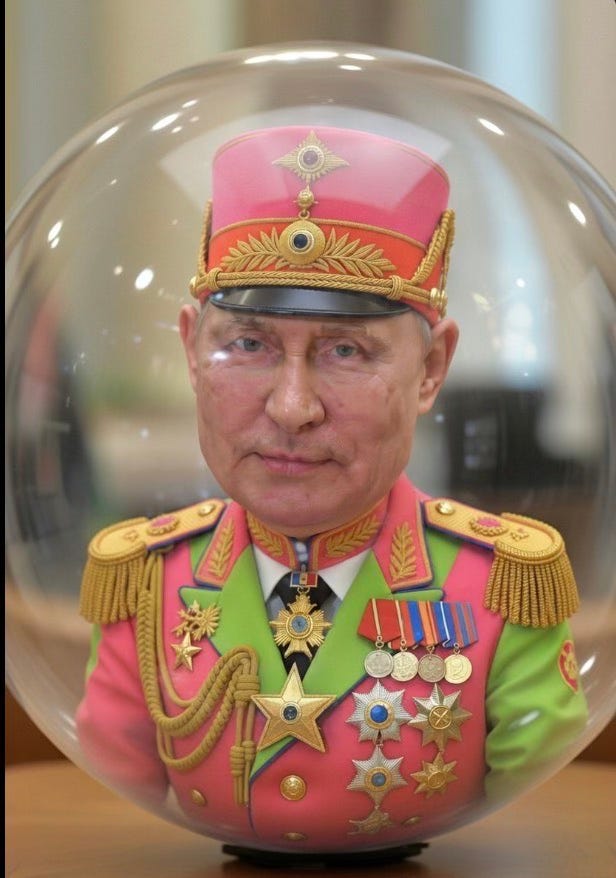
Russian President Vladimir Putin wants everyone to believe his army is winning his war – ‘special military operation’ – in Ukraine, and that he is prepared to take on NATO as well. Projecting strength while racing against time – hoping his economy and regime can hold out just a little longer. Something the Trump Administration seems willing to accommodate by allowing Moscow to drag out ‘peace talks’ between Washington, Miami, and Moscow.
At least that’s what his generals tell him – what he wants to hear. The hard reality is that he is losing over 1,000 soldiers a day in Ukraine. Not that their lives mattered to Putin. He and his generals have amassed over 1,200,370 casualties in just 1,400 days. His cost calculus was never measured in human life – Russian or Ukrainian. What matters is the end state – the capitulation of Ukraine. The reunification of the Soviet Union. The Russian Empire.
His Kremlin staff will just round up another 100,000 plus bodies to throw into the Ukrainian ‘meat grinder.’ There appears to be no shortage of cash to buy an army. As retired U.S. Army Gen. Petraeus recently told Politico, “Assuming that Putin is able to continue to fund the enormous enlistment bonuses (and death payments, too) and to find the manpower currently enticed to serve, Russia can sustain the kind of costly, grinding campaign that has characterized the fighting in Ukraine since the last major achievements on either side in the second year of the war.”
As Putin dons his military uniform – looking slightly more pathetic than his extra-large ‘mini-me’ in Belarus – taking briefings from his generals in the basement of a secure Kremlin bunker, Ukrainian President Volodymyr Zelensky calls out his bluffs by physically showing up on the battlefield – in cities and towns Putin says his soldiers have ‘liberated.’
When Putin said Russian forces had secured Pokrovsk in October, Ukraine’s Chief of the Main Directorate of Intelligence of the Ministry of Defense, Kyrylo Budanov, led an insertion of Ukrainian special forces via U.S. Blackhawk helicopters into the city.
In mid-December, when Putin announced that Russian forces had secured Kupyansk, Zelensky personally travelled to the city, taking a selfie in front a bullet-riddled sign bearing the town’s name at the entrance. He would later post on X that “The Russians kept going on about Kupyansk – the reality speaks for itself.”
In the Putinsphere – reporting success on the battlefield is how you avoid open windows and sudden stops on payment. That would explain Colonel-General Sergei Kuzovlev’s report to Putin in late November that his troops had “completed the liberation of Kupiansk [sic] … the city is under control.”
As the Financial Times recently reported, it “raises questions about whether the country’s top brass are massaging facts to tell the president what he wants to hear.” It also begs the question – does Putin even acknowledge reporting that does not come from his own sources?
The short answer is no. It does not fit his narrative – the one where he is winning. It’s the narrative he presents to President Trump, his Special Envoy Steven Witkoff and son-in-law Jared Kushner to show them that Ukraine’s fate is sealed. It is also a narrative easy to refute. The Institute for the Study of Warpresents a balanced and accurate assessment of the battlefront on a daily basis.
The Kremlin’s victories on the battlefield are measured in meters and cities razed to the ground by ballistic missiles and drones, while ignoring monumental losses in personal, equipment, and weapons – in Ukraine, Russia, and the Black Sea.
Just within the past month:
· December 10th and 11th: Ukraine’s Unmanned Systems Forces (SBS) decimated the Russian 76th Guards Air Assault Division near Pokrovsk, killing or wounding upwards to 1,400 Russian soldiers.
· December 15th: Security Service of Ukraine (SBU) used an underwater “Sub Sea Baby” drone to attack a Russian Kilo class submarine at its base in the Black Sea port of Novorossiysk, inflicting significant damage. December 19th: Ukraine strikes the Oman-flagged ship Qendil – a Russian shadow fleet oil tanker – in the Mediterranean Sea by drones fired from more than 2,000 kilometers away in Ukraine.
· December 20th: Sabotage operations directed by Ukraine’s Main Intelligence Directorate (HUR) damaged a Russian Su-30 and Su-27 fighter aircraft at the Lipetsk airfield in western Russia.
· Ukrainian drones damaged two Su-27 aircraft, a MiG-31, radar equipment and an air defense system at Belbek air base in Crimea. They also struck Saky and Kacha airfields in Crimea, destroying a Su-24 and MiG-29.
· December 22nd: Ukrainian drones struck the Tamanneftegaz oil terminal in Russia’s Krasnodar region damaging a pipeline, two piers, and two ships.
· They likely killed Russian Lt. Gen. Fanil Sarvarov – the head of the armed forces’ operational training department – with a car bomb in Moscow, which would be the third general officer killed in a bomb attack in the Russian capital over the last year. The other two were Lt. Gen. Igor Kirillov (head of the military’s nuclear, biological and chemical protection forces) and Lt. Gen. Yaroslav Moskalik (deputy head of the main operational department of the General Staff).
· Ukrainian Armed Forces (UAF) destroyed a Russian assault force from the 40th and 155th Naval Infantry Brigades consisting of 24 armored vehicles – tanks, infantry fighting vehicle and armored personnel carriers – along with several dozen motorcycles and quad bikes near the city of Pokrovskwith reconnaissance and strike drones, artillery, multiple launch rocket systems (MLRS), and HIMARS precision-guided rockets.
As Jon stated in David Kirichenko’s article in Forbes magazine, “They [Ukraine] are being aggressive where they can right now, and that’s in special operations. Ukraine is trying to demonstrate to the West that despite the Kremlin’s efforts to project strength, Russia is vulnerable – a hollow force that cannot protect its own generals, even in Moscow, or the assets that generate revenue to fund the war.”
While Russia retains the initiative in the close fight (tactical) and in the skies over Ukraine, there is plenty of fight left in Ukraine, who picks when and where to strike Russian targets in the deep fight (strategic). Each side in a race against time – trying to bleed out the life lines that support them.
Life in the Putinsphere is built upon on a false narrative. It is just one move away from the Jenga tower collapsing. Ukraine is desperately looking for that one piece to remove. Until then, Putin will continue to direct traffic from the third ring, and his clowns will continue to tell him what he wants to hear.